
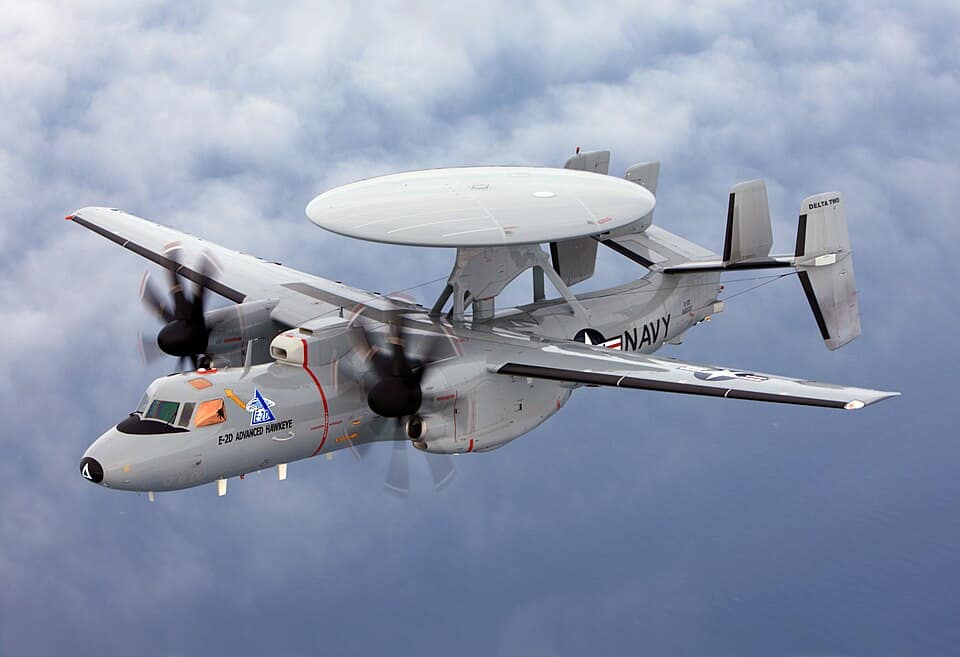
Quick Facts
- Aircraft: E-2D Advanced Hawkeye
- Upgrade: DREXR (Digital Receiver Exciter Recorder)
- Developer: Lockheed Martin & Northrop Grumman
- What it does: Replaces legacy analogue radar hardware with software-defined processing
- Key benefit: More precise beamforming, greater resistance to electronic jamming
- Block II CDR: May 2026 — most significant upgrade in 25 years
- Partners: General Dynamics, Collins Aerospace
The Eye Above the Fleet
Every carrier strike group depends on the E-2D Advanced Hawkeye as its airborne early warning and control platform. Flying at 25,000 feet with its AN/APY-9 radar rotating above the fuselage, the Hawkeye detects incoming threats — aircraft, missiles, surface vessels — at ranges exceeding 300 nautical miles and coordinates the air battle for every fighter, ship, and weapon system in the group. In the ongoing operations against Iran, E-2Ds from the Ford and Lincoln carrier strike groups have been flying continuous patrols over the Persian Gulf, tracking Iranian air force movements, drone launches, and anti-ship missile threats. The aircraft’s ability to detect low-flying cruise missiles against sea clutter has proven critical in an environment where the IRGC regularly fires anti-ship weapons at commercial vessels.
From Analogue to Software-Defined
The DREXR upgrade is deceptively simple in concept but transformative in effect. The E-2D’s radar receiver and exciter — the components that generate outgoing radar pulses and process returning echoes — were built with legacy analogue hardware designed decades ago. DREXR replaces this with a compact, fully digital system. The practical impact is twofold. First, software-defined processing enables more precise beamforming — the ability to shape and steer the radar beam with greater accuracy. This means better detection of small targets (drones, cruise missiles, stealth aircraft) in cluttered environments. Second, the digital architecture provides dramatically greater resistance to advanced electronic jamming. Instead of following fixed analogue signal paths that an adversary can characterise and exploit, DREXR can adapt its waveforms and processing in real time. Against a peer adversary like China — whose electronic warfare capabilities are designed specifically to blind American sensors — this kind of adaptive resilience could be the difference between seeing the threat and flying blind.Block II: The Bigger Picture
DREXR is part of the broader Block II upgrade, which Northrop Grumman describes as the most significant modernisation of the Hawkeye platform in a quarter century. The Block II package, being developed with General Dynamics and Collins Aerospace, will undergo its critical design review in May 2026, with production cut-in planned for aircraft deliveries starting in 2030. Northrop Grumman also has a separate contract with the Office of Naval Research to explore what a future radar mission upgrade could look like — suggesting that even Block II is not the endgame. The Hawkeye’s rotodome has physical constraints that limit radar aperture, but software-defined processing can extract more performance from the existing antenna than analogue systems ever could. The E-2D will remain the Navy’s airborne eyes for decades to come. DREXR ensures those eyes keep getting sharper.Sources: Aviation Week, FlightGlobal, Northrop Grumman
 English
0 Comments