
Quick Facts
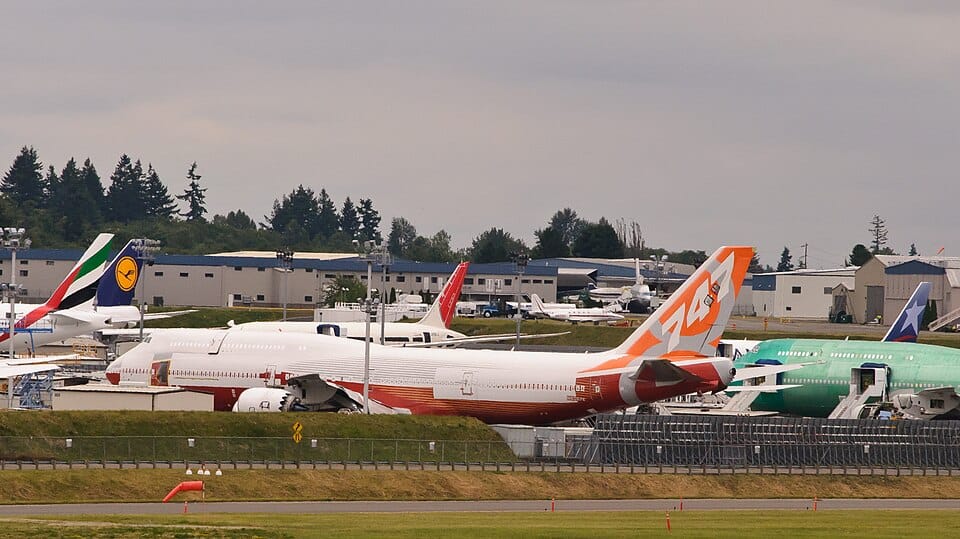
- Aircraft: Boeing 747-8i (formerly Qatari Amiri Flight)
- Designation: VC-25B Bridge Aircraft
- Conversion cost: ~$400 million
- Expected delivery: Summer 2026
- Missing capability: No aerial refuelling system
- Replaces: Current VC-25A (modified 747-200) pending VC-25B delivery (~2028)
- Origin: Donated by Qatar to the United States
The Most Expensive Gift Ever
The 747-8i was Qatar’s latest-generation VIP transport, configured with the kind of opulence that makes first-class airline cabins look like bus seats. Marble-clad bathrooms, a master suite, a lounge, a dining room, and communications equipment befitting a head of state — all packed into the world’s largest commercial aircraft frame. Qatar donated the jet to the United States, but “free” is doing a lot of heavy lifting in that sentence. The conversion from royal transport to presidential aircraft — adding secure communications, defensive systems, and the classified equipment that makes Air Force One a flying command post — has cost nearly $400 million.Speed Over Completeness
The urgency behind the bridge aircraft is real. The current Air Force One fleet — two VC-25As based on the 747-200 — entered service in 1990. They are 36 years old, running on analogue avionics, and increasingly expensive to maintain. The full VC-25B replacement program, contracted to Boeing for two new-build 747-8s, has been plagued by delays, cost overruns, and supplier problems. First delivery isn’t expected until mid-2028 at the earliest. The bridge aircraft is being built for sufficiency, not perfection. The compressed timeline means certain capabilities have been deliberately sacrificed. Most significantly, the jet will not have an aerial refuelling system — the boom receptacle that gives the current Air Force One theoretically unlimited range. Without it, the bridge aircraft is limited to the 747-8i’s standard range of approximately 7,700 nautical miles. That’s still enough to fly nonstop from Washington to almost anywhere in Asia or Europe. But it cannot match the current VC-25A’s ability to stay airborne indefinitely — a capability designed for Cold War nuclear continuity-of-government scenarios that remains relevant in an era of great power competition.From Doha to Andrews
The test flight programme is underway. Photographs show the aircraft in a two-tone blue-and-white paint scheme consistent with the standard Air Force One livery, though the Air Force has not confirmed whether it will use the traditional design or a modified scheme. The bridge aircraft will operate alongside the existing VC-25As until the first full-specification VC-25B arrives. At that point, its future is unclear — it could continue in a secondary presidential transport role, be reassigned to VIP government transport, or be retired. For a jet that began life as a royal conveyance for the Emir of Qatar, its second career carrying the American president is a remarkable transformation — marble showers and all.Sources: The War Zone, Defense News, Simple Flying, CNN
 English
0 Comments