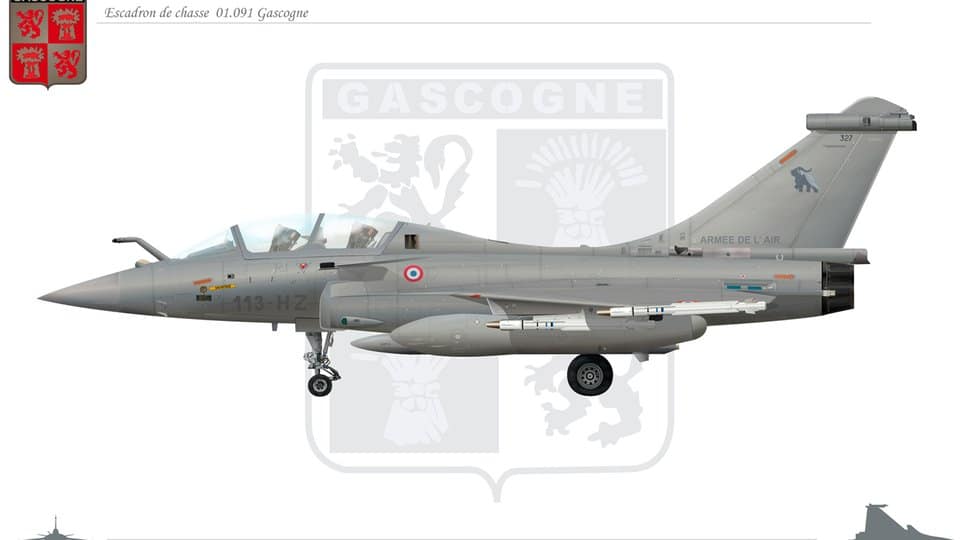
French Rafale fighters armed with nuclear-capable ASMP cruise missiles will soon rehearse strikes on targets near St. Petersburg. The exercise partner is Poland. The theatre is the Baltic Sea. And the message is aimed squarely at Moscow.
According to the Polish news portal Wirtualna Polska, France and Poland are planning joint air force exercises over the Baltic and northern Poland in which Rafales will simulate launching ASMP missiles with nuclear warheads — weapons with yields between 100 and 300 kilotons and a range of approximately 500 kilometres. Polish F-16s will participate alongside, practising conventional JASSM strikes and providing target designation.
This is not a routine training sortie. It is the most explicit nuclear signalling NATO has conducted in the Baltic region since the Cold War.
Quick Facts
Exercise area: Baltic Sea and northern Poland
French aircraft: Dassault Rafale (nuclear-capable)
Polish aircraft: F-16C/D with JASSM missiles
Simulated weapon: ASMP-A cruise missile (100–300 kt yield, ~500 km range)
Simulated targets: Reported to be in the St. Petersburg area
Status: Announced April 23, 2026 — dates not yet confirmed
France’s Nuclear Umbrella Moves East
France is the only EU member state with an independent nuclear deterrent. Its Force de Dissuasion operates entirely outside NATO’s nuclear sharing arrangements — Paris controls the warheads, the delivery systems, and the doctrine. Until now, French nuclear exercises have been conducted over the Atlantic or the Mediterranean, far from Russia’s borders.
Moving those rehearsals to the Baltic is a deliberate escalation. President Macron has framed it as a one-time deployment, limited to the exercise period. But the symbolism is unmistakable: France is telling Moscow that its nuclear umbrella extends to NATO’s eastern flank.
The ASMP-A is the air-launched leg of France’s nuclear triad. It is a ramjet-powered cruise missile that can reach Mach 3 and deliver a thermonuclear warhead with surgical precision. Every Rafale in the Armée de l’Air can carry it. And now, for the first time, those Rafales will practise firing it from Baltic airspace.
Poland’s Role: Target Designation and Conventional Strike
Poland’s contribution is equally significant. Polish F-16s equipped with AGM-158 JASSM cruise missiles — stealthy, long-range conventional weapons — will simulate attacks on the same target complexes. Their role is twofold: suppress enemy air defences and provide target designation data to the French nuclear strike package.
This is precisely the kind of combined conventional-nuclear mission profile that NATO has theorised about for decades but rarely practised in public. The fact that Poland, which does not possess nuclear weapons, is openly participating in a nuclear strike exercise sends a powerful message about the depth of European defence integration.
Warsaw has been the loudest voice in Europe calling for stronger deterrence against Russia. Hosting nuclear strike rehearsals on its doorstep is the logical extension of that policy.
Moscow’s Calculus
The Kremlin has not yet responded publicly, but the exercise is designed to be provocative in the precise, calibrated way that nuclear signalling demands. Simulating strikes on targets near St. Petersburg — Russia’s second city and the home port of its Baltic Fleet — is as pointed as deterrence gets without actually loading warheads.
For Russia, the exercises complicate an already tense Baltic picture. NATO intercepted two Tu-22M3 bombers escorted by ten Su-30 and Su-35 fighters over the Baltic just days ago. France, Sweden, Finland, Poland, Denmark, and Romania all scrambled jets. The airspace above the Baltic is becoming the most contested corridor in Europe.
A New Nuclear Reality
The France-Poland exercise reflects a broader shift in European defence thinking. The Iran war, the ongoing conflict in Ukraine, and growing doubts about U.S. commitment to NATO Article 5 under the Trump administration have pushed European capitals to think seriously about continental defence — including its nuclear dimension.
Macron has repeatedly offered to discuss extending France’s nuclear deterrent to cover European allies. These exercises are the first concrete step in that direction. Whether they remain a one-off or become a regular feature of NATO’s Baltic posture will depend on how the summer unfolds.
One thing is certain: the days when nuclear deterrence was an abstract concept discussed in think-tank papers are over. The Rafales are heading east, and their missiles are designed for a very specific purpose.
Sources: Wirtualna Polska (via news-pravda.com), Aerospace Global News

 English
0 Comments