
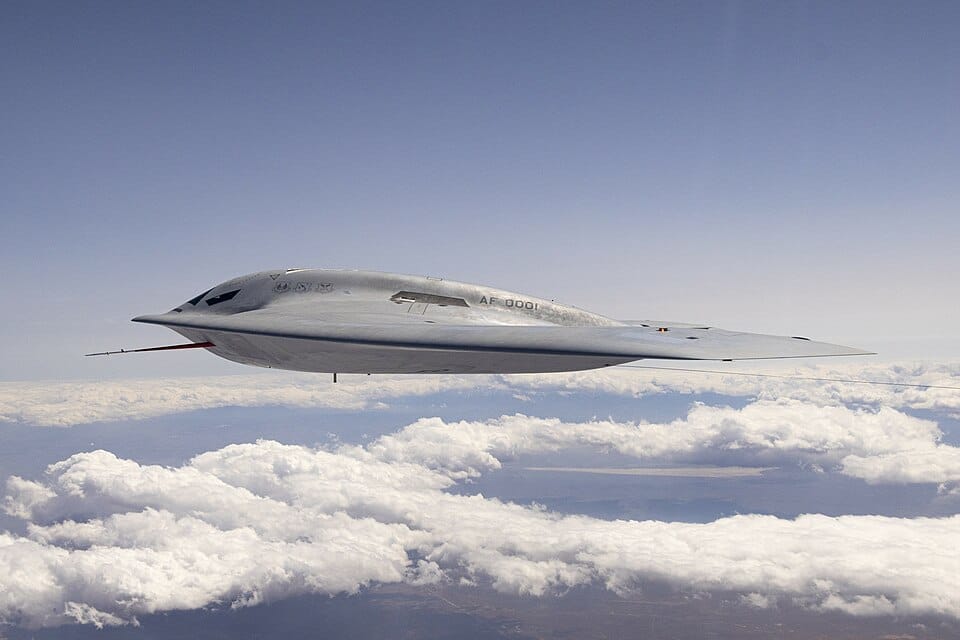
Quick Facts
| Programme | B-21 Raider — next-generation stealth bomber |
| Manufacturer | Northrop Grumman, Palmdale, California |
| Production boost | 25% increase in annual output |
| Company investment | $2.5 billion (private capital, phased 2026–2029) |
| Total infrastructure spent | $5+ billion to date on digital manufacturing |
| First delivery | Ellsworth AFB, South Dakota, 2027 |
| Current fleet target | 100 aircraft (under review — may rise to ~145) |
| Status | Low-rate initial production (5 lots, 21 aircraft) |
Why Northrop Is Writing the Check Itself
The $2.5 billion is not charity. It is a calculated wager that the B-21 programme will expand well beyond its baseline 100-aircraft buy. The Air Force has publicly hinted that the fleet could grow to approximately 145 bombers, and the service’s appetite for long-range, penetrating strike has only sharpened since Operation Epic Fury demonstrated how fast precision munitions get consumed in a high-intensity air campaign. Northrop expects roughly $200 million of the investment to land in 2026, with the bulk — the heavy construction, tooling, and digital manufacturing infrastructure — concentrated between 2027 and 2029. The company’s Palmdale facility, already the most advanced aircraft production site in the world, will receive new production lines and expanded capacity.
“We are making investments that reduce production costs, accelerate delivery timelines, and ensure the B-21 is available when our nation needs it most.”
Kathy Warden — CEO, Northrop Grumman
Digital Manufacturing at Scale
To date, Northrop has poured more than $5 billion into the B-21’s digital and manufacturing infrastructure. The results are striking: software certification timescales have been cut by 50 percent, and engineers can validate aircraft performance in real time during flight tests rather than waiting weeks for post-flight analysis.
Ellsworth: The Bomber Base Prepares
Ellsworth Air Force Base in South Dakota is undergoing its own transformation in preparation for the B-21. The base was selected as the Raider’s first operational home, and construction of new hangars, maintenance facilities, and pilot training infrastructure has been underway since 2024. The first aircraft is scheduled to arrive in 2027, with the 28th Bomb Wing transitioning from the B-1B Lancer — itself slated for retirement — to the B-21. The base will eventually host two operational B-21 squadrons.
The Bigger Picture: Why 100 May Not Be Enough
The Air Force originally settled on 100 B-21s as a floor — the minimum needed to maintain a credible nuclear and conventional long-range strike capability. But the strategic environment has shifted dramatically since that number was set. China’s military buildup in the Pacific demands aircraft that can penetrate sophisticated air defences at intercontinental range. The Iran campaign demonstrated that precision-guided munitions are consumed at rates far exceeding peacetime projections. And Russia’s war in Ukraine has reminded planners that the ability to strike deep — from safe distances, through contested airspace — is not a luxury. It is the entry price of modern air power. Northrop’s $2.5 billion gamble suggests the company believes 145 bombers is not just likely — it is inevitable. If the Air Force’s FY2028 budget request moves the fleet target north, Palmdale will already be ready to deliver.Sources: Breaking Defense, Air & Space Forces Magazine, Northrop Grumman, The Defense Post

 English
0 Comments