Northrop Grumman has delivered the first production unit of a navigation system designed to solve one of modern air combat’s most dangerous problems: what happens when the enemy jams your GPS. The Embedded GPS/Inertial Navigation System Modernisation, designated EGI-M, replaces the legacy LN-251 with a new LN-351 unit built around fibre-optic gyroscope technology and military-exclusive M-code GPS signals. The F-22 Raptor and E-2D Advanced Hawkeye are the first platforms to receive it.
The delivery marks a threshold moment for American tactical aviation. For the first time, frontline fighters will carry a navigation system specifically engineered to operate accurately in environments where adversaries are actively trying to deny GPS — exactly the kind of electronic warfare environment that Iran demonstrated during Operation Epic Fury.
Quick Facts
System: EGI-M (Embedded GPS/Inertial Navigation System Modernisation)
Designation: LN-351 (replacing LN-251)
Manufacturer: Northrop Grumman
Core technology: Fibre-optic gyroscopes + M-code military GPS receiver
First platforms: F-22 Raptor, E-2D Advanced Hawkeye
Future platforms: RQ-4 Global Hawk, MQ-4C Triton, P-8 Poseidon, CH-53K King Stallion
Key capability: Accurate navigation in GPS-jammed and GPS-denied environments
Why GPS Jamming Changes Everything
Standard GPS relies on extremely weak signals broadcast from satellites roughly 20,200 kilometres above the Earth. The signal strength at ground level is measured in femtowatts — approximately one hundred-billionth of the power of a standard light bulb. Jamming it requires surprisingly little energy. A truck-mounted jammer costing a few hundred thousand dollars can deny GPS across hundreds of square kilometres.
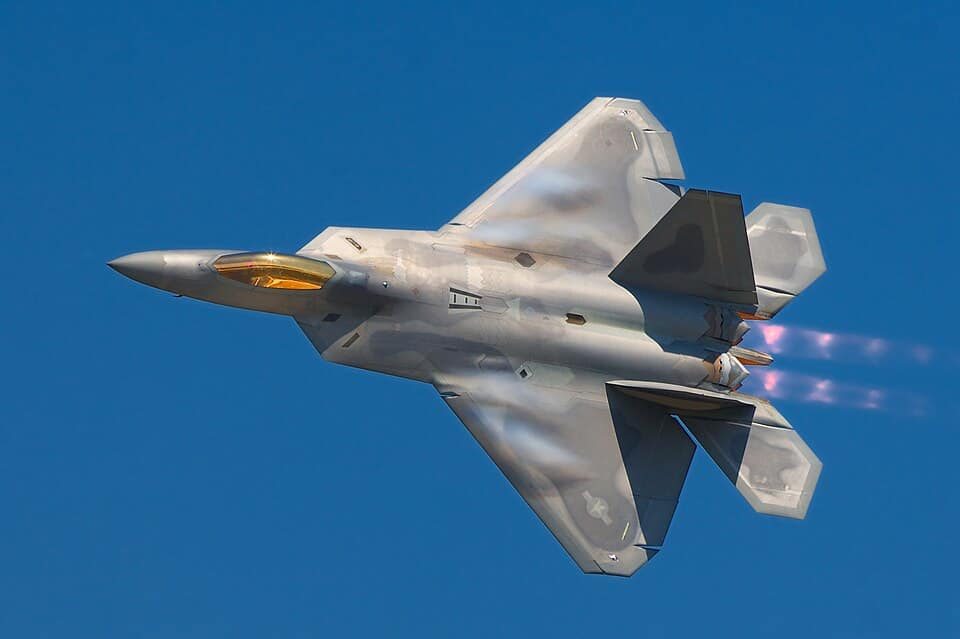
An F-22 Raptor off the coast of Oahu — the Raptor is the first platform to receive the new jam-resistant EGI-M navigation system. USAF / Wikimedia Commons
Russia and Iran have both invested heavily in GPS jamming and spoofing capabilities. During Epic Fury, Iranian electronic warfare units successfully disrupted GPS-guided munitions in several engagements, forcing the Air Force to rely on inertial navigation for terminal guidance — a less precise method that degrades weapons accuracy significantly. The problem is not theoretical. It is operational and current.
The legacy LN-251 system in the F-22 uses older GPS receivers that are vulnerable to these jamming techniques. When the signal degrades, the inertial navigation system drifts over time, accumulating positional errors that compound with every passing minute. For a stealth fighter operating deep behind enemy lines, where precise navigation is essential both for weapons delivery and for returning safely to tanker rendezvous points, GPS denial is a serious tactical problem.
M-Code: The Military’s Private GPS Channel
The EGI-M’s primary defence against jamming is M-code — a military-exclusive GPS signal broadcast by the latest GPS III satellites through high-gain directional antennas. Unlike the civilian GPS signal, M-code uses spread-spectrum encryption that is orders of magnitude harder to jam. The signal is stronger, more resilient, and available only to receivers with the correct cryptographic keys.
E-2 Hawkeyes fly past Mount Fuji — the E-2D Advanced Hawkeye is the second platform slated for the EGI-M upgrade. US Navy / Wikimedia Commons
The LN-351 pairs this M-code receiver with an upgraded fibre-optic gyroscope inertial measurement unit. Fibre-optic gyros measure rotation by detecting the phase shift of laser light travelling through coiled optical fibres — a technology that offers excellent drift performance without the mechanical wear of older ring-laser gyros. The system operates in multiple modes: blended INS/GPS for maximum accuracy, INS-only when GPS is completely denied, GPS-only for low-dynamic situations, and a Blended Navigation Assurance mode that validates GPS integrity when signals are under attack.
The practical result: the F-22 pilot can navigate with precision even when the enemy is actively trying to blind the aircraft. Weapons can be guided accurately. Tanker rendezvous points can be hit within metres. And the fighter’s own position can be tracked by friendly forces through encrypted blue force tracking — a capability that has previously been degraded in jammed environments.
Beyond the Raptor
The F-22 and E-2D are first in line, but Northrop Grumman has identified a long list of platforms for EGI-M integration. The RQ-4 Global Hawk and MQ-4C Triton unmanned surveillance aircraft, the P-8 Poseidon maritime patrol aircraft, and the CH-53K King Stallion heavy-lift helicopter are all candidates. Essentially any platform currently carrying the LN-251 can be upgraded.
For the Air Force and Navy, this is less a technology upgrade than a strategic imperative. The next major air campaign — whether over the Taiwan Strait, the Baltic, or a return to the Middle East — will be fought in a GPS-contested environment. Every aircraft that cannot navigate without satellites is an aircraft that may not complete its mission.
The EGI-M ensures the Raptor will not be one of them.
Sources: Air & Space Forces Magazine, Northrop Grumman, Army Recognition, Aviation A2Z
Every fighter pilot trains for it. Most pray they'll never experience it. The moment a jet engine — the machine that keeps you flying at 500 knots and 30,000 feet — stops working. Whether it's a compressor stall that sounds like a cannon going off behind your seat, a...
Luca Parmitano has lived two lives that most people only dream about. In the first, he was a fighter pilot — flying AMX Ghibli attack jets for the Italian Air Force, deployed to Afghanistan, trained to fly low and fast into hostile territory. In the second, he became...
Before the Rafale, before the Mirage 2000, before the Mirage F1 — there was the Mirage III. Dassault's first supersonic fighter was a revelation when it entered service in 1961: a sleek, tailless delta that could break Mach 2, carry a nuclear bomb, and outfight...





 English
0 Comments