It first flew in 1935. It hunted U-boats in the Atlantic, rescued downed B-17 crews in the Pacific, and spotted the Japanese fleet before Midway. It has been retired from military service for decades, declared obsolete more times than anyone can count, and yet — in 2026 — the Consolidated PBY Catalina is still flying. A beautifully restored example is headed to Oshkosh this summer, where it will remind a new generation that some aircraft refuse to die.
The Catalina is not fast. It is not elegant. It lumbers through the sky at 125 knots, its parasol wing casting an enormous shadow on the water below. But it can do something that almost no other aircraft in history can match: land on the open ocean, pick up survivors, and take off again. That capability made it the most important rescue aircraft of the Second World War.
Quick Facts
Manufacturer: Consolidated Aircraft
First flight: March 28, 1935
Total built: ~3,300 (all variants)
Engines: 2× Pratt & Whitney R-1830 Twin Wasp (1,200 hp each)
Endurance: Up to 24 hours with auxiliary tanks
Range: 2,520 miles (4,060 km)
Roles: Maritime patrol, ASW, search and rescue, bombing, transport
On June 3, 1942, Ensign Jewell Reid was flying a routine patrol in his PBY-5A Catalina southwest of Midway Atoll when his radar operator picked up a contact. Through a gap in the clouds, Reid spotted the Japanese transport fleet — the first confirmed sighting that would lead to the decisive Battle of Midway. He shadowed the fleet for hours, radioing position updates that allowed American carriers to position their dive bombers.
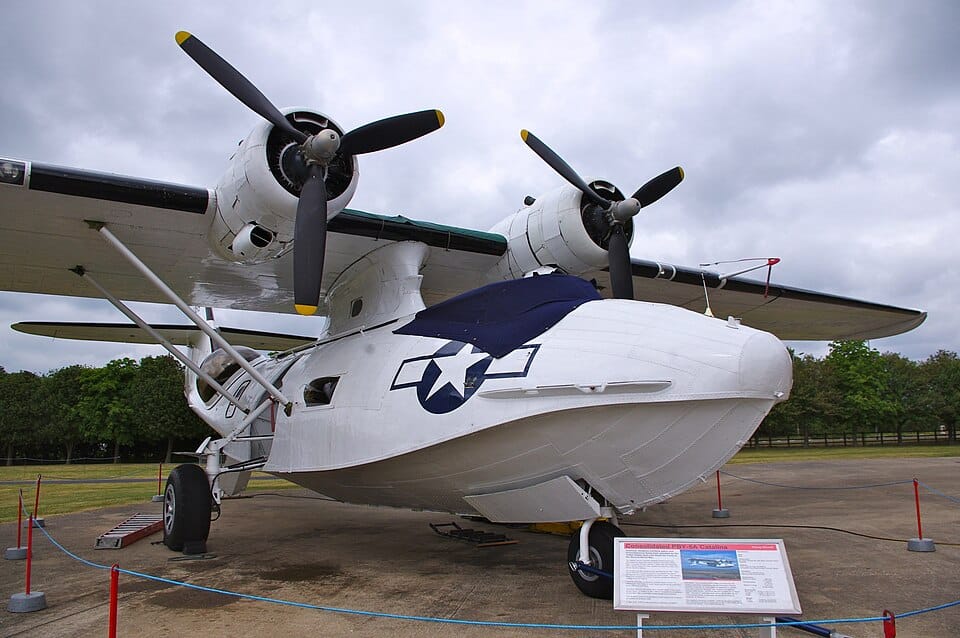
A restored PBY Catalina — the iconic flying boat that rescued more downed airmen than any other aircraft in WWII, and still flies today. Wikimedia Commons
It was the kind of mission the Catalina was built for. With an endurance of up to 24 hours, the flying boat could loiter over vast stretches of ocean that no other aircraft could cover. In the Pacific, where distances between islands could be thousands of miles, the Catalina was often the only set of eyes available. In the Atlantic, Catalinas flew the mid-ocean gap — the stretch of water beyond land-based fighter range where U-boats hunted with impunity — and closed it.
The “Black Cats” — PBY squadrons painted matte black for night operations — became some of the most feared Allied units in the Pacific. Flying at night with radar, they hunted Japanese shipping, dropped bombs on harbour installations, and rescued downed aircrews from the sea, often under enemy fire.
Rescue Machine
The Catalina’s greatest legacy is measured in lives. No other aircraft in WWII rescued more downed airmen from the open ocean. The PBY’s ability to land on rough seas, taxi to survivors, haul them aboard through the hull blisters, and then take off again — often under terrible conditions — made it the last hope for thousands of pilots and aircrew who ditched in the Pacific.
A PBY Catalina lands at Naval Air Station Jacksonville, Florida, circa 1943 — during the war, Catalinas flew gruelling 12-hour patrols over vast stretches of ocean. US Navy
The flying boat’s hull was designed to absorb the impact of open-ocean landings, with a stepped bottom that broke the suction of the water and allowed the aircraft to “unstick” at relatively low speeds. In calm conditions, a skilled PBY pilot could put the aircraft down, pick up survivors, and be airborne again in minutes. In heavy swells, the operation was violent and dangerous — but pilots did it anyway, because the alternative was leaving men to die.
After the war, the Catalina’s unique capabilities found new employment. Converted PBYs became aerial firefighters, scooping water from lakes and dropping it on forest fires across Canada, the United States, and southern Europe. Others served as bush planes in remote regions of South America, Africa, and Southeast Asia, where their ability to operate from water made them irreplaceable.
Still Flying After 91 Years
In 2026, a handful of PBY Catalinas remain airworthy. The aircraft heading to Oshkosh this summer represents years of painstaking restoration — the kind of labour-of-love project that keeps aviation history alive in a way that museum displays cannot. When the Catalina’s twin Pratt & Whitney engines rumble to life and the flying boat lifts from the water, it connects the present to a time when these aircraft were the difference between rescue and death for thousands of young men floating in the Pacific.
The PBY Catalina is slow, noisy, and obsolete by every modern standard. But it did something no fast, sleek, modern aircraft ever had to do: fly 12-hour patrols over empty ocean, land in the middle of nowhere, and bring people home alive. That is why it still flies. That is why people still restore them. And that is why Oshkosh crowds will stand and watch when the flying boat that won’t die passes overhead one more time.
Sources: National Naval Aviation Museum, aviation history archives, Oshkosh 2026 schedule
Quick FactsNationalityAmerican 🇺🇸Aerial Victories11.5 (WWII ace); also 1st pilot to break sound barrierAircraft FlownP-51 Mustang, Bell X-1, F-86 SabreWarsWorld War II, Korean War (advisor)Born / Died13 Feb 1923 – 7 Dec 2020 (age 97)Unit357th Fighter Group (WWII)...
On New Year's Day 1914, a crowd gathered on the waterfront in St. Petersburg, Florida, to watch history. A Benoist XIV flying boat — a wood-and-canvas biplane with a pusher propeller and a hull designed to land on water — taxied out across Tampa Bay. In the single...
Quick FactsNationalitySoviet 🇷🇺Aerial Victories22 (highest jet ace in history, Korean War)Aircraft FlownMiG-15bisWarsKorean WarBorn / Died5 May 1923 – 9 Nov 1986 (age 63)Unit17th IAP (Fighter Aviation Regiment) MiG-15 is shot down by US Navy planes over Korea c1952 —...



 English
0 Comments