
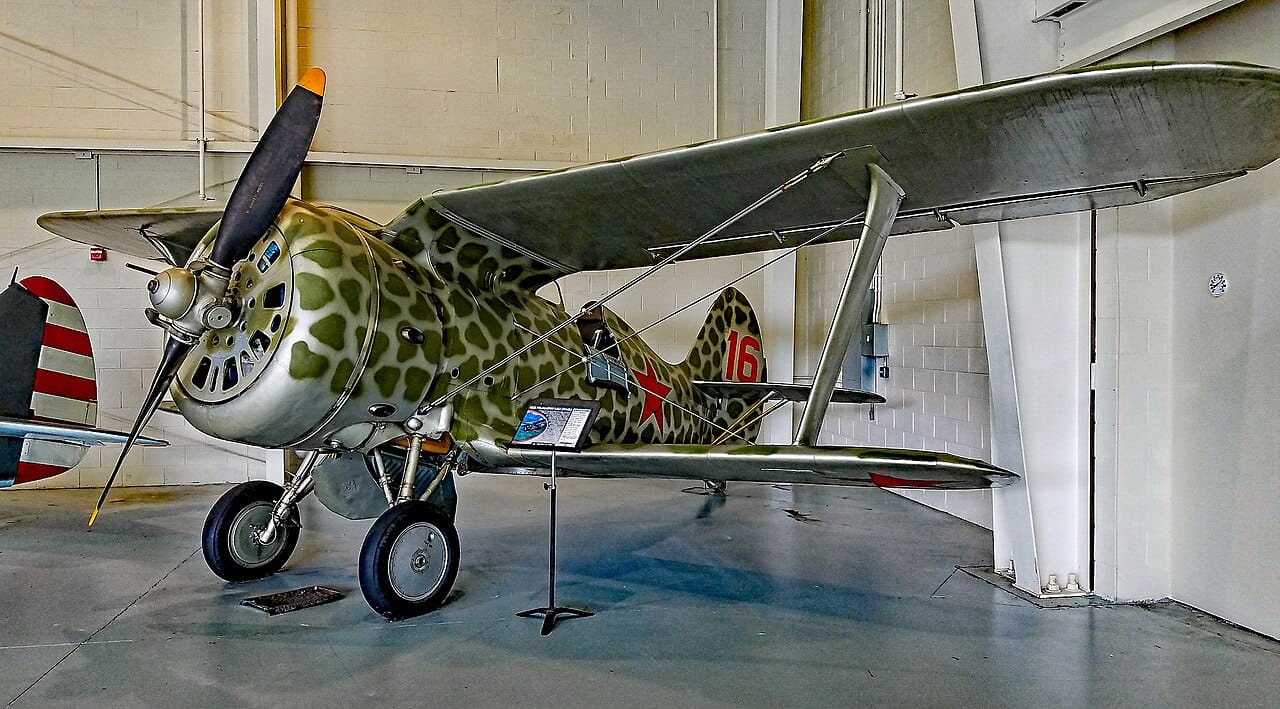
By 1939 the biplane was supposed to be finished. Monoplane fighters — the Bf 109, the Spitfire, the Hurricane — were establishing what air combat in World War II would look like. And yet the Soviet Union was, that same year, accepting deliveries of a new biplane fighter: the Polikarpov I-153 Chaika. It had two wings, an 800-horsepower engine, and a startling concession to modernity — retractable landing gear that folded into the lower fuselage. It looked, to anyone outside the Soviet Union, like a contradiction.
And yet the I-153 served. It fought. It went on serving. It engaged Japanese aircraft at Khalkhin Gol, Finnish forces in the Winter War, German Bf 109s in 1941, and — astonishingly — was still in marginal operational use as a trainer when MiG-15s were entering Soviet service in 1949.
Quick Facts
Aircraft: Polikarpov I-153 Chaika ("Seagull")
Designer: Nikolai Polikarpov, OKB-51
Maiden flight: August 1938
Production: ~3,437 built (1939–1941)
Configuration: Biplane with gull upper wing, retractable landing gear
Powerplant: Shvetsov M-62, 800 hp
Armament: 4 × 7.62 mm ShKAS machine guns; later RS-82 rockets
Combat record: Khalkhin Gol, Winter War, Operation Barbarossa, partisan support
A Last-Generation Compromise
The I-153 was the final evolution of a design line that started with the I-15 in 1933. By the mid-1930s, Soviet doctrine called for a "high-low" mix: a fast monoplane fighter (the I-16) for speed and a maneuverable biplane (the I-15 family) for dogfighting. The I-153 represented the apex of the biplane half of that pairing — agile, well-armed, and crucially equipped with retractable gear that closed roughly 30 km/h of speed gap with monoplane fighters.
It was, by the standards of 1937 when it was designed, an entirely reasonable aircraft. By the standards of 1941, when it met the Luftwaffe, it was a generation out of date.
Surprise Performance
What the I-153 lacked in speed it kept in turn radius. It could out-turn almost anything in the sky. In Mongolian skies during the 1939 border war against Japan, I-153s tangled with Nakajima Ki-27s — nimble fixed-gear monoplanes — and came out reasonably well. Soviet pilots discovered they could lure Japanese pilots into protracted turning fights and shoot them off the tail of their own loops.
This success bred dangerous confidence. When Operation Barbarossa opened in June 1941, the I-153s caught on the ground at forward airfields were destroyed wholesale. Those that got airborne could turn inside a Bf 109, certainly — but the Bf 109 simply zoomed away, climbed, and dove again, refusing to dogfight on the I-153's terms. Soviet biplane losses in the first weeks of Barbarossa were catastrophic.
The Long Quiet Twilight
What the I-153 lost in air-to-air combat, it gained in unglamorous utility. Its short-field performance and low maintenance demands made it an excellent ground-attack platform. Equipped with RS-82 unguided rockets — making it one of the earliest production aircraft to carry rocket armament — it served the partisan war effort and forward Soviet air regiments throughout 1942 and into 1943.
By 1944, the I-153 had been retired from front-line service. But it remained in flight schools and second-line units for years afterwards. A handful of surviving airframes were still on Soviet rolls when the MiG-15 entered service in 1949 — meaning the same air force that operated the first practical swept-wing jet fighter was, that same week, still flying a 1939 biplane somewhere down the chain of command.
Veteran VVS pilots recalled that the Chaika could out-turn anything in the sky — over Mongolia they lured Japanese pilots into protracted turning fights, though against the Messerschmitt the same trick did not work.
Summarised from Soviet veteran pilot accounts
The Last Biplane Fighter to Matter
The I-153 has a strong claim to being the last biplane fighter that ever mattered operationally. The British Gloster Gladiator was already obsolete when war broke out. The Italian CR.42 had a longer combat career but was a pure rear-guard story. The Polikarpov, with its retractable gear, rocket armament, and surprising sortie count, took the biplane concept as far as it could possibly go.
Three thousand four hundred and thirty-seven were built. A handful, restored to airworthy condition in the 1990s, still fly today.
Why the Soviets built a brand-new biplane in 1938 — the Polikarpov I-153.
Sources: Polikarpov design bureau archives, “Soviet Combat Aircraft of WWII” (Gordon & Khazanov), VVS Operational Records.
Related Questions
What was the Polikarpov I-153 Chaika?
The Polikarpov I-153 Chaika ('Seagull') was a Soviet biplane fighter that first flew in August 1938. Designed by Nikolai Polikarpov, it featured a distinctive gull-shaped upper wing and, unusually for a biplane, retractable landing gear. Powered by an 800-hp Shvetsov M-62 engine and armed with four machine guns, about 3,437 were built between 1939 and 1941.
Why did the Soviets build a biplane fighter in the late 1930s?
By the late 1930s Soviet doctrine called for a 'high-low' mix: a fast monoplane (the I-16) paired with a nimble biplane for dogfighting. The I-153 was the apex of that biplane line, adding retractable gear that closed roughly 30 km/h of the speed gap with monoplanes. It was a reasonable design in 1937, even as monoplanes like the Hawker Hurricane were taking over.
What combat did the I-153 Chaika see?
The I-153 fought in several conflicts: the 1939 Khalkhin Gol border war against Japan, the Winter War against Finland, and Operation Barbarossa in 1941. Against Japanese Nakajima Ki-27s it did reasonably well by luring opponents into turning fights. But when Germany invaded in 1941, many were destroyed on the ground and outclassed by faster Bf 109s.
How did the I-153 perform against the Bf 109?
The I-153 could out-turn a Messerschmitt Bf 109 in a dogfight, but that rarely mattered. German pilots refused to turn-fight: they used superior speed to climb, dive, and attack on their own terms, then zoom away. Soviet biplane losses in the opening weeks of Operation Barbarossa were catastrophic, both in the air and on the ground.
How long did the I-153 stay in service?
Remarkably long for a biplane. After losing its edge in air combat, the I-153 found new life as a ground-attack aircraft thanks to its short-field performance and low maintenance. Some remained in marginal use as trainers as late as 1949 — the same period the jet MiG-15 was entering Soviet service. Other Soviet biplanes like the Antonov An-2 proved similarly long-lived.
Why were biplanes still used after monoplanes took over?
Biplanes offered tight turning, slow-speed control, and rugged short-field performance that early monoplanes could not match, so they lingered in training and ground-attack roles. The I-153 served into the jet age, and biplanes even harassed jets in Korea — as in the famous 'Bedcheck Charlie' night raids.
0 Comments