
On the morning of February 20, 1959, workers arrived at Avro Canada's sprawling plant in Malton, Ontario, and were handed slips of paper that said one thing: you are dismissed. By lunchtime, 14,000 people were out of work. By the following weeks, engineers who had built one of the most advanced aircraft in the world were packing their bags for Houston, Texas — where NASA was hiring. Canada had just cancelled its masterpiece, and it would spend the next six decades wondering what might have been.
The Avro CF-105 Arrow was, by any objective measure, extraordinary. A twin-engined, delta-winged interceptor capable of Mach 2 at 50,000 feet, it was designed to do one thing: sprint to the edge of the atmosphere and kill Soviet bombers before they could drop nuclear weapons on Canadian cities. At a time when the F-104 Starfighter was considered cutting-edge, the Arrow was already operating in a different league. And then, with one parliamentary announcement, it was gone — not mothballed, not sold, not archived. Destroyed. Every airframe, every blueprint, every jig and tool, ordered cut into pieces and hauled to the scrapyard.
The story of the Avro Arrow is the story of a nation that briefly touched the frontier of aerospace technology — and then, for reasons that still generate furious debate, let go.
Quick Facts
Aircraft: Avro Canada CF-105 Arrow
First flight: March 25, 1958
Top speed achieved: Mach 1.98 (Mach 2+ projected)
Engines: 2 × Pratt & Whitney J75 (planned: Orenda Iroquois)
Crew: 2 (pilot + weapons systems officer)
Cancellation date: February 20, 1959 ("Black Friday")
Jobs lost: ~14,000 overnight
Aircraft built: 5 completed (RL-201 through RL-205); all destroyed
Surviving examples: Zero (some components and a replica exist)
A Machine Ahead of Its Time
To understand why the Arrow's cancellation stings so deeply, you first have to understand what Canada actually built. In 1953, Avro Canada — already famous for the CF-100 Canuck interceptor — began designing the CF-105 to a Royal Canadian Air Force specification demanding Mach 1.5 performance, all-weather capability, and the ability to intercept high-altitude bombers over the Canadian Arctic. By the time the Arrow rolled out of the factory in 1957, the design had leapfrogged those requirements entirely.
The Arrow was a large aircraft — nearly 24 metres long, with a massive delta wing spanning 15 metres. That delta configuration wasn't chosen for aesthetics. It gave the Arrow a huge internal volume for fuel and systems, exceptional high-altitude stability, and the structural rigidity needed to handle sustained supersonic flight. The leading edge was swept at 60 degrees, optimised for minimising wave drag at Mach 2. Testing had been extensive — alongside wind tunnel work, Avro launched eleven instrumented free-flight models on rocket boosters over Lake Ontario and the Atlantic before the first metal was cut.

The avionics package was equally forward-thinking. The Arrow was designed around the ASTRA fire control system, an extraordinarily ambitious integrated digital avionics suite that was essentially fly-by-wire before the term existed in common use. The aircraft would have been fitted with the Sparrow II or Velvet Glove missile systems. The pilot and weapons system officer sat in tandem cockpits fitted with purpose-built Martin-Baker ejection seats under clamshell canopies that blew open in an emergency. In 1958, the integrated package of systems around them was science fiction made metal.
The powerplant story is equally remarkable. The production Arrow was intended to fly on the Orenda Iroquois — a Canadian-designed and built afterburning turbojet producing around 19,000 pounds of dry thrust and around 26,000 pounds with afterburner. That would have pushed the Arrow comfortably past Mach 2, making it faster than any fighter aircraft then in service with any air force in the world. The five flying prototypes used borrowed Pratt & Whitney J75 engines while Iroquois development continued. The first Iroquois-powered Arrow flight was scheduled for spring 1959. It never happened.
The Political Guillotine
The Arrow did not die because it failed. It died because of a collision between Cold War politics, Washington's strategic interests, and the fiscal conservatism of a prime minister who fundamentally did not believe in the project. Understanding the cancellation requires holding several threads simultaneously, because it was never one thing — it was everything at once.
John Diefenbaker's Progressive Conservative government took power in 1957, inheriting an Arrow program that was already alarming the Treasury Board with its costs. The program was projected at $12.5 million per aircraft — roughly $130 million in today's money — for an initial order of 100 aircraft. Critics noted that the Soviet threat was shifting: ballistic missiles, not bombers, were becoming the primary nuclear delivery system. If the Soviets were going to destroy Canada, they were increasingly going to do it with ICBMs, not Tu-95 Bears crossing the Arctic. An interceptor aircraft was useless against a ballistic missile.

Washington applied pressure too — though the nature of that pressure remains contested. The US had already developed the BOMARC surface-to-air missile system, and there was strong American interest in Canada adopting BOMARC batteries for continental defence rather than maintaining an expensive independent fighter capability. The NORAD agreement, signed in 1957, integrated Canadian and American air defence under a joint command — and the Americans were not keen on a Canadian interceptor that outperformed anything they had. The Pentagon and the State Department both signalled, through various channels, that they would not purchase the Arrow and would not share development costs.
Without American participation, the per-unit cost became unsustainable. Canada simply could not afford to develop and produce a frontline supersonic interceptor entirely on its own. The RCAF had lobbied hard for 100 aircraft; the government was considering cutting the order back sharply, which would have pushed the unit cost even higher. The economics were brutal, and Diefenbaker knew it. What he perhaps did not fully anticipate was the cultural and industrial catastrophe that would follow his decision.
Black Friday and the Brain Drain
February 20, 1959, became known simply as "Black Friday" in the Canadian aerospace industry. The announcement came without warning — Avro's management heard about the cancellation from a radio broadcast, not from the government. Within hours, 14,000 workers had been dismissed. The plant in Malton went from building the future to silence in the space of an afternoon.

What followed was one of the most dramatic brain drains in aviation history. Avro Canada's engineering team was, at that moment, among the most technically sophisticated groups of aerospace engineers in the world. NASA was building the Mercury program and desperately needed people who understood high-speed aerodynamics, avionics integration, and complex systems engineering. The Americans came to Malton and hired. Names like Jim Chamberlin, Owen Maynard, John Hodge, and Bryan Erb — all Avro Canada engineers — went on to design the Mercury and Gemini capsules and contribute directly to the Apollo program that put humans on the Moon.
The bitter Canadian joke, told for decades afterward: Diefenbaker cancelled the Arrow, so Canadians went to work for NASA and put Americans on the Moon instead. It is not entirely a joke. The intellectual capital that Canada discarded in February 1959 materially contributed to the American space program's success through the 1960s.

And then came the order to destroy. Not to preserve, not to sell, not to donate to museums — to destroy. The government directed that all five flying Arrow prototypes, along with the partially-completed airframes on the production line, be cut up and scrapped. Blueprints were ordered incinerated. Jigs and tooling were broken up. The reasoning given — that the technology might fall into Soviet hands — struck many as absurd cover for a simpler motive: eliminating any possibility that a future government might reverse the decision.
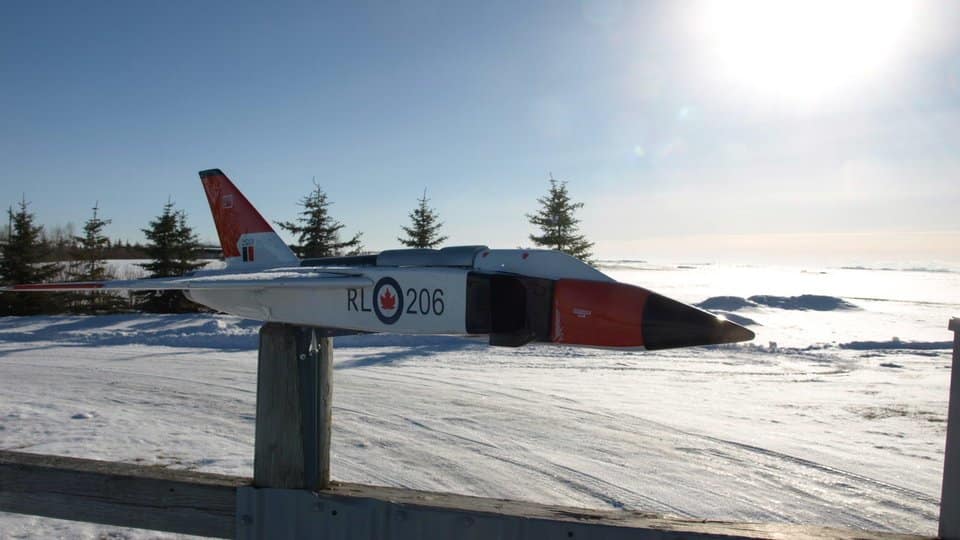
Today, Canada possesses no complete Arrow. The Canada Aviation and Space Museum in Ottawa has the nose and cockpit section of RL-206, the unflown first Mk 2 Arrow, and two outer wing panels from RL-203. A few components survived, scattered across private collections. A full-scale replica was constructed for display purposes. But of the actual aircraft that flew — RL-201 through RL-205 — nothing remains. The scrapping was, in its thoroughness, almost vindictive.
The Legacy That Won't Die

More than sixty years on, the Arrow remains a live wound in Canadian aerospace consciousness. It appears in novels, films, and television dramas. The 1997 CBC miniseries The Arrow was one of the highest-rated programs in Canadian broadcast history. Political leaders still reference it. The Canadian aerospace industry, which never quite recaptured the sovereign capability it lost in 1959, measures itself against what might have been.
The "what if" questions are genuinely interesting. Had the Arrow entered service, it would have been operationally superior to the F-106 Delta Dart that the USAF adopted instead. Its Iroquois engine had drawn serious French interest for a planned enlarged Dassault Mirage IV bomber, with an order of some 300 engines under discussion before negotiations collapsed in late 1958. The fly-by-wire avionics concepts that Avro Canada pioneered would not become standard in Western fighters for another two decades.
There is also the question of industrial trajectory. Canada in 1959 had a genuine, sovereign, world-leading aerospace industry. Avro Canada had already built the CF-100, had the Arrow flying, and had the Iroquois in development — a complete, integrated national aerospace capability stretching from design through manufacture to test flight. The Arrow's cancellation effectively ended that. Canada subsequently became a buyer rather than a builder of frontline military aircraft, a status that persists today — still visible in the decades-long saga of Canada's CF-18 replacement program.
The Arrow is many things to Canada: a ghost, a symbol, an argument, a wound. What it unambiguously is, sixty-seven years after Black Friday, is proof that technical brilliance is not enough. Politics decides. And sometimes politics, in its wisdom, chooses to cut the future into pieces and haul it to the scrapyard.
Sources: Canada Aviation and Space Museum; RCAF historical archives; Palmiro Campagna, "Storms of Controversy: The Secret Avro Arrow Files Revealed"; Murray Peden, "Fall of an Arrow"; Julius Lukasiewicz and Harold Skaarup, "The Avro Arrow Story"; CBC Archives; Wikimedia Commons
Related Questions
What was the Avro Arrow?
The Avro Canada CF-105 Arrow was an advanced Canadian twin-engine, delta-winged interceptor designed to fly at Mach 2 at 50,000 feet. First flown in 1958, it was one of the most advanced aircraft of its era before the Canadian government abruptly cancelled it in 1959.
Why was the Avro Arrow cancelled?
The Canadian government cancelled the Arrow on 20 February 1959, a day remembered as "Black Friday," citing soaring costs and a shift toward guided missiles for air defence. The decision instantly put about 14,000 Avro workers out of a job.
How fast was the Avro Arrow?
The CF-105 Arrow reached Mach 1.98 in testing, with Mach 2-plus projected once its intended Orenda Iroquois engines were fitted. Test flights used Pratt & Whitney J75 engines; the more powerful Canadian Iroquois engines were still in development when the program ended.
What happened to the Avro Arrow prototypes?
After the cancellation, the completed Arrow aircraft, along with the jigs and tooling, were ordered destroyed and cut up for scrap. No complete Arrow survives, which has fuelled decades of Canadian debate and mythology about the lost program.
Did the Avro Arrow cancellation help NASA?
Yes. After the program collapsed and 14,000 workers were dismissed, many of Avro's top engineers moved to the United States, where NASA was hiring. Several joined the American space program, bringing their expertise to the early human spaceflight effort.
When did the Avro Arrow first fly?
The Avro CF-105 Arrow made its first flight on 25 March 1958. It was a two-seat interceptor crewed by a pilot and a weapons systems officer, designed to defend Canada against high-altitude Soviet bombers.
Related Posts
More History & Legends from the MiGFlug Blog
0 Comments