
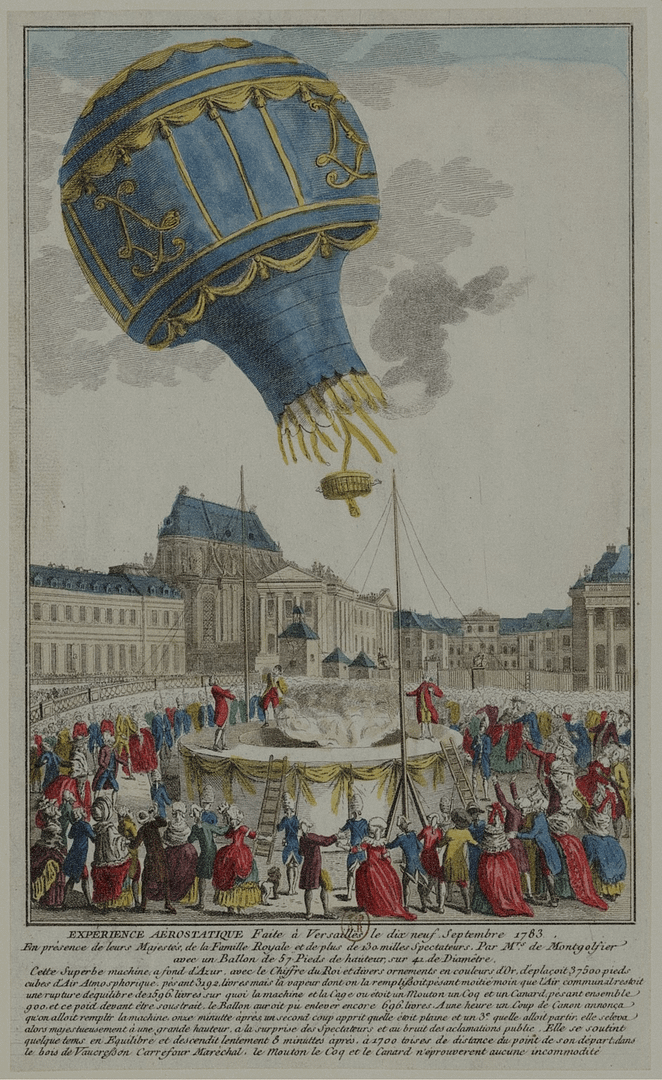
On the morning of September 19, 1783, at the Palace of Versailles, King Louis XVI of France watched a balloon rise into the sky carrying three passengers: a sheep named Montauciel, a duck, and a rooster. They flew for eight minutes and landed two miles away. All three animals survived.
Two months later, on November 21, 1783, a balloon made by the same brothers carried two human beings over the rooftops of Paris for the first time in history. The age of aviation had begun — not with an engine or a wing, but with hot air and a linen bag, built by paper merchants from a small town in southern France.

Paper Merchants Who Watched Smoke Rise
Joseph-Michel and Jacques-Étienne Montgolfier ran the family paper business in Annonay, a town in the Ardèche region of France. They were educated and curious, as many prosperous provincial Frenchmen were in the Age of Enlightenment, but they were not scientists by profession.
The story goes that Joseph was watching laundry dry over a fire one evening in 1782 when he noticed that the heated air caused the cloth to billow and lift. He began experimenting with paper bags held over heat sources and found that a sealed bag filled with hot air would rise. The principle was simple: hot air is less dense than cool air, so a bag filled with it becomes buoyant, like a bubble rising through water.
In June 1783, the brothers conducted a public demonstration in Annonay’s marketplace. They burned a mix of straw and wool under a linen balloon 35 feet in diameter. It rose to roughly 1,000 metres and drifted a mile and a half before coming down. The crowd was stunned. Word reached Paris within days.
“We were the first men to enter the empire of the air.”
— Jean-François Pilâtre de Rozier, after the first manned flight, November 21, 1783Animals First, Humans Second
Before sending people up, the brothers — and their patrons at the Académie des Sciences — wanted to know whether living creatures could survive at altitude. Nobody knew whether the air above the ground was breathable. Nobody knew what the experience would do to an animal’s physiology. King Louis XVI had reportedly suggested using condemned criminals as the first passengers, to avoid risking valuable lives. The brothers declined. They chose animals instead.
The Versailles flight of September 19 answered the question. The sheep, duck, and rooster survived without apparent harm (though the sheep reportedly kicked the rooster during the flight). The path was clear for human passengers.
The first manned flight came on October 15, 1783, when physicist Jean-François Pilâtre de Rozier made a tethered ascent to about 26 metres. Five weeks later, on November 21, Pilâtre de Rozier and military officer the Marquis d’Arlandes rose from the Château de la Muette in Paris, untethered, and flew for 25 minutes — covering roughly 9 kilometres at an altitude of up to 1,000 metres before landing safely on the other side of the city.
Paris Watched From Below
An estimated 400,000 people watched that first manned flight — roughly half the population of Paris. It was the largest crowd ever assembled to witness a single event in human history to that point. Benjamin Franklin was among the observers. When someone beside him asked what use such a thing could be, Franklin is said to have replied: “What use is a newborn baby?”
The race was immediately on. Just two weeks later, on December 1, 1783, physicist Jacques Alexandre César Charles and Nicolas-Louis Robert flew a hydrogen balloon from the Tuileries Garden — a flight that would cover 35 kilometres and reach an altitude of 550 metres. Charles, who had independently developed the principle of gas expansion with temperature (later named Charles’s Law), had built a technically superior vehicle. While the Montgolfier balloon needed a fire burning in a brazier below to stay aloft, Charles’s balloon was sealed and self-sustaining.
The World Transformed in an Afternoon
The implications were immediately clear to those watching. For the first time in history, a human being could rise above the earth without touching it. The military applications were obvious within a decade: the French Revolutionary Army used observation balloons at the Battle of Fleurus in 1794 to monitor Austrian troop movements. By the American Civil War, Union Army balloonists were directing artillery from the air.
But the deeper meaning was philosophical. Humanity had looked up at the birds for a hundred thousand years and dreamed of joining them. On November 21, 1783, two men did. The sky was no longer unreachable. The only question left was how far it went — and how quickly the world could get there.
The Wright Brothers’ first flight, 120 years later, would be the chapter that gets remembered. But the story began in Annonay, with paper merchants and a bag of hot air, and a crowd of half a million people looking up.
Sources: L.T.C. Rolt, The Aeronauts: A History of Ballooning (1966); Charles Coulston Gillispie, The Montgolfier Brothers and the Invention of Aviation (1983); Wikipedia, “Montgolfier brothers”
 English
0 Comments