
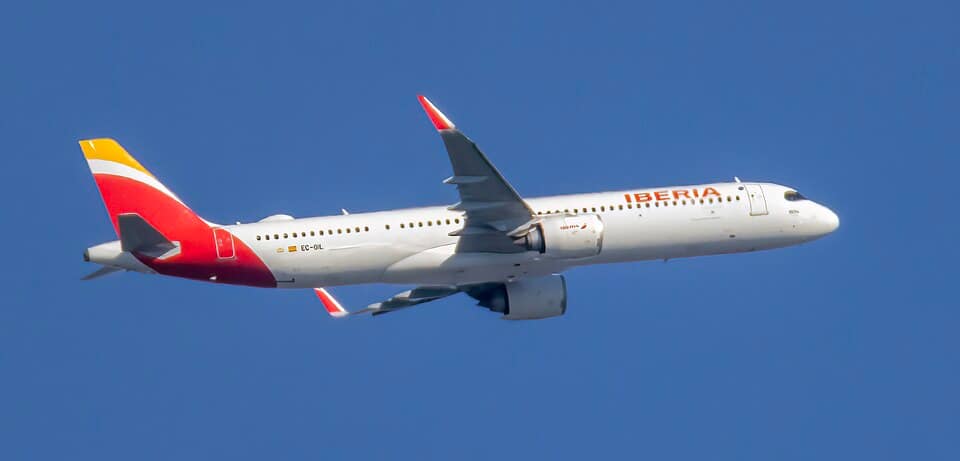
Quick Facts
| Aircraft | Airbus A321XLR (Xtra Long Range) |
| Range | 4,700 nautical miles (8,700 km) — the longest-range single-aisle airliner ever |
| Passengers | 180–220 (depending on configuration) |
| First Delivery | 2024 (Iberia received the first aircraft) |
| Key Innovation | Rear Centre Tank (RCT) — a structural fuel tank integrated into the fuselage, adding range without changing the airframe shape |
| Orders | 500+ from airlines including Iberia, Aer Lingus, United, JetBlue, Wizz Air, Cebu Pacific |
| Routes It Opens | Dublin–Raleigh, Stockholm–New York, Madrid–Tokyo, and hundreds of thin long-haul city pairs that wide-bodies can’t fill |

For decades, transatlantic flying has followed one rule: fill a wide-body or don’t bother. A Boeing 787 carries 250 passengers. An Airbus A350 carries 300. These are the aircraft that fly London–New York, Frankfurt–Chicago, Dubai–Los Angeles. If you cannot sell 250 seats on a route every day, the route does not exist. Entire cities are locked out of long-haul service because the demand is real but the economics require a plane that is too big.
The Airbus A321XLR changes that equation. It carries 180–220 passengers across 4,700 nautical miles — enough to cross the Atlantic, connect Europe to North America’s secondary cities, and open routes that no wide-body could justify. It is not the biggest plane in the sky. It is the most important.
A Fuel Tank That Changed Everything
The A321XLR looks identical to a standard A321neo from the outside. Same fuselage. Same wings. Same engines. The magic is hidden inside. Airbus engineers designed a Rear Centre Tank (RCT) — a permanent structural fuel tank integrated into the belly of the aircraft, beneath the cabin floor. It adds approximately 12,900 litres of fuel capacity without changing the aircraft’s external dimensions or requiring new wings.
That extra fuel extends the A321’s range from 4,000 nautical miles to 4,700 — a 17% increase that crosses a critical threshold. At 4,000 miles, you can reach the eastern seaboard of the United States from western Europe, but only in summer with headwinds in your favour. At 4,700 miles, you can fly Dublin to Raleigh-Durham, Stockholm to New York, or Madrid to Tokyo year-round, in all seasons, with full passenger loads.
The economics are transformative. A wide-body costs $300,000–$400,000 per day to operate. The A321XLR costs roughly $100,000–$150,000. An airline can profitably fly a 200-seat narrow-body on a route where a 300-seat wide-body would fly half empty. The aircraft does not create demand. It reveals demand that was always there but could never be served.
The Routes Nobody Could Fly
Aer Lingus launched Dublin–Raleigh-Durham service in April 2026 using the A321XLR — a route that connects Ireland’s capital with North Carolina’s Research Triangle. It is not a route that makes the front page. It is not London–New York. But it matters to the hundreds of thousands of people who live and work along that corridor and have spent years connecting through JFK, Newark, or Atlanta.
The A321XLR opens this pattern everywhere. Low-cost carriers like Wizz Air and Cebu Pacific have ordered the aircraft to launch long-haul routes from secondary European and Asian cities. JetBlue plans to expand its transatlantic service from the northeastern United States. United Airlines will use it to connect smaller US hubs with European cities that cannot support a daily 787.
The aircraft also disrupts existing markets. Airlines can offer two daily A321XLR frequencies on a route where a single daily wide-body currently operates — giving business travellers the schedule flexibility they crave. Two narrow-body rotations often generate more revenue than one wide-body rotation, even with fewer total seats, because frequency attracts premium passengers.
Narrow-Body, Wide-Body Comfort?
The A321XLR is still a single-aisle aircraft. Passengers sit six-abreast, three on each side of a single aisle. For a 10-hour flight, that can feel cramped. Airlines are responding with upgraded interiors — lie-flat business class seats, premium economy sections, and larger overhead bins. Iberia, Aer Lingus, and JetBlue have all configured their A321XLRs with premium cabins that would not look out of place on a wide-body.
The trade-off is real. No one will confuse the A321XLR experience with a 787 Dreamliner. The cabin is narrower, the galleys are smaller, and the lavatory count is lower. But for a five-to-seven-hour transatlantic crossing — the sweet spot the aircraft is designed for — most passengers will accept the cabin in exchange for a nonstop flight that did not exist before.
The Map Is Being Redrawn
With more than 500 orders from dozens of airlines, the A321XLR is already reshaping route networks. Aviation Week identified 50 new routes launching in April 2026 alone, many of them enabled by the XLR’s range. The summer 2026 schedule features transatlantic, Europe–Asia, and intra-Asian routes that were commercially impossible 18 months ago.
Boeing has nothing equivalent. The 737 MAX 10, its largest single-aisle variant, lacks the range to cross the Atlantic. Boeing’s response to the XLR remains unclear, and the gap is widening with every new order Airbus books. For now, the A321XLR occupies a market niche of one.
The Airbus A321XLR will not replace the 787 or the A350. It will not fly Sydney to London or Los Angeles to Singapore. What it will do is connect cities that have been waiting decades for a nonstop link — and prove that sometimes the most revolutionary aircraft is not the biggest, the fastest, or the most advanced. It is the one that fits.
Sources: Airbus, Aviation Week, Aer Lingus, Simple Flying, Reuters Aerospace



 English
0 Comments