

For most of aviation history, fighter radar worked like a lighthouse: a single beam sweeping mechanically back and forth, seeing one direction at a time. An antenna on a gimbal physically rotated to steer the beam, limited by the inertia of metal parts and the motors driving them.
Then came AESA — Active Electronically Scanned Array — and it changed everything. No moving parts. Thousands of individual transmitter-receiver modules firing simultaneously. A beam that can switch direction in microseconds instead of seconds. A radar that can track dozens of targets, jam enemy electronics, and map the ground below — all at the same time.
Quick Facts
- AESA: Active Electronically Scanned Array
- Key advantage: Steers radar beam electronically — no moving parts
- First operational AESA: AN/APG-77 on the F-22 Raptor (2005)
- F-35 radar: AN/APG-81 by Northrop Grumman
- GaN vs GaAs: Gallium nitride modules deliver 5–10× more power per element
- Simultaneous modes: AESA can track, jam, and map terrain at the same time
From Spinning Dish to Solid State
Traditional mechanically scanned radar used a single transmitter and receiver. The antenna dish rotated on a gimbal to sweep the beam across the sky, updating its picture every few seconds. The system worked, but it had fundamental limitations: it could only look in one direction at a time, the mechanical parts wore out, and the scan pattern was predictable enough for an enemy to detect and jam.
The first breakthrough was PESA — Passive Electronically Scanned Array. Instead of moving the antenna, phase shifters at each element steered the beam electronically. The Soviet Union got there first: the Zaslon radar on the MiG-31 Foxhound, operational in 1981, was the world’s first phased-array fighter radar. It could detect targets at 200+ km and track 10 simultaneously. The West would not match it until the F-22 entered service in 2005 — nearly a quarter-century later.
Why AESA Is Revolutionary
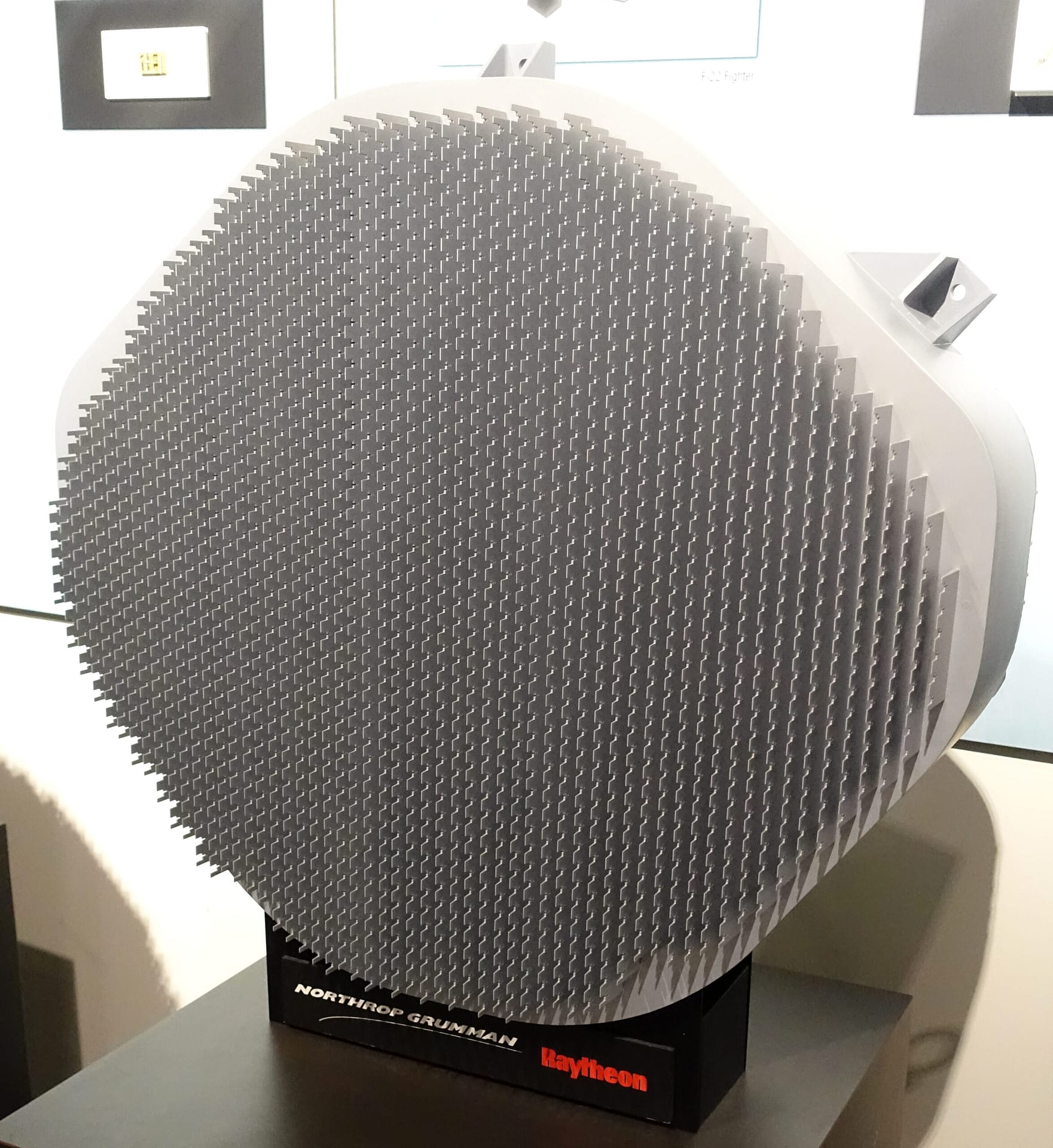
AESA took the PESA concept to its logical extreme. Instead of one central transmitter feeding all elements, each antenna element has its own solid-state transmit/receive module (TRM). The F-22’s AN/APG-77 has approximately 1,500 of them. The F-35’s AN/APG-81 has 1,676.
The advantages are transformative. Simultaneous track and attack: an AESA can operate in air-to-air and air-to-ground modes at the same time, tracking dozens of targets in different directions. Low Probability of Intercept: because each TRM can operate on a different frequency, the radar hops across thousands of frequencies per second in pseudo-random patterns, making the signal nearly impossible to detect against background noise. Electronic warfare: if the radar detects jamming, it can concentrate a narrow, high-power beam directly at the jammer — turning the radar itself into an electronic attack weapon.
And because there are no moving parts and hundreds of independent modules, an AESA degrades gracefully. If individual modules fail, the radar continues with slightly reduced performance rather than failing completely.

The AESA Arms Race
The F-22 Raptor’s AN/APG-77, operational in 2005, was the first volume-production AESA fighter radar. The F/A-18E/F Super Hornet followed in 2007 with Raytheon’s AN/APG-79. The F-35 brought the AN/APG-81 in 2015.
Now the technology is spreading to legacy fighters. Northrop Grumman delivered its 1,000th AN/APG-83 SABR for the F-16V Viper in May 2026 — derived from F-22 and F-35 radar technology, it gives Cold War-era F-16s capabilities approaching fifth-generation fighters without requiring any power, structural, or cooling modifications. The F-15EX Eagle II gets Raytheon’s APG-82, now evolving to an APG-82(V)X variant using advanced gallium nitride (GaN) technology for longer range and lower detectability.
Europe has joined the race. Leonardo’s Captor-E equips the Eurofighter Typhoon, featuring a mechanically repositioned array for wider scan angles. Thales’ RBE2-AA powers the Rafale. And Saab’s Gripen E/F carries Leonardo’s ES-05 Raven.
What Comes Next: Thinking Radar
The frontier is cognitive radar — systems that use AI and machine learning in a real-time feedback loop, adapting their transmissions based on what they are detecting. The radar learns about targets and environments, minimizes clutter autonomously, and develops countermeasures to perceived threats on the fly. GaN technology, offering 2-5 times the power density of current gallium arsenide modules, is enabling smaller, more powerful arrays that could eventually fit on drones.
From a spinning dish to a thinking electronic brain — the radar revolution is rewriting the rules of air combat one generation at a time.
Sources: Northrop Grumman, Armada International, IEEE Aerospace and Electronic Systems Magazine, Aviation Week & Space Technology
 English
0 Comments