
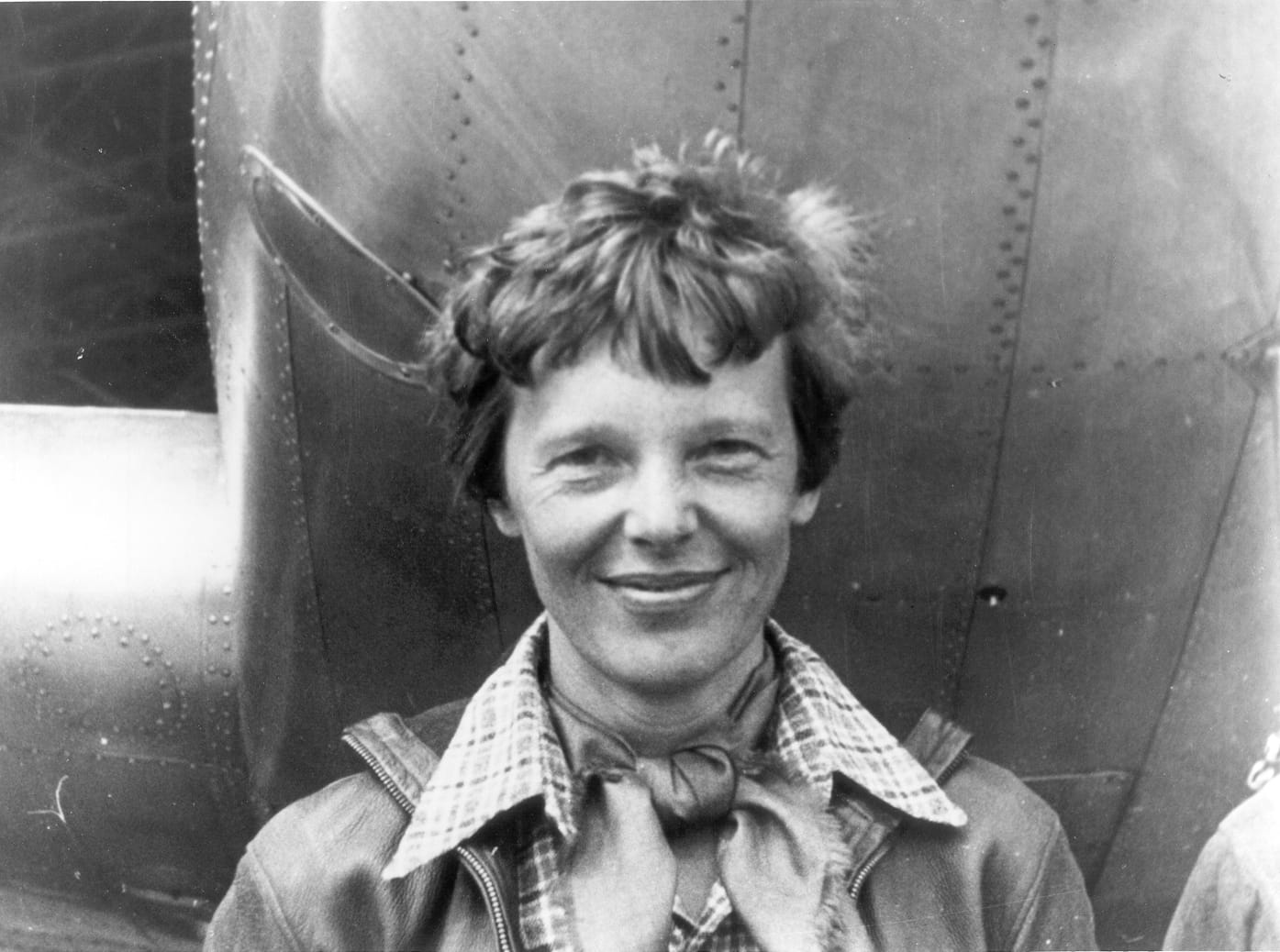
The Flight
Earhart was attempting to fly around the world at the equator — a route of roughly 29,000 miles. She was not the first person to fly around the world (Wiley Post did it in 1933), but she would have been the first woman, and her equatorial route was the longest circumnavigation attempted by air. Her aircraft was a Lockheed Model 10-E Electra, a twin-engine, all-metal monoplane originally designed as a small airliner. It had been heavily modified for the attempt: extra fuel tanks filled most of the cabin, extending the range to approximately 4,000 miles. Her navigator was Fred Noonan, a former Pan American Airways navigator with extensive Pacific experience. The flight departed Miami on June 1, 1937, heading east. Earhart and Noonan made it across South America, Africa, South Asia, and Southeast Asia without major incident. By late June, they had covered 22,000 miles and were in Lae, New Guinea — the last major stop before the most dangerous leg of the entire journey.The Final Leg — Key Facts
- Departure: Lae, New Guinea — July 2, 1937, 00:00 GMT
- Destination: Howland Island — a flat coral island 1.6 km long, 0.5 km wide
- Distance: 2,556 miles (4,113 km)
- Aircraft: Lockheed Model 10-E Electra, NR16020
- Crew: Amelia Earhart (pilot), Fred Noonan (navigator)
- Expected flight time: ~18 hours
- Radio contact lost: 08:43 GMT, July 2, 1937
The Last Leg
The flight from Lae to Howland Island was 2,556 miles over open ocean. Howland is a speck — 1.6 kilometres long and half a kilometre wide, barely two metres above sea level. Finding it required precise celestial navigation and accurate radio direction finding. The US Coast Guard cutter Itasca was stationed at Howland to provide radio homing signals. But communication between the Electra and the Itasca was poor throughout the flight. Earhart transmitted on 3105 kHz; the Itasca responded on 7500 kHz. It is unclear whether Earhart ever received the Itasca’s transmissions. Her radio direction finder may not have been functioning properly — or she may not have known how to use the specific equipment installed in the modified Electra. At 07:42 GMT, Earhart reported: “We must be on you, but cannot see you — but gas is running low. Have been unable to reach you by radio.” At 08:43 GMT, she transmitted: “We are on the line 157-337. We will repeat this message. We will repeat this on 6210 kilocycles. Wait.” It was the last confirmed transmission.“Yes, the basic mystery is solved. Earhart and Noonan landed and died on Gardner Island, but there’s still plenty to learn.”
— Ric Gillespie, founder of TIGHAR and lead Earhart investigator for over 40 years
What Probably Happened
The most widely accepted explanation is the simplest: Earhart and Noonan could not find Howland Island, ran out of fuel, and ditched in the Pacific. The Electra sank. Neither survived. The evidence supports this. The Electra’s fuel calculations, based on fuel load and engine consumption rates, suggest the aircraft ran dry within 30–60 minutes of the last transmission. The Pacific is 4,000 metres deep in that area. No debris was found despite an extensive Navy and Coast Guard search involving the battleship USS Colorado, the aircraft carrier USS Lexington, and multiple other vessels covering 250,000 square miles over sixteen days.The Competing Theories
Two alternative hypotheses have attracted serious investigation. The **Gardner Island (Nikumaroro) hypothesis**, championed by The International Group for Historic Aircraft Recovery (TIGHAR), proposes that Earhart landed on the reef at Gardner Island, approximately 350 miles southeast of Howland. TIGHAR has conducted multiple expeditions to the uninhabited atoll and found artefacts including a jar of freckle cream, aircraft aluminium consistent with an Electra panel, and bone fragments that were controversially re-analysed in 2018 as potentially matching Earhart’s build. None of this evidence is conclusive. The **Marshall Islands / Japanese capture hypothesis** suggests Earhart was captured by the Japanese military after landing or crashing in the Marshall Islands. This theory has no credible documentary support from either Japanese or American archives. It persists largely because it makes for good television.What We Will Probably Never Know
The Pacific is very large and very deep. The Electra carried no emergency locator transmitter (they did not exist in 1937). There was no radar tracking, no satellite communication, no GPS. Once radio contact was lost, Earhart and Noonan were alone in a single-engine aircraft (one engine may have been shut down to conserve fuel) over featureless ocean, looking for an island smaller than a city park. Modern deep-sea search technology — the kind that found the Titanic, MH370’s debris field, and Shackleton’s Endurance — has not been deployed at scale in the Earhart search area. Robert Ballard’s 2019 expedition searched near Nikumaroro but found no wreckage. Future expeditions with advanced autonomous underwater vehicles remain the best hope for a definitive answer. Until then, the evidence points to the most prosaic explanation: Earhart ran out of fuel and went down in the Pacific. The mystery is not what happened. It is where.“Everybody has a theory, some more serious than others, but it’s still the greatest mystery of the 20th century, and looks like it’s heading into the 21st century.”Sources: National Air and Space Museum, TIGHAR, National Geographic, Purdue University Libraries (Earhart Papers), This Day in Aviation
— Dorothy Cochrane, Curator of General Aviation, Smithsonian National Air and Space Museum

 English
0 Comments