
On the morning of March 31, two aircraft that barely anyone outside the electronic warfare community has heard of touched down at RAF Mildenhall in England. They had left Davis-Monthan Air Force Base in Arizona the day before, refuelled at McGuire in New Jersey, and crossed the Atlantic under the callsigns AXIS41 and AXIS43. They are EA-37B Compass Calls — the U.S. Air Force’s newest and most capable electronic attack jets. And they appear to be heading to war.
Flight tracking enthusiasts spotted the pair almost immediately. Serial numbers 19-1587 and 17-5579, assigned to the 55th Electronic Combat Group, lit up on open-source trackers as they made their transatlantic crossing. A Kalitta Air Boeing 747-400 cargo aircraft had departed Davis-Monthan with a follow-on flight plan to Istanbul, strongly suggesting the EA-37Bs’ next stop is Turkey — and from there, the Middle East.
If confirmed, this would mark the EA-37B’s first operational deployment. The aircraft only flew its first training sortie in May 2025. It visited Europe in January on a “roadshow” that the Air Force explicitly described as non-operational. That distinction no longer applies.
What the Compass Call Actually Does
From the outside, the EA-37B looks like what it is: a modified Gulfstream G550 business jet, the kind of aircraft you might see parked at Zurich or Teterboro. But the resemblance ends at the fuselage. Distinctive bulging “cheek” fairings on either side of the aircraft house an electronic warfare suite that can reach deep into enemy airspace without the jet ever crossing a border.
The Compass Call jams enemy radar systems, disrupts military communications, and blinds the command-and-control networks that coordinate air defence batteries, missile launchers, and ground forces. Its secondary role is intelligence collection — it spots, tracks, and geolocates the very emitters it is designed to suppress. The “A” in EA-37B stands for “attack,” reflecting a capability that goes beyond mere jamming into actively degrading and destroying electronic targets.
Captain Tyler Laska of the 55th Wing put it in operational terms: “Every moment of hesitation we can implant into an adversary’s decision-making process increases survivability of our personnel.”
EA-37Bs 19-1587 and 17-5579 as AXIS41 and AXIS43 are deploying to RAF Mildenhall via McGuire AFB. This is the first operational deployment for the EA-37B. pic.twitter.com/6InlHCdLnd
— KIWA Spotter (@KiwaSpotter) March 31, 2026
From Hercules to Gulfstream
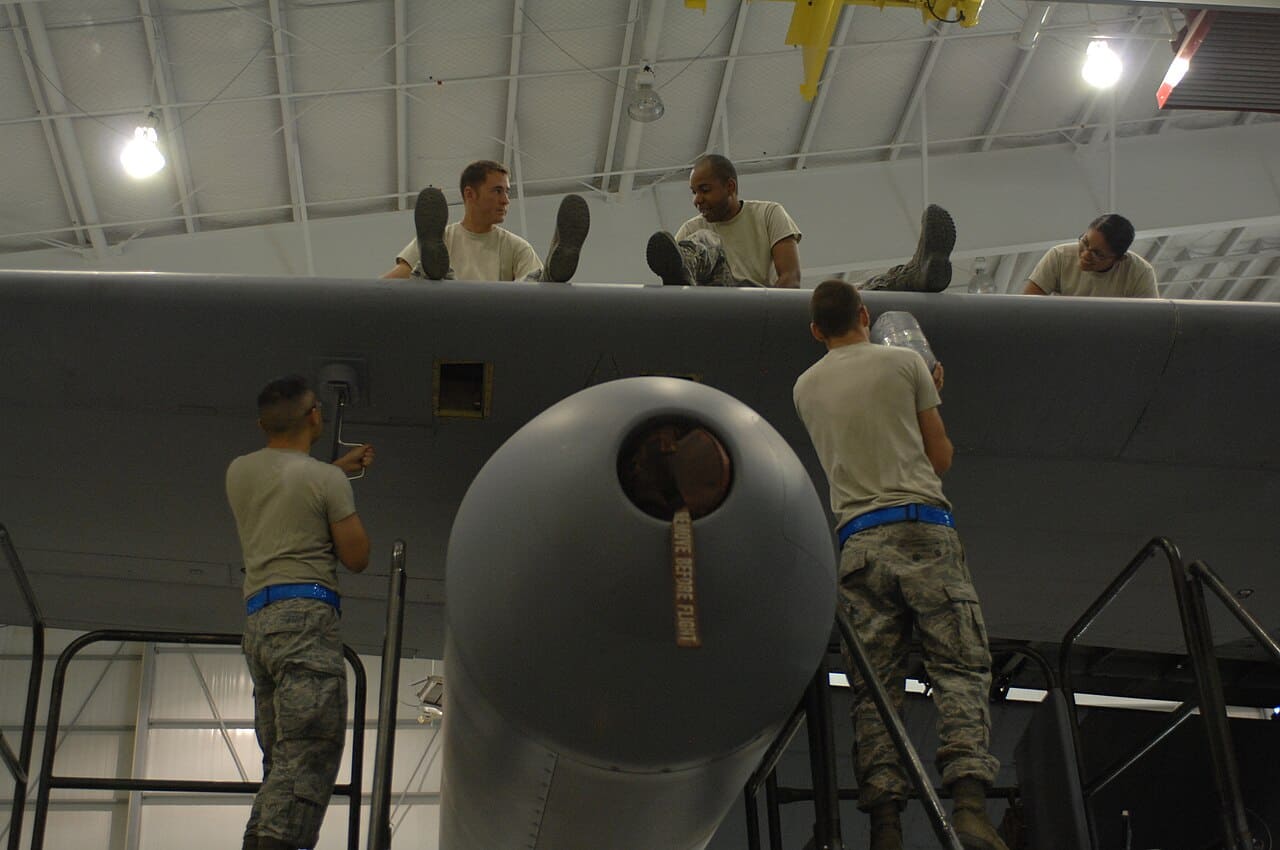
The EA-37B replaces the EC-130H Compass Call, a modified C-130 Hercules turboprop that had been the backbone of American airborne electronic warfare since the 1980s. The old fleet was down to just four airworthy airframes — slow, vulnerable, and unable to keep pace with the modern electromagnetic battlefield.
The jump to the Gulfstream G550 platform changes everything. The EA-37B flies faster, higher, and farther than its predecessor. Higher altitude means a dramatically expanded field of view — the aircraft can project electronic effects across vast areas without having to fly anywhere near the threat. Greater speed and range mean it can operate from stand-off distances that keep it well outside the engagement envelopes of modern surface-to-air missile systems.
The Air Force plans to acquire ten EA-37Bs in total, gradually replacing the remaining EC-130H fleet. L3Harris is the prime contractor for the electronic warfare mission systems, building on decades of Compass Call expertise.
Why Iran Changes the Calculus
The timing of this deployment is not subtle. Operation Epic Fury — the U.S. military campaign against Iran — has been escalating steadily. The EC-130H fleet reportedly saw action during the early phases, including possible support during operations in Venezuela. But those aging turboprops were never designed for the kind of sophisticated, layered air defence environment that Iran presents.
Iran operates one of the densest integrated air defence networks in the Middle East, built around Russian-supplied S-300 systems, domestically produced radars, and increasingly capable short-range air defence platforms. Suppressing those systems — or even degrading their coordination — is precisely what the Compass Call was built to do.
The pairing of two EA-37Bs also hints at a more ambitious concept. The Air Force has been working on integrating the Compass Call with the RC-135 Rivet Joint, its premier signals intelligence platform. The idea is to fuse the Rivet Joint’s deep sensing capabilities with the Compass Call’s electronic attack functions, creating a real-time cycle of finding, fixing, and frying enemy emitters.
The 55th Wing declined to comment on the deployment, deferring all questions to Central Command. But the flight tracking data, the cargo aircraft heading to Istanbul, and the operational context all point in one direction. The EA-37B Compass Call — barely a year out of its first training flight — appears to be going to war.
Sources: The War Zone, Stars and Stripes, FlightGlobal, Air & Space Forces Magazine
 English
0 Comments