
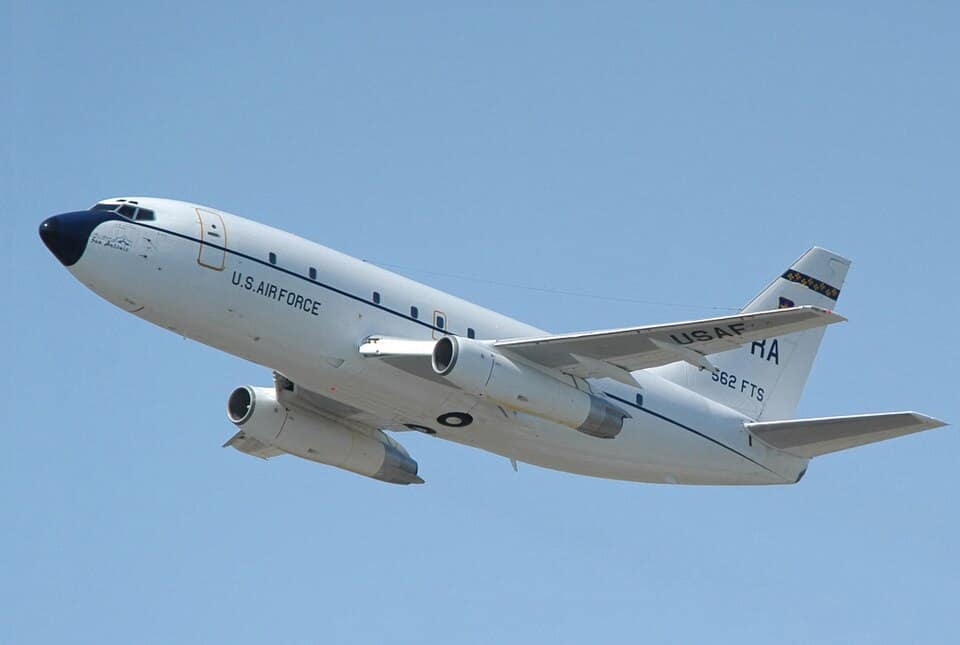

It’s a Boeing 737. Sort of. It has a bulging nose radome that makes it look like a beluga whale with a radar addiction, a massive aft fairing that shouldn’t be there, and a flight path that routinely takes it past the most classified airspace on Earth. The U.S. Air Force’s NT-43A — better known by its callsign RAT55 — is quite possibly the most secretive airliner-shaped aircraft in the world. And on March 31, it showed up over Florida, flying circles around NASA’s Artemis II launch pad.
This is not where you’d expect to find an aircraft that normally skulks around the Nevada Test and Training Range, measuring the radar signatures of stealth fighters and bombers. But the Air Force confirmed the appearance — and dropped a bombshell while they were at it. RAT55 is starting a new career.
“After decades of flights supporting the Air Force in various roles, the NT-43A Radar Test Bed is being transitioned to start the next phase of its career,” an Air Force spokesperson said. “Beginning with data collection during the upcoming launch of Artemis II, the NT-43A Radar Test Bed will continue its legacy of excellence in supporting some of our nation’s most important and technologically advanced capabilities.”
What RAT55 Actually Does
The NT-43A started life as a standard T-43 — the Air Force’s navigation trainer version of the Boeing 737-200. At some point, one airframe was pulled from the fleet and handed to Air Force Materiel Command for a radical transformation. Two enormous radar arrays were installed: one in a reshaped nose, one in a massive aft radome protruding from the tail. Additional sensor bays were added. The “N” prefix in the designation stands for “Special Test, Permanent” — Pentagon-speak for “this aircraft does things we’re not going to tell you about.”
Its primary known mission: measuring the radar cross-section of stealth aircraft. When the Air Force wants to verify that a B-2 Spirit or B-21 Raider is as invisible to radar as it’s supposed to be, RAT55 flies alongside (or opposite) and bathes the target in radar energy, recording exactly how much bounces back. This data validates stealth coatings, design modifications, and the overall low-observable signature that makes a stealth aircraft a stealth aircraft.
“The NT-43A Radar Test Bed will continue its legacy of excellence in supporting some of our nation’s most important and technologically advanced capabilities.” — U.S. Air Force spokesperson
RAT55 has been photographed — rarely — operating from Tonopah Test Range Airport in Nevada, the same remote, high-security facility that once hid the F-117 Nighthawk programme. It’s been spotted near Area 51, near Edwards Air Force Base, and alongside B-2 Spirits in flight. Each sighting makes aviation enthusiasts lose their minds, because seeing RAT55 in the open is roughly as common as seeing a snow leopard in Manhattan.
From Stealth to Space
So what’s a radar signature aircraft doing at a moon launch? The answer appears to involve its sensor suite. The NT-43A carries modular electro-optical, infrared, and radar systems in a large, pressurised cabin. That makes it an excellent platform for gathering telemetry, tracking data, and atmospheric measurements during a rocket launch — exactly the kind of data NASA needs but doesn’t always have enough aircraft to collect.
Flight-tracking data showed RAT55 orbiting near Kennedy Space Center’s Launch Complex 39B on March 31, using the callsign NASA522 — a NASA-assigned identifier rather than its usual Air Force callsign. It was flying in a pattern opposite to NASA’s WB-57F high-altitude research aircraft, which traditionally chase launches to capture optical and infrared data from above.
There’s a historical echo here. During the Apollo programme in the 1960s and 1970s, the Air Force supported NASA launches using EC-135N ARIA aircraft — modified Boeing 707s equipped with enormous nose radomes. Those planes tracked spacecraft as they left the atmosphere. RAT55, with its own oversized nose radome and sensor-packed cabin, is a spiritual successor to those Cold War-era machines — except it’s been hiding in the Nevada desert for the past few decades instead of flying over the Atlantic.
A New Chapter
The Air Force’s statement — that RAT55 is beginning “the next phase of its career” — suggests this isn’t a one-off. If the NT-43A is transitioning from pure stealth support to a broader sensor-platform role, it could appear at future launches, missile tests, or other events where the government needs an airborne sensor suite in a large, loiter-capable airframe.
Or the Air Force could be doing what it does best: saying just enough to explain a public sighting while revealing nothing about what else the aircraft will be doing. The NT-43A has been flying for decades and has never once been the subject of an official capability briefing. One press statement about Artemis II support doesn’t change that.
What we know for certain: on the day humanity sent astronauts toward the Moon for the first time in over 50 years, one of America’s most secretive aircraft was circling the launch pad — watching, listening, and recording. Some things in aviation are classified. Others are just beautiful.
Sources: The War Zone, The Aviationist, NASA, Air & Space Forces Magazine


 English
0 Comments