

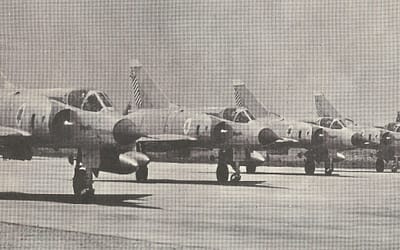
Argentina has not had real combat air power since 1982. Forty-four years after the Falklands, the country flew its last operational Mirage in 2015 and has been making do with subsonic A-4 Skyhawks and IA-63 Pampa trainers ever since. That is finally over: the F-16 Vipers are coming, and now Buenos Aires has done something nobody expected — it is buying tankers.
This week brought fresh movement on Argentina’s plan to acquire retired US Air Force KC-135R Stratotankers: the air force has formally requested up to two of them through the US Foreign Military Sales programme, which would make Argentina only the second Latin American nation after Chile to operate boom-equipped strategic refuellers. The cost has not been disclosed — though second-hand KC-135s come far cheaper than new-build alternatives — and the deal would triple the operational reach of Argentina’s incoming Vipers.
It would be the single biggest aerial-mobility upgrade Argentina has made since World War II.
Quick Facts
Buyer: Fuerza Aérea Argentina (FAA)
Aircraft: Up to 2× Boeing KC-135R Stratotanker (ex-USAF, hot transfer)
Cost: Not yet disclosed; transfer requested via US Foreign Military Sales
Boom type: Refuelling boom for receptacle-equipped aircraft (incl. F-16)
Combat impact: Could triple the F-16’s effective combat radius of ~550 km on internal fuel
Falklands relevance: Falkland Islands would sit well within refuelled F-16 strike range

Why Tankers Matter More Than Fighters
Argentina is enormous. The country stretches 3,800 kilometres from the tropical north to Tierra del Fuego in the south. The Atlantic seaboard alone is longer than the entire west coast of Europe. An unrefuelled F-16AM has a combat radius of about 550 kilometres on internal fuel — useful for defending the airspace immediately around its base, useless for projecting power across the country.
A KC-135 changes that completely. The Stratotanker can carry roughly 90,000 kilograms of fuel and offload it at altitudes up to 50,000 feet. Two F-16s topped off mid-mission can fly to almost any point in the South Atlantic, drop ordnance, and return.

London Will Notice
The Falklands Islands sit 480 kilometres from the Argentine mainland. With KC-135 support, Argentine F-16s could fly multiple combat passes over the islands and return without any single mission constraint. That does not mean another conflict is imminent — diplomatic relations between London and Buenos Aires have been calm — but it changes the deterrent maths in the South Atlantic for the first time in four decades.
The Royal Air Force currently keeps a small fighter detachment of Typhoons at RAF Mount Pleasant on the Falklands precisely to counter any Argentine raid. Until now, the British calculated they needed only enough firepower to defend the islands long enough for reinforcements to arrive. With Argentine tanker support and 24 F-16s, the threat profile shifts upward.
A Latin American First
Chile became the first South American nation to operate the KC-135 in 2010. Argentina would now join them, while Brazil is taking a different route: its two Airbus A330 “KC-30s” are being converted to full MRTT tanker standard, with the modified aircraft due back in service in 2026 and 2027.
For a country that 25 years ago could barely afford fuel for its trainers, Argentina is suddenly looking like a serious continental air power again.
Sources: Defence Blog, Zona Militar, Air Data News.


 English
0 Comments