
| Quick Facts | |
|---|---|
| Mission | Artemis II — first crewed lunar flyby since Apollo 17 (1972) |
| Launch Date | April 1, 2026, Kennedy Space Center, Florida |
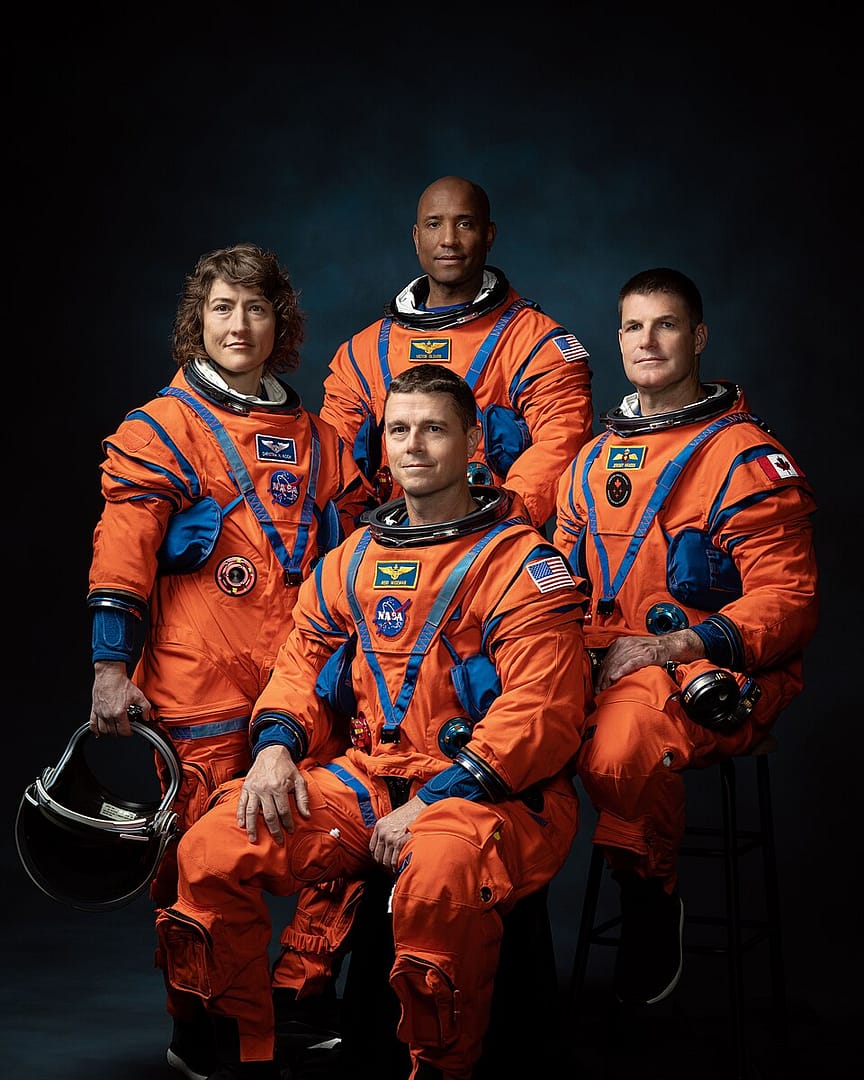
| Crew | CDR Reid Wiseman, PLT Victor Glover, MS Christina Koch (NASA), MS Jeremy Hansen (CSA) |
| Spacecraft | Orion MPCV atop Space Launch System (SLS) Block 1 |
| Mission Duration | Approximately 10 days |
| Flight Profile | Lunar flyby — no orbit, no landing; closest approach behind the far side |
| Aviation Connection | Glover: former F/A-18 test pilot; Wiseman: former F-14 pilot; Hansen: former CF-18 pilot |

At 12:34 p.m. Eastern on April 1, 2026, the most powerful rocket ever built did what it was designed to do: it sent humans toward the Moon. Four astronauts — three Americans and one Canadian — lifted off from Kennedy Space Center aboard NASA Orion spacecraft, riding 8.8 million pounds of thrust into a trajectory that no human has followed since December 1972.
As of Flight Day 3, the Artemis II crew is closer to the Moon than to Earth. They have completed the translunar injection burn that set Orion on its path to the far side, and they are preparing the cabin for the closest lunar approach any human has made in over half a century.
This is not a landing mission. Artemis II is a flyby — a figure-eight trajectory that will swing behind the Moon and use lunar gravity to slingshot Orion back toward Earth. But what it lacks in surface contact it makes up for in historical weight. After 54 years, humans are back in deep space.
A Crew of Pilots
For an aviation blog, the crew roster reads like a dream. Commander Reid Wiseman flew F-14 Tomcats off aircraft carriers before becoming a test pilot and astronaut. Pilot Victor Glover is a former F/A-18 Hornet test pilot who has already flown to the International Space Station aboard a SpaceX Dragon capsule. Canadian Mission Specialist Jeremy Hansen flew CF-18 Hornets for the Royal Canadian Air Force before joining the Canadian Space Agency.
Mission Specialist Christina Koch, while not a military aviator, spent 328 consecutive days aboard the ISS in 2019–2020 — the longest single spaceflight by a woman at the time. Together, the crew represents a blend of fighter pilot instinct and long-duration spaceflight experience that NASA specifically selected for this mission.
The pilot heritage matters more than you might think. Orion is not fully autonomous. While computers handle the primary navigation, the crew can fly the spacecraft manually — and if something goes wrong beyond the Moon, they may have to. Putting former fighter and test pilots in the seats is not nostalgia. It is risk management.

The Mission Profile
Artemis II follows a free-return trajectory: Orion flies past the Moon, swings behind the far side at its closest approach, and uses the Moon gravitational field to redirect back to Earth without needing a second major engine burn. It is the same profile Apollo 13 famously flew after its oxygen tank explosion in 1970 — though this time, by design rather than emergency.
The entire mission lasts approximately 10 days. During the outbound leg, the crew tests Orion life-support systems, navigation, and communications in deep space for the first time with humans aboard. At closest approach, they will see the lunar surface from a vantage point no living person has experienced — and photograph the far side in detail that orbital cameras cannot match.
Re-entry will be the most dramatic moment. Orion will hit Earth atmosphere at roughly 40,000 kilometres per hour — faster than any crewed vehicle since Apollo. The heat shield, already tested during the uncrewed Artemis I flight in 2022, will face temperatures exceeding 2,800 degrees Celsius. Splashdown is expected in the Pacific Ocean off the California coast.
Why It Took So Long
Apollo 17 returned from the Moon in December 1972. Artemis II launched in April 2026. That is 53 years and four months — the longest gap in the history of human exploration between visiting a destination and returning to it. The reasons are familiar: shifting political priorities, cancelled programmes, budget fights, and the sheer difficulty of rebuilding capabilities that were abandoned a generation ago.
Artemis itself was not quick. The programme was announced in 2017, the SLS rocket flew its first uncrewed test in late 2022, and the crewed mission was delayed multiple times by heat shield concerns, supply chain issues, and technical reviews. By the time Wiseman, Glover, Koch, and Hansen finally climbed aboard, the programme was running years behind its original schedule.

What Comes Next
If Artemis II succeeds — and so far, every system is performing as designed — NASA will proceed to Artemis III: the first crewed lunar landing since 1972, using a SpaceX Starship variant as the landing vehicle. That mission is tentatively targeted for 2028, though few in the industry expect the schedule to hold.
For now, four people are falling toward the Moon at thousands of kilometres per hour, seeing something no human has seen in half a century. Three of them are former fighter pilots. All of them are making history.
Sources: NASA, CNN, Live Science, Fox News, ABC News
 English
0 Comments