
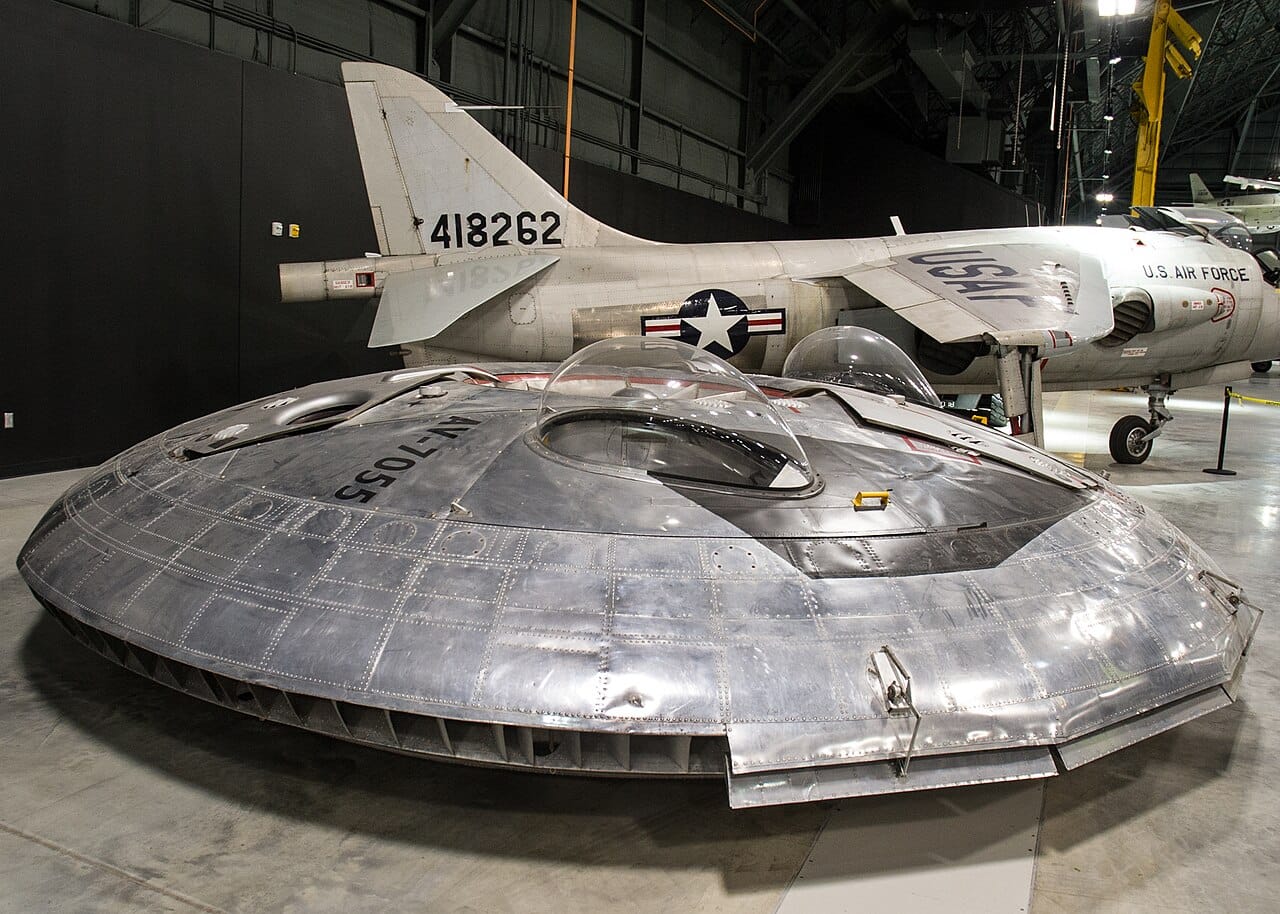
If you ever stand in front of the gigantic Cold War hangar at the National Museum of the United States Air Force in Dayton, Ohio, you will see, parked between an XB-70 Valkyrie and a YF-12, something that looks like it landed there yesterday — a domed metal disc, eighteen feet across, painted Air Force grey.
This is the Avrocar. The Pentagon's actual flying saucer. The one the U.S. Army Transportation Corps spent $10 million on, and that Avro Canada designed in collaboration with the U.S. Air Force, in a programme so classified for so long that conspiracy theorists were sure it explained Roswell.
It was meant to hit Mach 3 and climb to 100,000 feet. It actually hit 35 miles per hour and bounced uncontrollably three feet off the ground.
Quick Facts
Designation: Avro Canada VZ-9 Avrocar
Year: 1958–1961, two prototypes built
Diameter: 18 ft (5.5 m)
Thickness: 3.5 ft (1.1 m)
Propulsion: Three Continental J69 turbojets driving a central "turborotor" fan
Design top speed: Mach 3, ceiling 100,000 ft (intended)
Actual top speed: 35 mph, ceiling ~3 feet (achieved)
Cancelled: December 1961
Total programme cost: Approximately $10 million
Where the Saucer Came From
Avro Canada had a problem. The company was the design force behind the cancelled-in-1959 CF-105 Arrow — Canada's Mach 2 interceptor masterpiece, killed by the Diefenbaker government in one of the most controversial aviation cancellations in history. The company needed a follow-on project. Britain wasn't buying anything. Canada had just stopped buying. The only customer left was the United States.
The Avrocar started life as Project Y, an Avro internal study from 1952 for a supersonic radial-flow VTOL fighter. The early sketches looked exactly like the standard 1950s science-fiction flying saucer — because that's what the engineering naturally wanted to be. A central turbine driving a peripheral exhaust ring should, in theory, produce both vertical lift (Coandă effect) and forward thrust (vectored exhaust) from the same rotating mass.
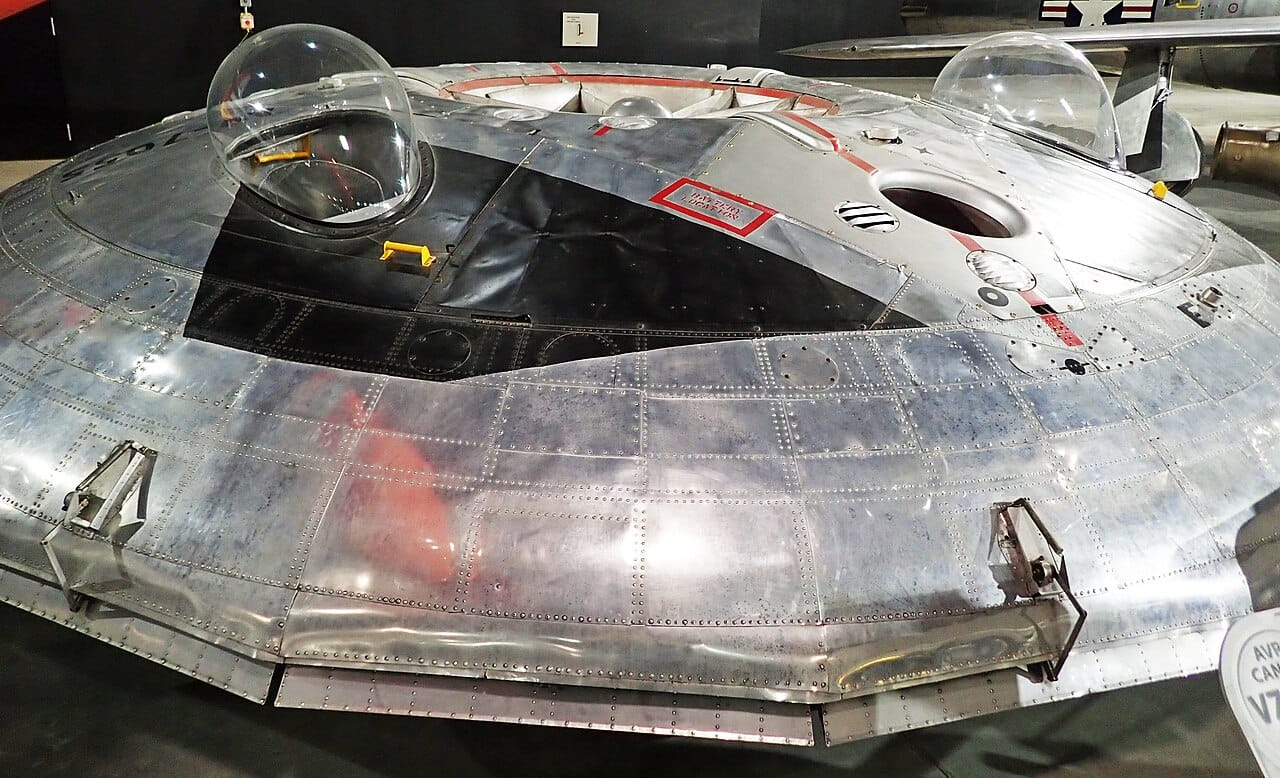
The Canadian government dropped funding in 1953 when the budget got embarrassing. Avro shopped the design to the U.S. Army (who wanted a "Subsonic Reconnaissance/Strike Vehicle" — essentially a flying jeep), and the U.S. Air Force (who imagined a Mach 3 disc-shaped interceptor that could hover indefinitely while waiting for Soviet bombers). The Army wanted a small, simple flying jeep. The Air Force wanted a supersonic miracle. Avro promised both, in the same airframe.
What Actually Happened in the Hover Tests
The Avrocar flew — and "flew" is doing some heavy lifting in that sentence — for the first time on 29 September 1959, initially tethered to the ground, at Avro Canada's facility in Malton, Ontario. The first completely free flight followed on 12 November 1959. Both were powered by three Continental J69 turbojets producing about 1,000 lbs of thrust each, exhausting into a 1.5-metre diameter central turborotor that the engineers cheerfully called "the centrifuge."
The Avrocar lifted. The Avrocar moved forward. The Avrocar got about three feet off the ground.
And then it started doing something the Avro engineers had not anticipated. The cushion of high-pressure air the Coandă effect was supposed to provide began oscillating violently. The aircraft would pitch nose-down, recover, then pitch nose-up, then roll, then pitch again. The engineers named the phenomenon "hubcapping" — the disc was behaving like a coin dropped on a table, wobbling unpredictably as it tried to settle.
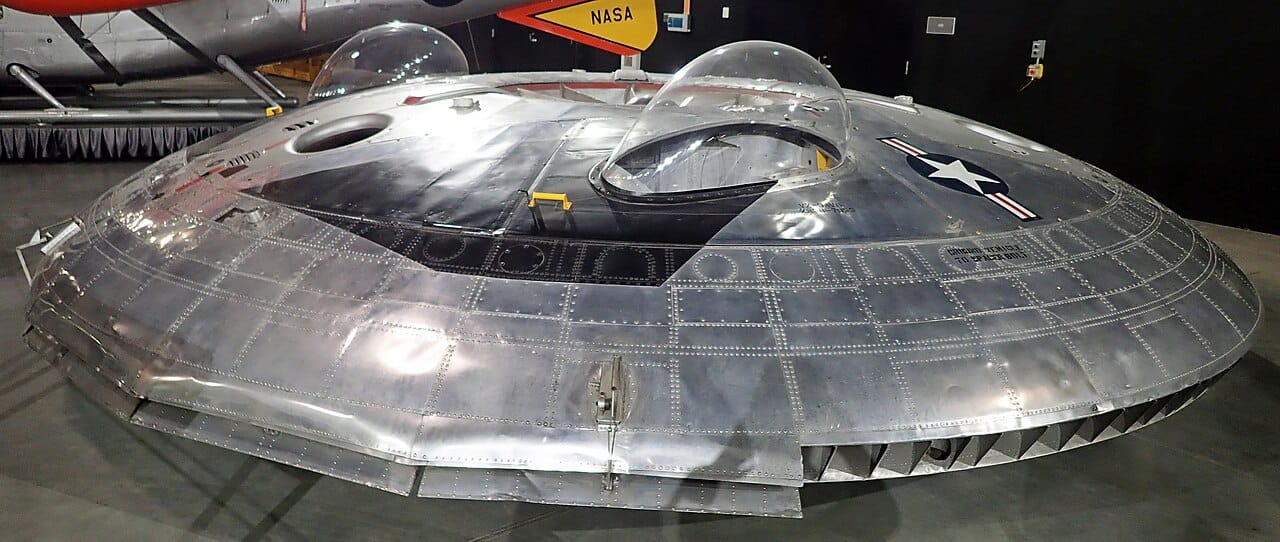
The Avrocar would not stop oscillating once it left the ground cushion. As soon as the aircraft tried to translate forward, the air under the disc collapsed asymmetrically and a coupled pitch-and-roll instability developed that could not be damped out.
Why the Coandă Effect Stopped Working at Three Feet
The physics turned out to be unforgiving. The Coandă effect — exhaust gas following a curved surface — works beautifully in steady-state laboratory conditions and very poorly in dynamic free flight. The cushion of air under the Avrocar was stable as long as the aircraft hovered in still air over a smooth, level surface. The moment it tried to move forward, the airflow over the leading edge separated, the air pressure under the front of the disc dropped, the disc pitched nose-down, the airflow re-attached, the pressure spiked, the disc pitched up, and you had hubcapping.
Avro tried fences, baffles, asymmetric exhaust geometry, modifications to the central rotor. Nothing worked. By 1961 the U.S. Army Transportation Corps had concluded that no amount of additional engineering would produce a stable hovering vehicle on the Coandă principle. The Air Force had already lost interest when it became obvious that Mach 3 was a fantasy. In December 1961 the programme was cancelled.
Why It Took 40 Years to Declassify
Here is the strangest part of the whole story. The Avrocar programme remained classified — at various levels — until 2001. For four decades the only public information was that a flying-saucer-shaped aircraft had been built, tested, and abandoned. Photographs were carefully controlled. The technical reports were locked up. The flight test data was not released.
The result, predictably, was that the Avrocar became the canonical conspiracy theory. The Roswell flying saucer was, in this telling, an early Avrocar prototype. The men-in-black were Air Force investigators recovering the wreckage. UFO sightings around U.S. air bases in the 1950s and 1960s were all Avrocars, or Avrocar successors, that the Pentagon had quietly kept developing.
None of this was true. The Avrocar was exactly what the technical reports eventually showed it to be — a brilliant engineering idea that did not survive contact with reality. The reason for the long classification was straightforward bureaucratic embarrassment: the U.S. military had spent $10 million on a saucer that hovered three feet off the ground at jogging pace.
Where the Saucer Is Today
The two prototypes survive. Prototype number 1 is at the National Museum of the U.S. Air Force in Dayton. Prototype number 2 is at the U.S. Army Transportation Museum at Fort Eustis, Virginia. Both are intact, restored, and look exactly like the science-fiction flying saucers of the era — because that is precisely what they are.
The Avrocar is a useful reminder that the gap between what engineers can sketch and what physics will permit is sometimes the entire programme. The Coandă effect was real. The lift was real. The instability was also real, and it killed the project. The Pentagon's only honest-to-goodness flying saucer became a museum exhibit. Which, all things considered, is exactly where most flying saucer designs probably belong.
Declassified USAF test footage of the Avro Canada VZ-9 Avrocar — the Pentagon\'s real flying saucer attempting hover and forward flight, 1960.
Sources: Wikipedia (Avro Canada VZ-9 Avrocar); National Museum of the U.S. Air Force Fact Sheet; U.S. Army Transportation Corps history; 19FortyFive.
Related Questions
Did the military ever build a flying saucer?
Yes. The Avro Canada VZ-9 Avrocar was a real, disc-shaped flying saucer built for the U.S. military around 1958–1961. Powered by three turbojets driving a central fan, it was meant to reach Mach 3 — but in reality it could only hover a few feet off the ground.
What was the Avrocar?
The Avrocar was a saucer-shaped VTOL aircraft developed by Avro Canada for the Pentagon. About 18 feet across, it used turbojet-driven fan thrust to take off vertically. Designers hoped for supersonic speed and high altitude, but the craft proved unstable and barely flew.
How well did the Avrocar fly?
Poorly. Although designed for Mach 3 and 100,000 feet, the Avrocar managed only about 35 mph and could rise just a few feet, wobbling on a cushion of its own exhaust. After two prototypes and roughly $10 million, the programme was cancelled in 1961.
Why did the Avrocar fail?
It couldn't stay stable once it left the ground cushion, and its turbojet fan couldn't deliver the speed or altitude promised. The flying-saucer shape simply didn't work as a high-performance aircraft. Other VTOL ideas of the era, like the Ryan X-13 Vertijet, fared rather better.
What was the Avrocar built for?
It was a U.S. military VTOL project, exploring whether a saucer could serve as a fast, vertical-takeoff aircraft or flying jeep. The era saw many such experiments, including the Army's one-man De Lackner HZ-1 Aerocycle.
Related Posts
The Flying Pancake: The Flat Disc That Actually Flew
0 Comments