
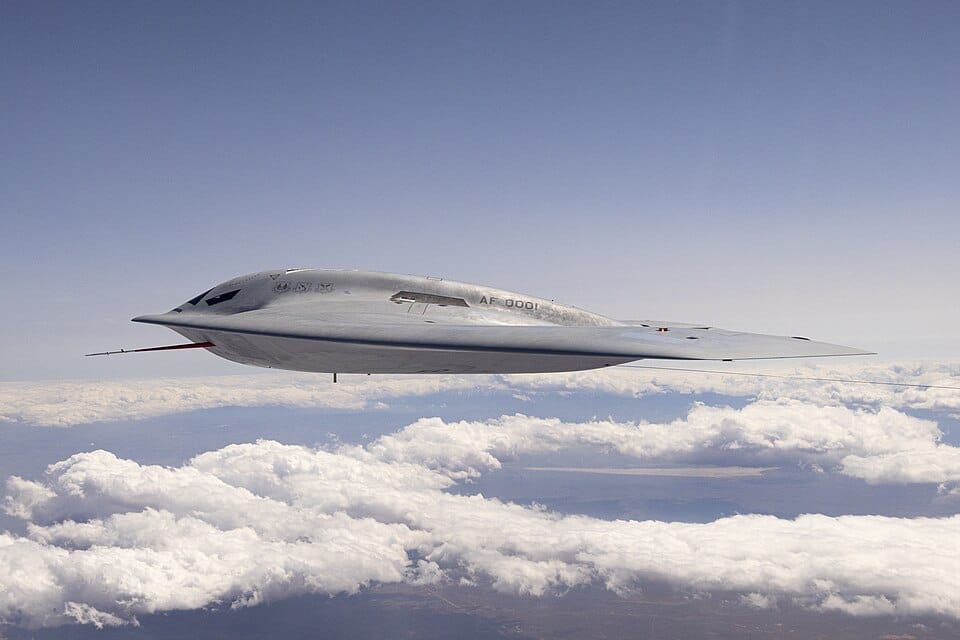
Aircraft Northrop Grumman B-21 Raider
Type Long-range stealth strategic bomber
First Flight November 10, 2023
Test Aircraft Flying Two (with two additional deliveries planned for 2026)
Production Site Air Force Plant 42, Palmdale, California
Estimated Unit Cost ~$692 million (2022 dollars)
Replaces B-2 Spirit (partially), B-1B Lancer (fully)
Planned Fleet At least 100 aircraft
First Operational Base Ellsworth AFB, South Dakota

Two stealth bombers are flying over the Mojave Desert right now, and almost nobody is talking about it. The B-21 Raider — the most expensive and secretive aircraft programme since the B-2 Spirit — has quietly advanced into a steady rhythm of flight testing, with two more airframes scheduled for delivery this year.
Northrop Grumman built these test aircraft to full production standards. That’s a deliberate choice. Unlike most prototype programmes where test airframes are hand-built one-offs that need extensive rework before they resemble the final product, the B-21 test jets are essentially the same machines that will eventually carry nuclear weapons into contested airspace. What they learn in testing translates directly to the operational fleet.
The programme is on schedule and on budget — two words that almost never appear together in defence procurement. In a world where the F-35 programme became synonymous with cost overruns and the B-2 shrank from 132 aircraft to 21 because of spiralling prices, the B-21’s discipline is itself newsworthy.
What We Know — and What We Don’t
The Raider is, by design, a black hole of information. Northrop Grumman and the Air Force have revealed remarkably little about its capabilities. The flying-wing shape is visible in released imagery — clearly evolved from the B-2’s iconic planform but with a cleaner, more refined profile. The inlet design is different. The trailing edge is different. The details that would tell an adversary exactly how stealthy this aircraft is remain classified.
What the Air Force has confirmed: the B-21 is designed to penetrate the most advanced integrated air defence systems on the planet. It will carry both conventional and nuclear weapons. It can operate with or without a crew — the airframe is optionally manned, a first for any bomber. And it incorporates an open-systems architecture that allows rapid software and hardware upgrades without the kind of costly structural redesigns that plagued earlier stealth platforms.
The open architecture is perhaps the most significant long-term feature. It means the B-21 delivered in 2027 and the B-21 flying in 2057 can be fundamentally different aircraft in terms of capability — new sensors, new weapons, new electronic warfare suites — all integrated without redesigning the airframe. The Air Force learned this lesson the hard way with the B-2, which required enormously expensive modifications for every new capability.

Why the World Needs to Pay Attention
The B-21 exists because of China. Specifically, because China’s integrated air defence network — layered with advanced SAMs like the HQ-9, over-the-horizon radars, and increasingly capable fighter aircraft — has made the Pacific a far more dangerous place for American strike aircraft. The B-1B Lancer, despite its impressive payload, cannot survive in these environments. Even the B-2 Spirit, revolutionary in 1989, faces growing risks against modern detection systems.
The Raider is designed to fly where nothing else can. Deep into defended airspace, at long range, with a weapons bay full of precision munitions or nuclear gravity bombs. Its stealth isn’t just radar-cross-section reduction — it’s a holistic approach to signature management across radar, infrared, visual, and electromagnetic spectra. The goal is an aircraft that is functionally invisible to the best air defences 2040 can produce.
With at least 100 aircraft planned — and Ellsworth Air Force Base in South Dakota already being prepared as the first operational home — the B-21 represents the largest investment in offensive air power since the Cold War. The test programme’s quiet, steady progress suggests that investment is paying off. No drama. No scandal. Just a stealth bomber, flying over the desert, getting ready to change the balance of power.
Sources: Air & Space Forces Magazine, Northrop Grumman, U.S. Air Force Global Strike Command

 English
0 Comments