
| Quick Facts | |
|---|---|
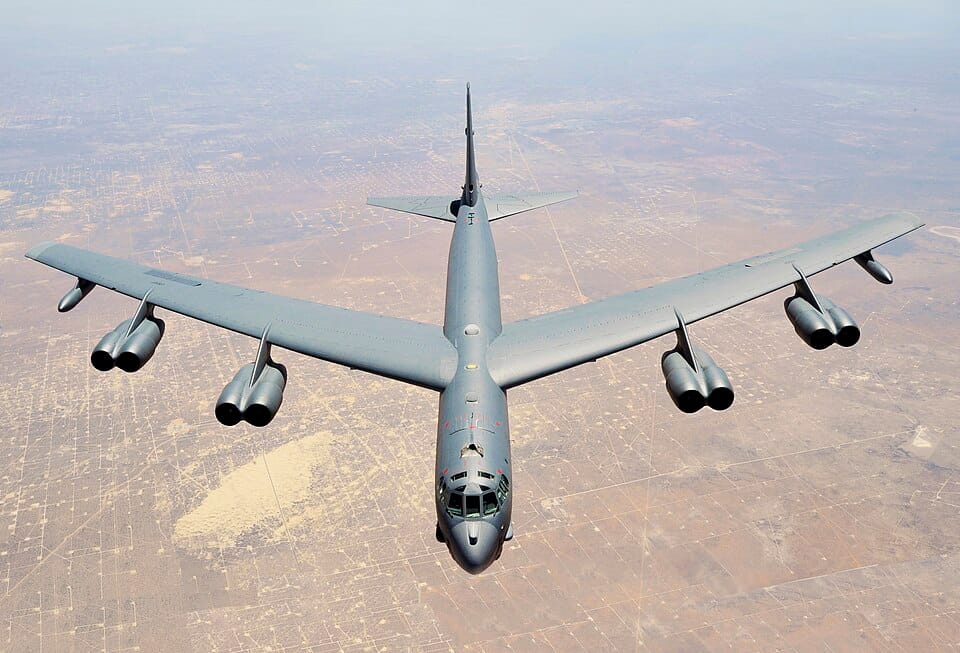
| Aircraft | Boeing B-52H Stratofortress |
| Deployment Base | RAF Fairford, England (8 B-52s and 15 B-1s forward-deployed) |
| Primary Weapon | GBU-31 JDAM (2,000-lb GPS-guided bomb, ~$80,000 each) |
| Payload Capacity | Up to 20 x 2,000-lb JDAMs or 30 x 1,000-lb JDAMs per sortie |
| Previous Weapons | AGM-158 JASSM cruise missiles ($3.5 million each) and Tomahawk cruise missiles |
| Significance | First B-52 overland bombing missions over Iran — signals air superiority achieved |
| Operation | Epic Fury (Week 5) |

Five weeks ago, B-52s launched cruise missiles at Iran from hundreds of miles away, staying well outside the reach of Tehran’s S-300s and Bavar-373s. Now they’re flying directly overhead, bomb bays packed with 20 two-thousand-pound JDAMs, dropping gravity bombs on whatever’s left. The shift tells you everything about how the air war is going.
General Dan Caine confirmed the change in posture: the US has achieved enough air superiority that it is now comfortable sending its most iconic — and most vulnerable — bomber directly over Iranian territory. The B-52H, for all its legend, is a 70-year-old subsonic aircraft with the radar cross-section of a small office building. You don’t fly it over a country that can still shoot back.
The fact that BUFFs are now doing exactly that means Iran’s integrated air defence network — once one of the most formidable in the Middle East — has been systematically dismantled.
From Stand-Off to Overhead
In the first weeks of Operation Epic Fury, B-52s played a cautious game. They carried AGM-158 JASSM cruise missiles — stealthy, long-range weapons that let the bomber launch from outside the threat envelope. Each JASSM costs about $3.5 million. Tomahawks, fired from ships and submarines, run roughly the same. At the tempo the US has been striking, those costs add up fast.
JDAMs cost around $80,000 apiece. A single B-52 loaded with 20 GBU-31s carries roughly $1.6 million worth of ordnance — less than the price of a single cruise missile. And unlike a cruise missile, which is one shot, the bomber can loiter over the battlefield for hours, hitting multiple targets in a single sortie.
Defence analyst Kelly Grieco put it simply: after a month, the US has reached a sufficient degree of air superiority that the economics of the air war have fundamentally changed. Why spend $3.5 million per target when $80,000 will do?

RAF Fairford: The Bomber Highway
The missions originate from RAF Fairford in southwestern England — the US Air Force’s preferred bomber forward operating location in Europe. As of early April, eight B-52Hs and fifteen B-1B Lancers are deployed there, making the quiet Gloucestershire airfield one of the most heavily armed bases on the continent.
The round trip from Fairford to Iran and back is roughly 6,000 miles — a long day’s work even for a bomber designed for intercontinental missions. But the B-52H was built for exactly this: sustained, heavy bombing at global range. It did it over Vietnam. It did it over Iraq. Now it’s doing it over Iran.
What JDAMs Over Iran Really Mean
The GBU-31 is a simple weapon: a 2,000-pound dumb bomb fitted with a GPS guidance kit that turns it into a precision munition accurate to within a few metres. It has a range of about 20 miles when dropped from altitude — far less than a cruise missile, but that’s the point. To drop JDAMs, you have to be overhead. And to be overhead, you have to own the sky.
Iran’s air defences were built around Russian-supplied S-300PMU-2 batteries and the indigenous Bavar-373. Five weeks of SEAD (Suppression of Enemy Air Defences) strikes, anti-radiation missiles, and electronic warfare have degraded those systems to the point where a subsonic, non-stealthy bomber can operate with acceptable risk. The GBU-72 Advanced 5K Penetrator — a 5,000-pound bunker-buster — has also been documented on B-52 loadouts, suggesting hardened underground targets are now on the menu.

The BUFF Endures
The B-52 first flew in 1952. It was designed to drop nuclear bombs on the Soviet Union. Seventy-four years later, it’s dropping GPS-guided conventional munitions on Iran from a base in rural England. No other weapons system in history has remained in frontline combat service this long. None is likely to again.
When a B-52 flies directly over hostile territory loaded with JDAMs, it’s making a statement that goes beyond the tactical. It says: we have broken your defences so thoroughly that we can send our oldest, slowest, most visible bomber overhead, and you cannot touch it. For Iran’s military leadership, watching a BUFF circle at 30,000 feet with impunity is the clearest possible signal of how this air war has gone.
Sources: Air & Space Forces Magazine, Fox News, Airforce Technology, 19FortyFive


 English
0 Comments