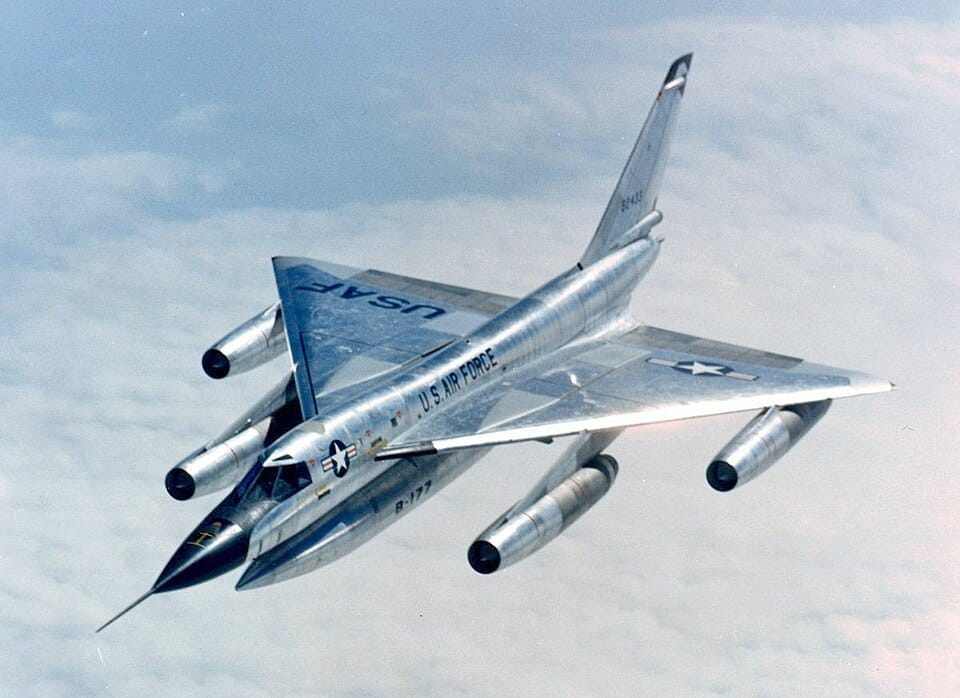
The Convair B-58 Hustler was the first operational supersonic bomber. It could outrun interceptors, deliver nuclear weapons at Mach 2, and looked like it was going fast standing still. It also killed more of its own crew than any bomber in USAF history relative to fleet size, cost a fortune to operate, and was retired after just ten years. The Hustler was a magnificent dead end.
✈ Quick Facts
- Role: Supersonic nuclear bomber
- First flight: November 11, 1956
- Max speed: Mach 2.0 (1,319 mph / 2,124 km/h)
- Crew: 3 (pilot, navigator/bombardier, defense systems operator)
- Engines: 4x General Electric J79-GE-5B turbojets (15,600 lbf each with afterburner)
- Built: 116 aircraft
- Accident rate: 26 aircraft lost in accidents (22.4% of fleet)
- Service: 1960–1970 (SAC)
Designed for the Nuclear Sprint
The B-58 was born from a simple Cold War premise: fly so fast and so high that Soviet interceptors and surface-to-air missiles cannot catch you. Convair designed the aircraft around four General Electric J79 engines — the same powerplant that would make the F-104 Starfighter and F-4 Phantom famous — mounted in pods beneath a thin, elegant delta wing.
The result was the most aerodynamically refined bomber ever built. The B-58’s area-ruled fuselage (the “Coke bottle” shape that minimizes transonic drag) was revolutionary for a large aircraft. It carried its nuclear weapon and most of its fuel in a massive external pod slung under the belly — the MB-1C pod — which could be dropped over the target, allowing the bomber to sprint home lighter and faster.
At Mach 2 and 40,000 feet, the Hustler was untouchable by the interceptors of its era. The problem was everything else.
Beautiful and Lethal — to Its Own Crews
The B-58 had the worst safety record of any bomber in Strategic Air Command history. Of 116 aircraft built, 26 were lost in accidents — a 22.4 percent attrition rate, all in peacetime. Thirty-six crew members were killed.
The aircraft was unforgiving. Its delta wing generated enormous lift at high angles of attack but stalled viciously with almost no warning. The landing speed was extremely high — around 180 knots — and the aircraft had to maintain a precise nose-high attitude on approach. Any deviation was potentially fatal. Engine failures at supersonic speed created asymmetric thrust that could snap the aircraft into an unrecoverable roll before the pilot could react.
The escape capsule system — individual pods that enclosed each crew member for high-speed ejection — was complex and unreliable. Several crews died when the capsules failed to separate or the parachutes did not deploy.
“The B-58 was a pilot’s airplane in the sense that it demanded everything from the pilot, every second. You couldn’t relax for a moment. If you did, it would kill you.”
— Col. James K. Johnson, former B-58 pilot, 43rd Bomb Wing
Speed Records and Trophy Runs
Despite its dangers, the Hustler was spectacularly fast. It set 19 world speed and altitude records, including a Los Angeles-to-New York dash in 2 hours and 58 seconds (averaging over 1,044 mph) that won the 1962 Bendix Trophy. A Tokyo-to-London speed run in 1963 covered 8,028 miles in 8 hours 35 minutes with five aerial refuelings — an average speed of 938 mph.
These record flights were not stunts. They demonstrated the B-58’s ability to cover intercontinental distances at supersonic speed — exactly the capability SAC needed for nuclear strike missions against the Soviet Union.
The B-58 also won the Bleriot Trophy, the Thompson Trophy, and the Mackay Trophy. No bomber before or since has accumulated as many speed records in so short a service life.
The Problem With Speed Alone
The B-58’s fatal flaw was not its performance but its concept. By the early 1960s, the Soviet Union was deploying surface-to-air missiles — particularly the S-75 Dvina (SA-2 Guideline) — that could reach the Hustler’s operating altitude. The shootdown of Gary Powers’ U-2 in 1960 proved that high altitude was no longer a sanctuary.
The Air Force’s response was to switch to low-level penetration: flying under radar coverage at treetop height. But the B-58 was designed for high-altitude supersonic flight. At low altitude, its delta wing generated punishing turbulence loads, structural fatigue accumulated rapidly, fuel consumption skyrocketed, and the aircraft’s range — already limited — became unacceptable.
The B-52, which the B-58 was supposed to supplement, adapted to low-level missions far more effectively. The big, flexible B-52 airframe could absorb the turbulence and carry enough fuel to complete long-range low-level profiles. The elegant Hustler could not.
Ten Years and Done
The B-58 entered service with SAC’s 43rd Bomb Wing at Carswell AFB, Texas in 1960. By 1970 it was gone — retired to the boneyard at Davis-Monthan AFB after just a decade of service. The fleet was replaced by FB-111As, which could fly low-level missions that the Hustler could not.
The retirement was driven by economics as much as tactics. The B-58 required 170 maintenance man-hours per flight hour — more than three times the rate for the B-52. Its specialized infrastructure, tanker support requirements, and small crew (three men per aircraft compared to the B-52’s six) meant fewer redundancies and higher risk per mission.
A Magnificent Dead End
The B-58 Hustler represents a road not taken. It proved that supersonic strategic bombing was technically possible — and then proved it was not strategically viable. The future belonged to low-level penetration (the B-1B), stealth (the B-2), and cruise missiles (the B-52 carrying ALCMs), not to raw speed.
But as a pure piece of aviation engineering, the Hustler has few equals. It was the fastest bomber ever to enter operational service, the most beautiful, and arguably the most demanding aircraft ever trusted to line crews and combat-ready pilots in the nuclear alert force. It deserved a longer life. The Cold War gave it what it gave it.
Sources: “Convair B-58 Hustler” by Jay Miller, Air Force Historical Research Agency, National Museum of the USAF, SAC historical records

 English
0 Comments