On 6 April 1965, Chancellor James Callaghan stood up in Parliament and — in the middle of his Budget speech — cancelled the most advanced military aircraft Britain had ever built. The BAC TSR-2 — Tactical Strike and Reconnaissance, Mark 2 — died not because it failed, but because it succeeded too expensively. The prototype that had flown faster, lower, and more precisely than anything else in the Western arsenal was scrapped. Most airframes were cut up with blowtorches. The jigs were destroyed. It was not merely a cancellation. It was an execution.
The TSR-2 was designed to do one thing that no other aircraft in the world could do in 1964: penetrate Soviet air defences at low level, at supersonic speed, in any weather, and deliver a nuclear weapon with pinpoint accuracy. Its terrain-following radar would have allowed it to fly at 200 feet above the ground at Mach 1.1, hugging the contours of the earth beneath enemy radar coverage. Nothing the Soviets had could have stopped it.
Quick Facts
First flight: 27 September 1964, Boscombe Down
Cancelled: 6 April 1965 (after only 24 test flights)
Max speed: Mach 2.35 at altitude, Mach 1.1 at sea level
Range: ~1,850 km on internal fuel
Replacement: F-111K (also cancelled), then Buccaneer and Tornado
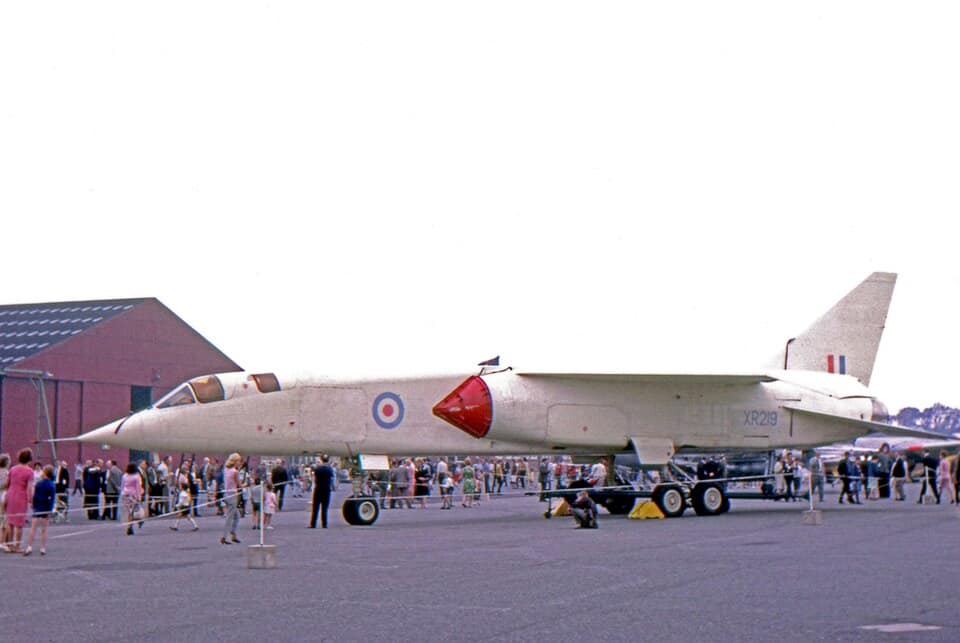
Survivors: 2 complete airframes — XR220 at the RAF Museum Cosford, XR222 at IWM Duxford
The Machine
The TSR-2 was ahead of its time by at least a decade. Its forward-looking radar could map terrain and follow ground contours automatically, allowing the pilot to fly at extreme low level in complete darkness or cloud. Its navigation and attack system — integrated, digital, and automated — was more sophisticated than anything the Americans had in service. The Olympus 320 engines (ancestors of the same family that later powered Concorde) gave it a top speed of Mach 2.35 at altitude and sustained supersonic dash at sea level.
The TSR-2 during flight testing — only one prototype flew before the programme was cancelled. Wikimedia Commons
Chief test pilot Roland Beamont, who made the first flight and led the early test programme — Jimmy Dell flew 12 of the 24 sorties, including the last, described it as the finest aircraft he had ever flown. The handling was superb. The systems worked. The performance exceeded specifications. In every measurable way, the TSR-2 was a success.
The Politics
What killed the TSR-2 was not engineering. It was cost, politics, and inter-service rivalry. The programme’s budget had spiralled — a familiar story for any advanced military project — and the incoming Labour government of Harold Wilson was looking for defence cuts. The Royal Navy wanted aircraft carriers (and the money the TSR-2 was consuming). The Treasury wanted savings. The Americans were offering the F-111, which they claimed could do the same job for less money.
The government cancelled the TSR-2 and ordered 50 F-111Ks from General Dynamics instead. In January 1968 it cancelled the F-111K order too — the costs had risen even faster than the TSR-2’s. Britain ended up with neither aircraft. The RAF eventually received the Blackburn Buccaneer (a capable but subsonic aircraft designed for a different role) and waited until 1982 for the Panavia Tornado to partially fill the gap the TSR-2 would have occupied.
The Destruction
What happened after the cancellation was worse than the cancellation itself. The government ordered the completed and partially completed airframes destroyed. Jigs and tooling were scrapped. Technical documentation was dispersed. The destruction was so thorough that conspiracy theories persist to this day about whether the American government pressured Britain to kill the programme to protect F-111 sales.
Two complete airframes survive: XR222 at the Imperial War Museum Duxford, and XR220 at the RAF Museum Cosford. They are among the most visited exhibits in British aviation museums — monuments to a capability that was proven, funded, and then deliberately destroyed.
The BAC TSR-2 flew 24 times. It proved everything it needed to prove. And then the politicians broke it into pieces. Sixty years later, the question still stings: what would British defence have looked like with a Mach 2 strike bomber in 1968?
Sources: RAF Museum, Imperial War Museum, BAE Systems Heritage, Wikipedia
Before AWACS, air warfare was a knife fight in a dark room. Pilots relied on their own radar, ground controllers with limited visibility, and radio calls that were often confused, late, or wrong. After AWACS, one side had the lights on and the other did not. The...
On May 1, 1960, CIA pilot Francis Gary Powers took off from Peshawar, Pakistan in a Lockheed U-2 spy plane. His mission: fly across the entire Soviet Union at 70,000 feet, photographing military installations, and land in Bodø, Norway. He never made it. A Soviet S-75...
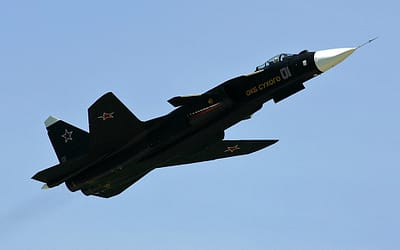
When the Sukhoi Su-47 Berkut rolled out in 1997, it looked like nothing else in the sky. Its wings swept forward instead of back — an aerodynamic concept that promised extraordinary agility, superior low-speed handling, and enhanced controllability at high angles of...

 English
0 Comments