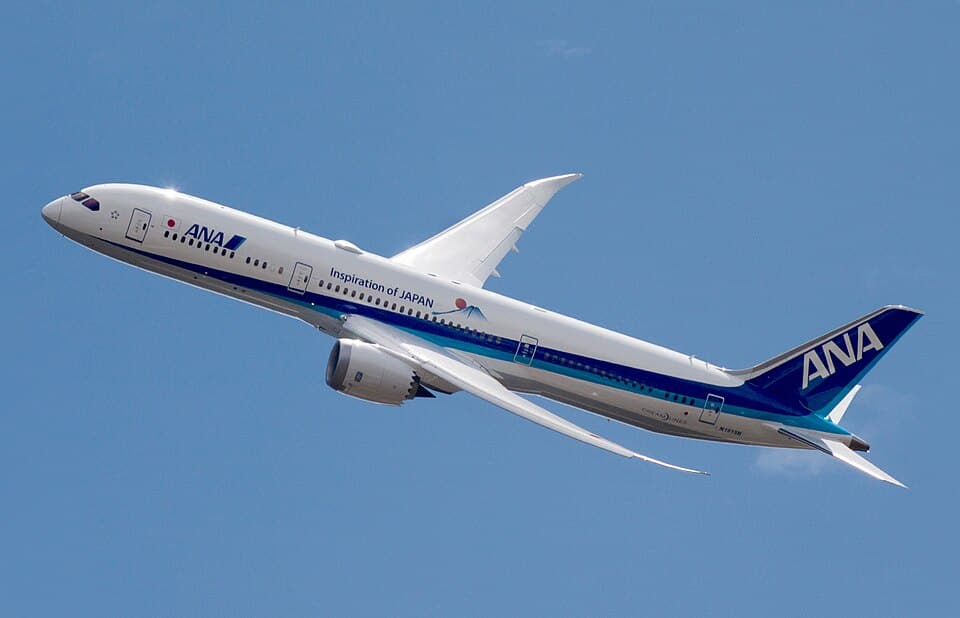
The Boeing 787 Dreamliner was supposed to revolutionize commercial aviation. Lighter composites, better fuel economy, higher cabin pressure, bigger windows — it was the future of air travel. Instead, it has become a case study in what happens when manufacturing ambition outruns manufacturing discipline. Battery fires, fuselage gaps, substandard titanium, improperly spaced fasteners, delivery halts, and now the first fatal crash in the type’s history. The 787 keeps breaking, and the question is no longer whether Boeing has a quality problem — it is whether Boeing can fix it.
✈ Quick Facts
- First flight: December 15, 2009
- Entry into service: October 26, 2011 (ANA)
- Delivered: ~1,100 aircraft (as of early 2026)
- Grounding (2013): Worldwide fleet grounded for 3 months — lithium-ion battery fires
- Delivery halts: Multiple halts between 2020–2023 for manufacturing quality issues
- FAA inspection orders: 145 aircraft ordered inspected (March 2025) for faulty components
- First fatal crash: Air India Flight A717, 2025 (Ahmedabad)
- Current production: Stabilizing at 8 per month (Q1 2026)
A Revolutionary Aircraft With a Troubled Birth
The 787 was genuinely revolutionary. It was the first large commercial aircraft with a fuselage made primarily from carbon-fiber-reinforced polymer composites rather than aluminum. This made it roughly 20 percent lighter than a comparable aluminum aircraft, translating directly into fuel savings that airlines estimated at 20–25 percent per seat compared to the 767 it replaced.
The composite fuselage also allowed a higher cabin pressure (equivalent to 6,000 feet altitude versus 8,000 feet in most aluminum aircraft), larger windows, and higher humidity — measurably improving passenger comfort. The 787 was a better airplane to fly in, and a more efficient airplane to operate.
But Boeing’s decision to outsource the vast majority of the 787’s design and manufacturing to a global network of suppliers — a radical departure from Boeing’s traditional approach — planted the seeds of every quality problem that followed.
The Battery Crisis: 2013
The first major crisis came just 15 months after the 787 entered service. In January 2013, a Japan Airlines 787 caught fire at Boston Logan Airport after a lithium-ion battery in the auxiliary power unit overheated and went into thermal runaway. Eight days later, an All Nippon Airways 787 made an emergency landing in Japan after smoke was detected from the same battery system.
The FAA grounded the entire worldwide 787 fleet — the first grounding of an entire aircraft type since the DC-10 in 1979. The fleet remained grounded for three months while Boeing redesigned the battery containment system.
The root cause was never fully resolved. Boeing’s fix — a stainless steel containment box designed to vent battery gases overboard if thermal runaway occurred — was approved by the FAA, but critics noted that it treated the symptom (containment) rather than the cause (why the batteries overheated in the first place).
The Manufacturing Nightmare: 2020–2023
The battery crisis was a design problem. What came next was worse: a systemic manufacturing quality breakdown.
In 2020, Boeing disclosed that some 787 fuselage sections had gaps at the joints where barrel sections were joined together. These gaps — fractions of an inch, but outside the engineering tolerances specified in the design — could potentially weaken the fuselage structure over time, particularly around the areas subjected to repeated pressurization cycles.
The FAA halted 787 deliveries. Boeing investigated and found more problems: improperly shimmed joints, incorrectly spaced fasteners, and fuselage sections that did not meet dimensional specifications. The delivery halt lasted, with interruptions, from 2021 through much of 2023.
The supply chain was at the center of the problem. Boeing had outsourced fuselage barrel production to facilities in Italy (Leonardo/Alenia), Japan (Kawasaki, Mitsubishi, Fuji), and South Carolina (Boeing’s own non-union factory in North Charleston). Quality control across this distributed manufacturing network proved far more difficult than Boeing had anticipated.
The Titanium Scandal
In 2024, Boeing disclosed that some 787s (and 737s) contained titanium components sourced from a supplier that had falsified material certifications. The titanium parts — used in structural applications — did not meet the specifications that Boeing’s engineering required.
The scope of the problem was significant. Boeing and the FAA launched inspections to identify affected aircraft and determine whether the substandard titanium posed a safety risk. The investigation revealed that the fraudulent certifications had passed through multiple layers of the supply chain without detection — raising fundamental questions about Boeing’s quality assurance processes.
The First Fatal Crash
In 2025, Air India Flight A717 — a Boeing 787 — crashed shortly after takeoff from Ahmedabad, killing all aboard. It was the first hull loss and the first fatal accident involving the Dreamliner type.
The investigation revealed that both engine fuel control switches were moved to the “cutoff” position during flight — an operational issue rather than a structural or manufacturing defect. The crash was not directly linked to the 787’s known quality problems, but it ended the aircraft’s record as the only modern widebody type with zero fatalities, and it added to the cloud hanging over the program.
March 2025: Another Inspection Order
In March 2025, the FAA ordered inspections of 145 operational 787s to identify and replace faulty components related to a new airworthiness directive. The specifics pointed once again to manufacturing quality — parts that had been installed but did not meet specifications.
This was not a one-time event. It was part of a pattern of post-delivery discoveries that has defined the 787 program: aircraft delivered to airlines, put into service, and then found to contain components or assemblies that do not meet the engineering requirements.
Where Things Stand in 2026
As of early 2026, Boeing was stabilizing 787 production at eight aircraft per month — well below the pre-crisis target of 14 per month. The lower rate reflects both the ongoing quality remediation effort and the reality that Boeing is still working through a backlog of undelivered aircraft that require rework before they can be handed over to airlines.
Boeing’s new CEO, Kelly Ortberg, has made quality the stated priority. But the fundamental challenge remains: the 787’s distributed manufacturing model creates quality control challenges that a more centralized production approach would not. Every fuselage section that arrives from an overseas supplier must be inspected, verified, and potentially reworked before assembly — a process that is inherently slower and more expensive than building in-house.
The 787 Dreamliner is still a remarkable aircraft. Airlines love its economics. Passengers love its cabin. But the program has become a cautionary tale about what happens when manufacturing complexity outpaces quality assurance — and the cost of getting it wrong.
Sources: FAA airworthiness directives, Boeing SEC filings (10-Q FY2026), Aero News Journal, Aviation Week, NTSB preliminary reports


 English
0 Comments