
| Quick Facts | |
|---|---|
| Operation | Epic Fury (ongoing since Feb 28, 2026) |
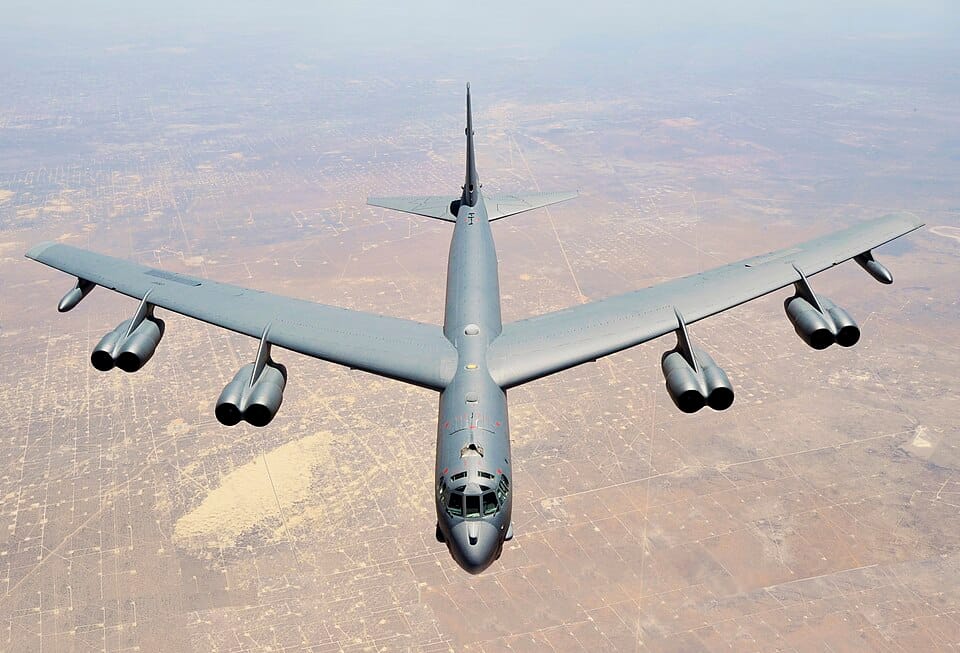
| Aircraft | B-52H Stratofortress |
| Weapons | GBU-31 JDAM (2,000 lb), GBU-38 JDAM (500 lb) |
| Capacity | Up to 20 × 2,000 lb JDAMs or 30 × 1,000 lb JDAMs |
| Significance | First overland B-52 bombing runs inside Iran |
| Targets Hit (total) | 10,000+ since campaign began |

Four weeks ago, no American bomber could fly over Iran. The country’s layered air defence network — Russian-supplied S-300PMU-2s, indigenous Bavar-373 batteries, and dozens of shorter-range systems — made overland bombing runs a suicide mission. That changed this week.
B-52H Stratofortresses, the oldest bombers in America’s arsenal, have been spotted carrying GPS-guided JDAMs — gravity bombs that require the aircraft to fly directly over its target. That means the BUFFs aren’t standing off at distance anymore. They’re flying inside Iranian airspace, at altitude, and dropping dumb iron made smart by satellite guidance directly onto what’s left of Iran’s military infrastructure.
It’s a signal no analyst expected to see this early in the campaign.
From Standoff to Overland
When Operation Epic Fury launched on February 28, the air campaign relied almost exclusively on standoff weapons — cruise missiles fired from hundreds of miles away. The opening salvos featured Tomahawk missiles from naval vessels and JASSM-ERs released from B-1B Lancers and B-52Hs well outside Iranian engagement zones. Over 850 cruise missiles were fired in the first month alone, prompting serious questions about whether U.S. inventories could sustain the tempo.
But the math has shifted. Weeks of sustained strikes against Iran’s integrated air defence system have systematically degraded its ability to detect, track, and engage targets at altitude. Radar sites have been hit. SAM batteries have been destroyed or forced to relocate. Command-and-control nodes linking the network together have gone silent.
The result: enough of the defensive umbrella has collapsed that planners now consider it safe to send the big bombers directly overhead.
Why JDAMs Change the Equation
A JDAM isn’t a high-tech weapon. It’s a kit — a GPS tail assembly bolted onto a conventional unguided bomb — that turns a $3,000 piece of iron into a precision munition for about $25,000. Compared to a $1.5 million Tomahawk or a $1.1 million JASSM, it’s practically free.
The trade-off is range. A JDAM has no motor. It falls. The aircraft has to be within glide distance of the target — typically 15 to 25 miles — and at altitude. That means the bomber must enter contested airspace. For planners to authorize JDAM runs, they have to be confident that the threat environment along the flight path has been sufficiently suppressed.

The fact that B-52s are now carrying JDAMs over Iran tells us two things: Iranian air defences in those corridors are functionally neutralized, and the U.S. is pivoting to a cheaper, higher-volume strike model that can sustain the campaign for months.
The BUFF Can Carry a Staggering Load
A single B-52H can carry up to 20 GBU-31 JDAMs — each a 2,000-pound weapon — split between internal bomb bays and external pylons. In a lighter configuration, it can haul 30 of the 1,000-pound GBU-38 variant. One aircraft, one sortie, 30 precision-guided weapons on target.
Compare that to a fighter: an F-15E Strike Eagle typically carries two to four JDAMs per mission. A single B-52 sortie replaces eight to fifteen fighter sorties in raw munitions delivered. For a campaign grinding through its fifth week, that efficiency is everything.
What Happens Next
The shift to overland JDAM operations signals that Operation Epic Fury is entering a new phase. The opening weeks focused on strategic targets — air defences, ballistic missile sites, command bunkers. With the defensive umbrella degraded, the target list is expanding to include dynamic, mobile targets: transporter-erector launchers, military convoys, field headquarters that move every 24 hours.
JDAMs are ideal for this work. They’re precise enough to hit a building, cheap enough to use in volume, and the B-52 can loiter at altitude for hours waiting for target coordinates to arrive from surveillance assets. It’s a shift from the precision-at-distance doctrine of the first month to a volume-over-target model that defined Allied air power in the 2003 Iraq campaign.

The B-52 first flew in 1952. It has outlived every aircraft designed to replace it. And now, 74 years later, it’s flying combat over Iran — dropping bombs it was never designed to carry, guided by satellites that didn’t exist when it was built. Some machines refuse to become history.
Sources: Air & Space Forces Magazine, The War Zone, Army Recognition


 English
0 Comments