
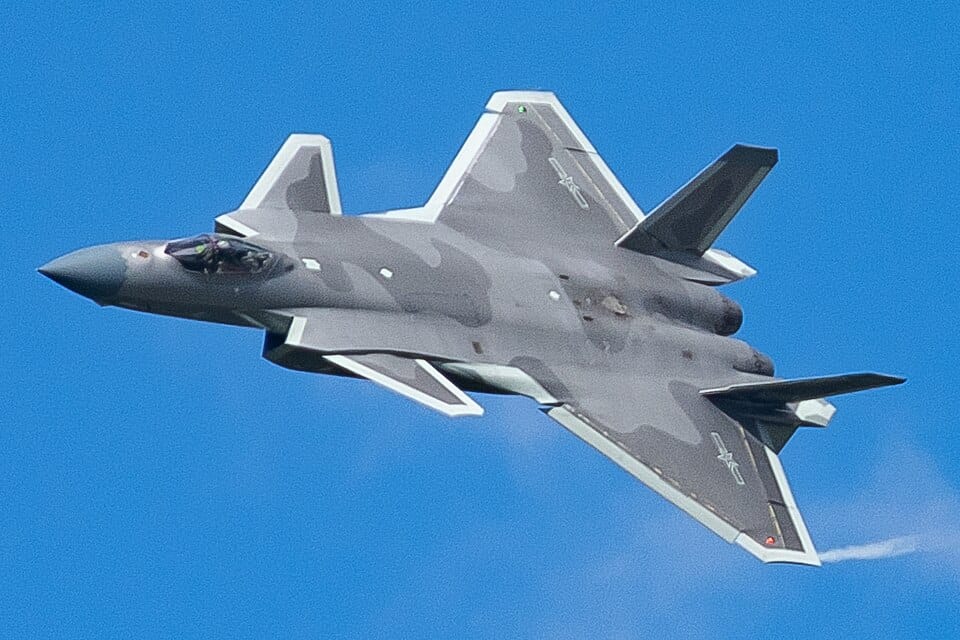
In January 2026, two sleek silhouettes pierced a Chinese sky in perfect formation. The J-35A, Shenyang Aircraft Corporation’s answer to the F-35, had taken to the air. What appeared on video footage was a signal: China’s stealth program had moved from theoretical to serial production. The geopolitical calculus of Asian airspace just shifted.
The J-35A is not a copycat design. It is a distinctly Chinese approach to fifth-generation aviation—twin-engine where the F-35 has one, carrier-capable from day one, built for speed and range over sensor fusion dominance. When the PLA Navy’s Fujian aircraft carrier enters service, the J-35 will be waiting.
The implications stretch from the Taiwan Strait to the South China Sea and far beyond.
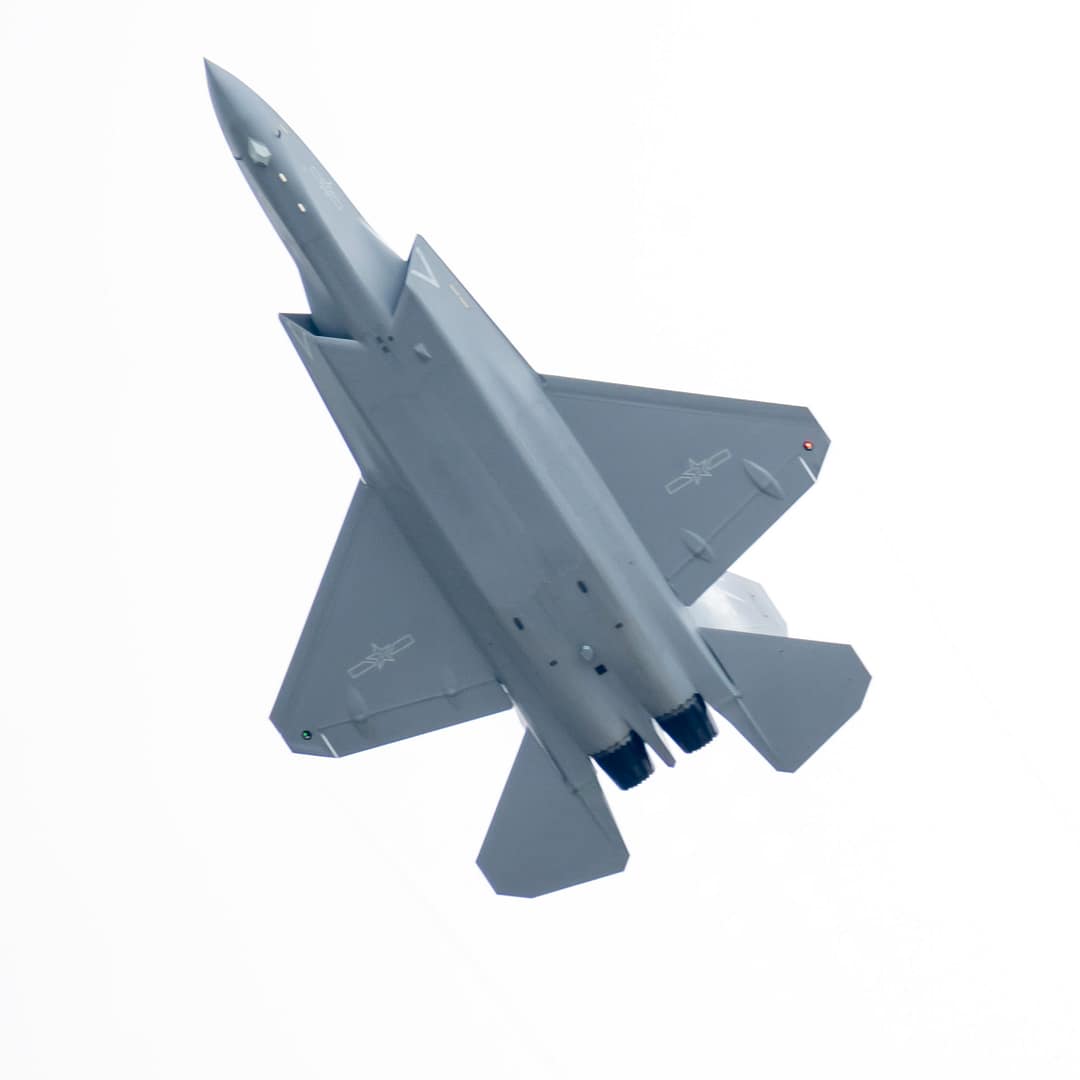
The Architecture of a Stealth Fighter
The J-35A is a single-seat, twin-engine, all-weather multirole combat aircraft with an estimated length of 17.3 meters and a wingspan of 11.5 meters. Its design philosophy reflects Chinese doctrine: speed, range, and carrier operations matter more than extreme sensor fusion capabilities. The airframe incorporates radar-absorbent materials, diverterless supersonic inlets (DSIs), and careful shaping to reduce radar cross-section.
The twin-engine layout is critical. It gives the J-35A redundancy and raw thrust that the single-engine F-35 cannot match. Powered by the WS-21 turbofan engines (or improved WS-13 variants), the J-35A can sustain speeds around Mach 1.8—faster than the F-35’s Mach 1.6 ceiling. Some estimates suggest peak speeds could reach Mach 1.9-2.0 with next-generation powerplants.
Combat radius sits around 1,200 kilometers, extendable to 1,500 kilometers with in-flight refueling. This is substantially longer than the F-35A’s operational range, giving Chinese fighters the ability to project power across the greater Asia-Pacific region without external tanker support.
Made for the Carrier, Built for the Future
Here’s where the J-35 departs sharply from the F-35: carrier capability. The J-35 was designed for CATOBAR (Catapult-Assisted Takeoff But Arrested Recovery) operations from day one. In September 2025, the PLA Navy announced that the J-35 had been certified for launch from the Fujian, a Type 003 carrier equipped with China’s new electromagnetic aircraft launch system (EMALS).
The J-35 became the world’s first fifth-generation stealth fighter ever launched from an aircraft carrier using an electromagnetic catapult. The American F-35C can operate from carriers, but it was designed for the Navy afterward. The J-35 was built for carrier operations from its inception. The naval variant features reinforced landing gear, folding wings for compact hangar storage, and arrestor hooks rated for the violent deceleration of a trapped landing.
This is a masterstroke of design philosophy. Where the U.S. Navy built the F-35 to fly from carriers, the Chinese Navy designed the J-35 as a carrier platform first. The difference is not subtle. It suggests a different operational vision for naval air power in the Pacific.
The Comparison That Matters
On paper, the aircraft are cousins in stealth, separated by philosophy. The F-35 is the sensor hub of modern warfare—a flying computer designed to gather information, share it across a networked battlespace, and enable other platforms to strike. Its optimization is for integrated air defense penetration and intelligence gathering.

The J-35A emphasizes acceleration, speed, and sustained supercruise capability. With its twin engines, it can accelerate faster to high altitude and sustain supersonic flight without afterburners. It can carry 6-8 tons of internal and external payload. The avionics suite includes an AESA radar and electro-optical targeting systems for sensor fusion, but the design prioritizes kinetic performance.
The F-35A achieves speeds up to Mach 1.6 with 9g combat limits, optimized for subsonic maneuverability. The J-35A is built for supersonic speed and range. It’s a different calculus for a different theater.
The Geopolitical Signal
The January 2026 flight of two factory-fresh J-35A aircraft in formation indicated something far more significant than a milestone: serial production has begun. The twin-aircraft formation suggests that China is moving beyond development and test flights. Manufacturing capability has ramped. Supply chains are functional. Multiple airframes are rolling off production lines.
China now operates two domestically developed fifth-generation fighters: the J-20, designed for air superiority, and the J-35, designed for multirole penetration and carrier operations. Together, they represent an enormous investment in stealth aviation capability. The U.S. has dominated fifth-generation fighter production for two decades. That monopoly is ending.
Export potential is enormous. Allied nations seeking fifth-generation fighters outside the Western orbit—Pakistan, Iran, possibly Russia itself—may turn to the J-35 as an alternative to American systems. The aircraft represents a Chinese vision of modern aerial warfare that doesn’t require buying into the F-35 ecosystem or accepting the political restrictions that come with American military technology.
The J-35A’s first flight in its air force variant signals the opening of a new chapter in Asian air power. China’s stealth program is no longer an aspiration. It is a reality, accelerating toward deployment, and reshaping the military balance across a region that matters more than any other on Earth.
Sources:Army Recognition: J-35A Production Test Flight, Interesting Engineering: J-35A vs F-35 Comparison

 English
0 Comments