
For years it existed only in grainy satellite photos and rumors on Chinese military forums. Then, in September 2025, China rolled it out at a Victory Day parade in Beijing. Now, for the first time, Japan has intercepted one in the wild — and the implications stretch far beyond a single flight.
On March 28, 2026, Japan Air Self-Defense Force fighters scrambled to meet a Chinese military aircraft flying over the East China Sea. When they pulled alongside, the pilots found themselves looking at something new: the Y-9FQ, China’s next-generation anti-submarine warfare aircraft. The Japanese Ministry of Defense released intercept imagery two days later.
It was not alone. Flying alongside was an older Y-8 variant — likely a KQ-200, the Y-9FQ’s predecessor. Two generations of Chinese sub-hunters, flying together, testing the waters that separate China from the first island chain.
What Makes the Y-9FQ Different
The Y-9FQ is built on the Shaanxi Y-9 transport airframe — a four-engine turboprop roughly comparable to the old American C-130. But where the transport carries cargo, the FQ variant carries a sophisticated sensor suite designed to find submarines hiding beneath the ocean’s surface.
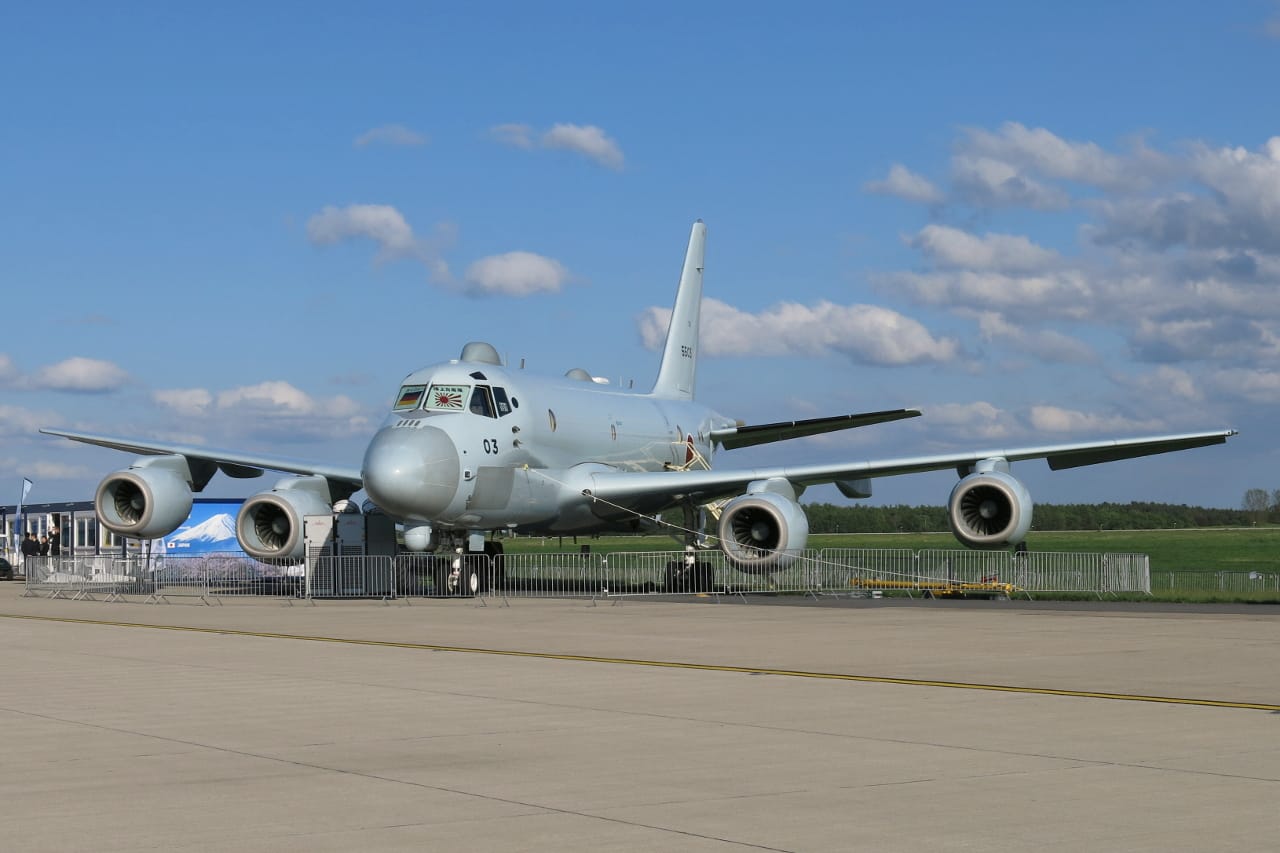
The most visible upgrade sits in the nose. The Y-9FQ features a completely redesigned forward section housing an Active Electronically Scanned Array radar — an AESA system capable of air-to-air, air-to-ground, and synthetic aperture radar modes. Two prominent air intakes behind the radome cool the powerful electronics. At the tail, a magnetic anomaly detector sting extends from the fuselage — the telltale signature of a dedicated sub-hunter.
“This represents a quantum leap for Chinese ASW capability,” said Collin Koh, a maritime security researcher at Singapore’s S. Rajaratnam School of International Studies. “They’ve gone from having virtually no credible fixed-wing ASW platform to fielding something that approaches Western standards in a single generation.”

Closing the ASW Gap
For decades, anti-submarine warfare was China’s most glaring weakness. The People’s Liberation Army Navy built an impressive surface fleet and a growing submarine force, but finding other nations’ submarines — particularly American ones — remained a critical blind spot. The Y-9FQ is designed to close that gap.
How does it compare to the best in the business? The U.S. Navy’s P-8 Poseidon is jet-powered, faster, flies higher, and carries a more mature sensor suite refined over years of global operations. The Y-9FQ, as a turboprop, trades speed for endurance — it can patrol for 10 or more hours, covering vast stretches of ocean at lower altitudes where submarine detection is most effective.
Against the aging P-3 Orion that many allied navies still fly, the comparison is more favorable to the Chinese aircraft. The Y-9FQ’s AESA radar represents a generational leap over the P-3’s original surface search radar. In the sensor game, at least, China is catching up fast.
A Busy Week Near Japan
The Y-9FQ intercept didn’t happen in isolation. On March 27, two Russian Tu-142 maritime patrol aircraft — Russia’s own long-range sub-hunters — conducted flights around Japan, tracing routes through the Pacific, the Sea of Okhotsk, and the Sea of Japan. A Russian surveillance ship, the Pribaltica, was spotted near the Tsugaru Strait. A Chinese Dongdiao-class intelligence ship, the Jinxing, sailed through the Tsushima Strait into the Sea of Japan.
The coordinated activity paints a picture of two navies probing Japan’s maritime approaches simultaneously. The JASDF and Japan Maritime Self-Defense Force tracked it all — P-3C Orions shadowed the Russian ship while fighters intercepted the aircraft. Japan published everything, a deliberate signal that it sees, it tracks, and it wants the world to know.
“Whoever controls the sea controls everything.”
— Themistocles, 5th century BC
The Y-9FQ’s first operational intercept marks a milestone. China now has a modern, purpose-built sub-hunter flying real-world missions over some of the most strategically sensitive waters on earth. The era of the ASW gap is closing — and the undersea balance of power in the Western Pacific just got a lot more complicated.
Sources: USNI News; Flight Global; Global Security
 English
0 Comments