
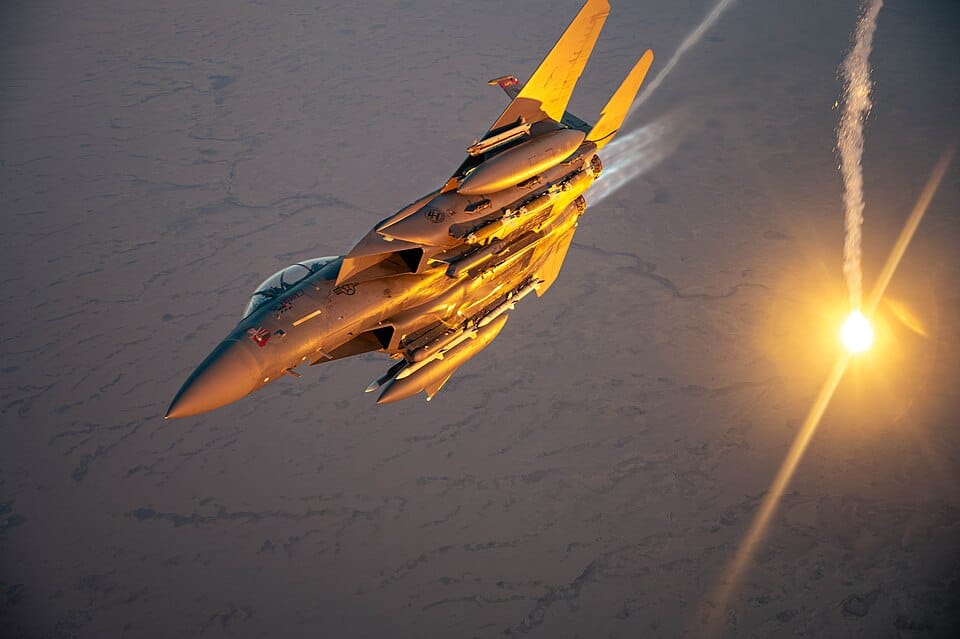
Related: F-15E Down Over Iran — Crew Fate Unknown
| Quick Facts | |
|---|---|
| Event | Rescue of F-15E Weapons Systems Officer (WSO) shot down over Iran |
| Date | April 5, 2026 — approximately 36 hours after shootdown on April 3 |
| Aircraft Lost | F-15E Strike Eagle (494th Fighter Squadron, 48th Fighter Wing, RAF Lakenheath) |
| Rescue Forces | US Special Operations Command, Air Force Special Warfare, CIA intelligence assets |
| Rescue Aircraft | MC-130J Commando II, HH-60 helicopters, fighter escort, surveillance drones |
| CIA Role | Launched deception campaign inside Iran; located WSO with classified capabilities |
| Outcome | Both crew members recovered alive; WSO wounded but ambulatory |
| Operation | Epic Fury (ongoing since February 28, 2026) |

For 36 hours he was alone in enemy territory — wounded, hiding in a mountain crevice in southern Iran, invisible to the search parties hunting him. Then the CIA found him, and the United States launched what President Trump called “one of the most daring Search and Rescue Operations in U.S. History.”
The unnamed Weapons Systems Officer — a colonel from the 494th Fighter Squadron, 48th Fighter Wing at RAF Lakenheath — ejected from his F-15E Strike Eagle after it was hit by Iranian air defences on April 3. His pilot was recovered within hours by a separate rescue team. But the WSO landed deeper inside Iran, in mountainous terrain, and vanished.
What followed was a race against time. Iranian forces knew roughly where the American had come down. So did the Pentagon. The question was who would reach him first.
The CIA’s Gambit
According to senior administration officials, the CIA launched a deception campaign before the military rescue even began. Agency operatives spread word inside Iran that US forces had already located the missing colonel and were moving him overland toward an exfiltration point. The Iranians took the bait. While their forces scrambled to intercept a ground extraction that didn’t exist, the CIA used what one official described as “unique, exquisite capabilities” to pinpoint the WSO’s actual location.
The official painted a vivid picture: a wounded American soul wedged inside a mountain crevice, invisible to anyone without the Agency’s classified tools. Once the CIA had coordinates, they passed them simultaneously to the Pentagon and the White House. Trump ordered an immediate rescue.

Firefight at the Extraction Point
US Special Operations forces, reinforced by Air Force Special Warfare operators, launched with a massive air package. MC-130J Commando II transport planes — the special operations variant built for austere-field landings deep inside hostile territory — flew directly into Iran. HH-60 rescue helicopters provided close support. Fighters flew top cover. Surveillance drones and intelligence jets mapped the threat picture in real time.
It didn’t go cleanly. At the extraction site, the rescue force ran into what officials described as a “massive firefight.” Two HH-60 helicopters took incoming fire and were damaged. Two MC-130Js became stuck on the ground — whether from terrain, battle damage, or both remains unclear — and required three additional aircraft to complete the extraction. The stuck transports were demolished in place rather than left for Iran to exploit.
Despite the chaos, the WSO was pulled out alive. He was wounded but walking. The pilot, recovered separately the day before, was already safe. For the first time in modern military memory, a combat search and rescue operation had recovered both crew members from a shootdown deep inside enemy territory in two separate missions.
The Biggest CSAR Since Vietnam
The scale of the operation is staggering. Trump claimed “dozens of aircraft, armed with the most lethal weapons in the World” were committed to the rescue. The involvement of MC-130Js — aircraft designed to land on dirt strips in denied airspace — suggests the WSO was far from any border or coastline. Landing fixed-wing transports inside Iran, under fire, to recover a single airman is an operation with almost no precedent since the Vietnam War.
The loss of at least two MC-130Js (destroyed in place) and damage to two helicopters underscores the cost. These are not expendable assets. An MC-130J costs roughly $75 million. But in the calculus of combat rescue, no price is too high. The US military’s promise — that it will never leave a crew member behind — was tested over Iran and held.

What Comes Next
The shootdown of the F-15E on April 3 was the first loss of a US combat aircraft to enemy fire since 2003. The rescue of both crew members is a tactical and propaganda victory — but the loss of an F-15E, an A-10, multiple rescue aircraft, and damage to several helicopters in a single 48-hour period reveals the real price of sustained air operations over a country with layered air defences.
The CIA’s role is the most striking detail. Intelligence agencies don’t normally feature in CSAR narratives. That Langley ran a deception campaign and used classified sensors to find a downed airman suggests a level of interagency integration rarely seen — and a recognition that Iran’s territory is not permissive, even five weeks into a bombing campaign. The WSO survived because a spy agency lied to Iran while a commando force fought its way in under fighter cover.
That is what “leave no one behind” actually looks like.
Sources: The War Zone, Air & Space Forces Magazine, CBS News, NBC News, Fox News

 English
0 Comments