In 1940, when Britain was burning through aluminium faster than it could import it, Geoffrey de Havilland proposed building a combat aircraft out of wood. The Air Ministry laughed. Bomber Command’s hierarchy dismissed the idea as amateurish. The specification called for metal. De Havilland built it anyway. The result was the de Havilland DH.98 Mosquito — and it was faster than every fighter in the Luftwaffe.
The Mosquito was an act of engineering defiance. Constructed primarily from Ecuadorian balsa, Canadian birch plywood, and English ash, bonded with casein and later synthetic Aerolite adhesives, it weighed less than contemporary metal aircraft of similar size. That weight saving, combined with two Rolls-Royce Merlin engines, gave it a top speed of 668 km/h — faster than the Spitfire, faster than the Bf 109, faster than anything the Germans could put in the air to catch it.
Quick Facts
First flight: 25 November 1940
Construction: Balsa, birch plywood, ash — bonded with casein and later synthetic Aerolite adhesives
Engines: 2x Rolls-Royce Merlin (various marks, up to 1,710 hp each)
Max speed: up to 668 km/h (415 mph) in later marks — quicker than the fighters sent to chase it
Roles: Bomber, fighter-bomber, night fighter, reconnaissance, pathfinder, anti-shipping
Units built: 7,781
Crew: 2 (pilot and navigator/bombardier)
Loss rate: Lowest of any Bomber Command type in WWII
Schneller als jeder Jäger
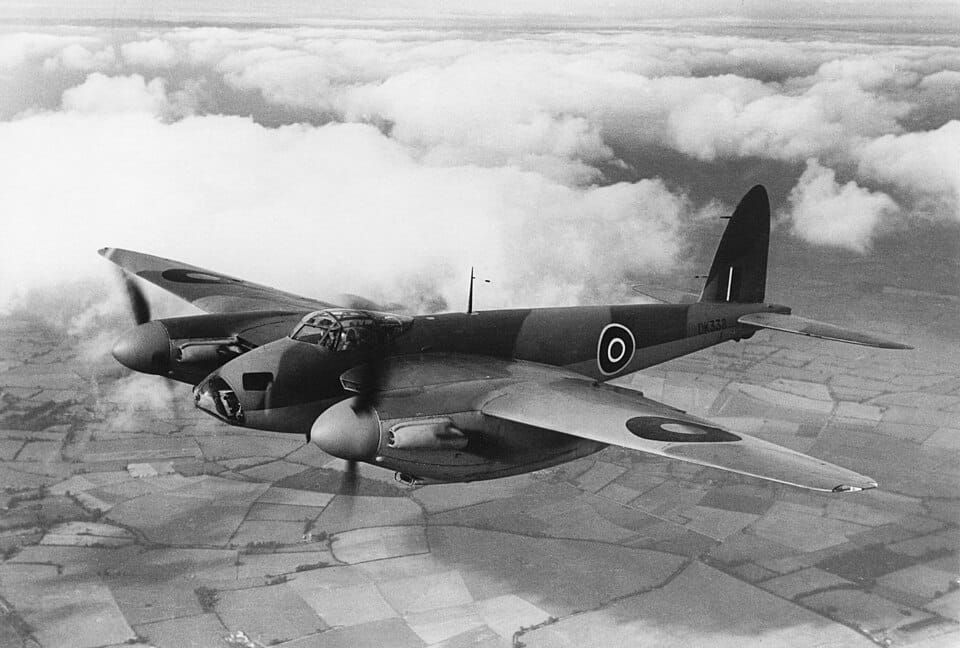
The Mosquito’s speed was not just impressive — it was tactically transformative. Bomber Command’s heavy bombers (Lancasters, Halifaxes, Stirlings) flew at night because they could not survive in daylight against German fighters. The Mosquito flew in daylight and at night, often without defensive armament, relying purely on speed. The bomber variant carried no guns at all. It did not need them. Nothing could catch it.
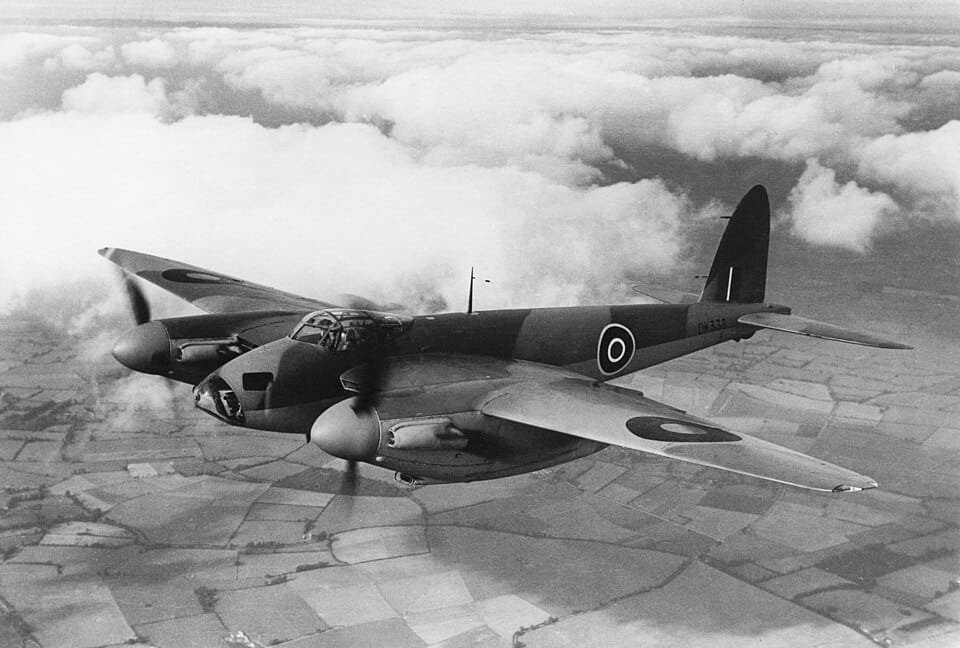
A Mosquito FB.VI fighter-bomber variant — the most produced mark, serving in every theatre of the war. Wikimedia Commons
The Pathfinder Force used Mosquitoes to mark targets for the main bomber stream. Photo reconnaissance Mosquitoes flew over Berlin in broad daylight. Night fighter Mosquitoes, equipped with AI radar, became the RAF’s most effective interceptor against German night raiders. The fighter-bomber variant carried four 20mm cannons, four .303 machine guns, and could haul up to four 500-pound bombs or eight rockets. It was, by any measure, the most versatile combat aircraft of the Second World War.
Holz schlägt Metall
Building the Mosquito from wood was not a compromise — it was an advantage. Britain’s furniture factories, piano makers, and woodworking shops could build Mosquito components without competing for the aluminium that Spitfire and Lancaster production demanded. The labour force was different too: skilled carpenters and cabinet makers, many of them women, could be trained faster than sheet-metal workers.
“In 1940 I could at least fly as far as Glasgow — but now I can scarcely go over the North Sea. It makes me furious when I see the Mosquito. The British knock together a beautiful wooden aircraft that every piano factory over there is building.”
Hermann Goering — Commander-in-Chief, Luftwaffe, January 1943
Goering’s famous outburst captured the German frustration perfectly. The Luftwaffe spent enormous resources developing the Focke-Wulf Ta 154 — a wooden night fighter intended as a direct response to the Mosquito. It never worked properly. The Ta 154 programme collapsed after Allied bombing destroyed the Tego-Film adhesive plant and the acidic substitute glue corroded the airframes.
Das Vermächtnis
By the end of the war, 7,781 Mosquitoes had been built in 30 variants. It served in every theatre: Europe, North Africa, the Mediterranean, Burma, the Pacific. Its loss rate was the lowest of any Bomber Command type. And it had done what no other aircraft in history had managed: excelled simultaneously as a bomber, a fighter, a reconnaissance platform, and a night interceptor.
The Mosquito proved that speed, ingenuity, and unconventional materials could defeat industrial orthodoxy. In a war defined by mass production, it was the artisan’s masterpiece — built from balsa and birch, glued together in piano factories, and faster than anything the enemy could build from steel.
Sources: de Havilland Aircraft Museum, Imperial War Museum, RAF Museum, Wikipedia
Open-source investigators have identified Russian-made cluster munitions used in an airstrike in northern Mali, according to a Bellingcat investigation published May 26, 2026. The findings add to mounting evidence that Russian forces operating alongside Mali's...
The U.S. Air Force's KC-135 Stratotankers — the 60-year-old aerial refueling workhorses that keep American air power flying — are taking hits in the Iran war. Six aircraft have been damaged since the conflict began — a figure that covers aircraft damaged but not...
When Iranian ballistic missiles slammed into Al Udeid Air Base in the early weeks of the war, they hit the most important building on the base: the Combined Air Operations Center. The CAOC — the nerve center that coordinates every U.S. and coalition aircraft across...

 English
0 Comments