

Once the furball starts, the MiG-29 is the perfect fighter jet to have
(Furball is not a hairball here, but a large dog fight between groups of fighter aircraft). The MiG-29 is currently the only modern supersonic fighter jet available for MiG-29 fighter jet flights worldwide - and we are very proud to have this exceptional fighter to offer for tourist fun flights as everyone who follows knows. But now how is the MiG-29 such a great aircraft on close aerial combat? First - the MiG-29 sports unparalleled agility and superb aerodynamics. Second it is very powerful with a thrust/weight . And third - it has a helmet mounted sight, something the West copied later (more about this in the article here). To start with - there is an interesting video that might be interesting for this topic to start with:The MiG-29s agility
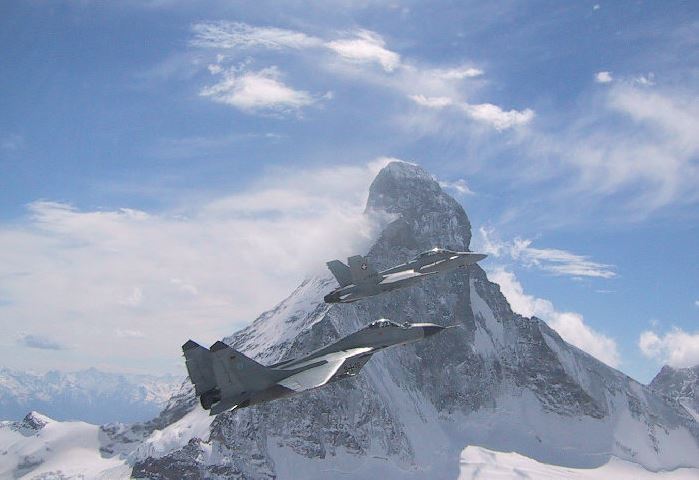
Fulca 2002 - MiG-29 and F-18
“Inside ten nautical miles I’m hard to defeat, and with the IRST, helmet sight and ‘Archer’ (NATO designation for the R-73 missile) I can’t be beaten. Even against the latest Block 50 F-16s the MiG-29 is virtually invulnerable in the close-in scenario. On one occasion I remember the F-16s did score some kills eventually, but only after taking 18 ‘Archers’ (Just as we might seldom have got close-in if they used their AMRAAMs BVR!) They couldn’t believe it at the debrief, they got up and left the room!”Another quote by Test Pilot John Farley who got to fly the MiG-29 as one of the first Western pilots (lucky him!):
Ever since the MiG-29 was first displayed in public at the Farnborough'88 airshow I've wanted to test fly the plane to see for myself how it handled. At Farnborough'90 I met Mikhail Waldenburg, chief designer for the Mikoyan Bureau, and Valery Menitsky, chief test pilot, to discuss the plane's aerodynamic achievements. Valery then offered me the chance of a lifetime - a flight in their two-seater to see how their plane flew. I wasn't disappointed, after years testing aircraft such as the Harrier for British Aerospace, the MiG-29 proved one of the most exhilarating flights I've ever had. When flying the MiG-29, note how the high thrust and low drag of this remarkable machine allows it to accelarate at low level during a 9g turn.
Take off from unpaved runways
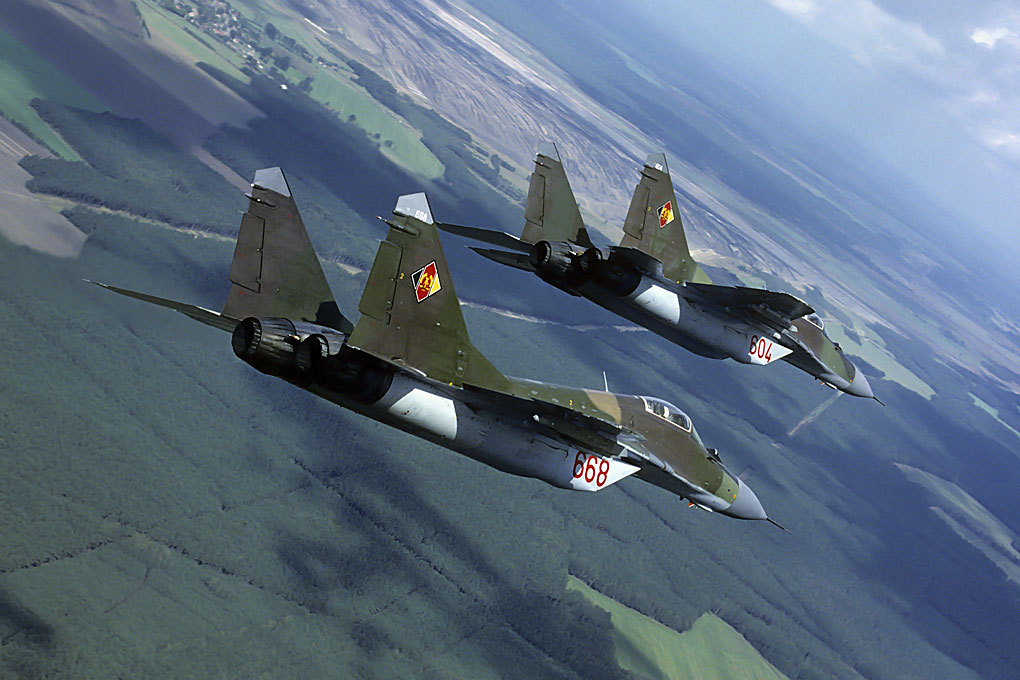
MiG-29 Luftstreitkräfte der NVA
Shortcomings of the MiG-29
Now - since there is so much of fame for the beautiful Fulcrum - what are the shortcomings? Yes - there are some. Mainly two major weaknesses - Fuel/range and radar. Let's quote Oberstleutnant Köck again:The most obvious limitation of the MiG-29 was the aircraft’s limited internal fuel capacity of 3,500 kg (4,400 kg with a centerline tank). The MiG-29 had no air-to-air refueling capability, and its external tank was both speed and maneuver limited. If a mission started with 4400 kg of fuel, start-up, taxy and take off took 400 kg, 1,000 kg were required for diversion to an alternate airfield 50 nm away, and 500 kg for the engagement, including one minute in afterburner, leaving only 2,500 kg of fuel. If we need 15 minutes on station at 420 kts that requires another 1000 kg, leaving 1500 kg for transit. At FL 200 (20,000 ft) that gives us a radius of 150 nm, and at FL 100 (10,000 ft) we have a radius of only 100 nm.And about the Radar - Köck said:
The MiG-29s radar had a poor display, giving poor situational awareness, and this was compounded by the cockpit ergonomics. The radar had reliability and lookdown/shootdown problems, hence its poor discrimination between targets flying in formation, and moreover it couldn’t lock onto the target in trail, only onto the lead.Mainly because of these two limitations, the MiG-29s role in the German Luftwaffe was restricted to only a few clearly defined roles. It was mainly used as adversary threat aircraft for dogfight training where it brought valuable insights in the training of not only German pilots (see video above). On top of that it was also used for point defense, and as wing (but never lead) in mixed Fighter Operations. And after all - the MiG-29 found the perfect destination - flying MiGFlug customers from all over the world. They do not care much about radar capabilities and range since most of them have enough after a sporty aerobatics flight or Edge of Space flight that last up to 50min.
Related Questions
What makes the MiG-29 good in a dogfight?
The MiG-29 excels in close combat thanks to three strengths: exceptional agility and aerodynamics, a high thrust-to-weight ratio, and a helmet-mounted sight. The helmet sight, paired with the R-73 missile, let its pilot lock onto a target simply by looking at it — a decisive edge over Western fighters of its era.
What is a furball in air combat?
A furball is fighter-pilot slang for a large, chaotic close-range dogfight involving multiple aircraft from both sides swirling together. In that confused, turning fight, raw agility and quick target acquisition matter more than long-range missiles, which is exactly the arena where the MiG-29 was designed to shine.
What is a helmet-mounted sight?
A helmet-mounted sight projects targeting information onto the pilot's visor and lets them cue a weapon simply by looking at the target. On the MiG-29, combined with the agile R-73 missile, it allowed off-boresight shots that Western fighters initially could not match — a major advantage in a close-in turning fight.
Can you experience MiG-29 agility as a passenger?
Yes. The same agility that makes the MiG-29 a fearsome dogfighter is on full display during a MiG-29 Fulcrum experience, where passengers feel the tight turns and rapid manoeuvres firsthand. It is currently the only modern supersonic fighter offered for civilian flights worldwide.
Why is the MiG-29 still flown for civilian flights?
The MiG-29 remains the only modern supersonic fighter available to paying passengers, prized for the agility and performance that once made it a top dogfighter. Its combination of power and manoeuvrability translates into a thrilling ride, which is why it anchors experiences like the Edge of Space flight.


As said by a USAF pilot who was the first to fly the MIG-29 after East/West German Re-Unification. Also a pilot of F-5’s, F-15’s, and F-16’s.
What was the MiG-29 Fulcrum like to fly? Did it live up to the fear and Cold War hype?
“The Mig-29’s “handling qualities are mediocre at best. The flight control system is…sloppy and not very responsive. This does not mean the jet isn’t very maneuverable. It is.”
“The radar was actually pretty good and enabled fairly long-range contacts. As already alluded to, the displays were very basic and didn’t provide much to enhance the pilot’s situational awareness. The radar switchology is also heinous.”
“The Fulcrum’s radar-guided BVR weapon, the AA-10A Alamo, has nowhere the same legs as an AMRAAM and is not launch-and-leave like the AMRAAM. ”
“The IRSTS turned out to be next to useless and could have been left off the MiG-29 with negligible impact on its combat capability. ”
“There was no alignment process as required with the Joint Helmet-Mounted Cuing System. It just worked.”
” I saw shot opportunities I would’ve never dreamed of with the AIM-9L/M. Those on the receiving end were equally less enthused about being ‘shot’ from angles they couldn’t otherwise train to. Playing the hunted for two F-16’s hunting the Mig-29, in a visual 2 versus 1 combat scenario, a F-16 was readying for gun shot. Instead of calling me ‘dead’ with an AIM-9M, he flew through AIM-9M launch parameters trying to get gun video on me. His attempt put him in launch parameters for an Archer shot, so with a push of a button on the right throttle I commanded the seeker head to slave to the HMS line-of-sight and was able to call a kill shot on him. Imagine pulling lead for a gun shot and getting killed by the target!”
“From BVR (beyond visual range), the MiG-29 is totally outclassed by western fighters. Lack of situation awareness and the short range of the AA-10A missile compared to the AMRAAM means the NATO fighter is going to have to be having a really bad day for the Fulcrum pilot to be successful.”
The truth about MiG-29 from german sight:
https://www.16va.be/mig-29_experience.htm
“But when all that is said and done, the MiG-29 is a superb fighter for close-in combat, even compared with aircraft like the F-15, F-16 and F/A-18. This is due to the aircraft’s superb aerodynamics and helmet mounted sight. Inside ten nautical miles I’m hard to defeat, and with the IRST, helmet sight and ‘Archer’ I can’t be beaten. Period. Even against the latest Block 50 F-16s the MiG-29 is virtually invulnerable in the close-in scenario. On one occasion I remember the F-16s did score some kills eventually, but only after taking 18 ‘Archers’. We didn’t operate kill removal (forcing ‘killed’ aircraft to leave the fight) since they’d have got no training value, we killed them too quickly. (Just as we might seldom have got close-in if they used their AMRAAMs BVR!) They couldn’t believe it at the debrief, they got up and left the room!
“They might not like it, but with a 28deg/sec instantaneous turn rate (compared to the Block 50 F-16’s 26deg) we can out-turn them. Our stable, manually controlled airplane can out-turn their FBW aircraft. But the real edge we have is the ‘Archer’ which can reliably lock on to targets 45deg off-boresight.
“I should stress that I’m talking about our Luftwaffe MiG-29s, which are early aircraft. They also removed the Laszlo data link and the SRO IFF before the aircraft were handed over to us, so in some respects we’re less capable than other contemporary MiG-29s. From what we hear the latest variants are almost a different aircraft. I’d like to see our aircraft get some of the updates being offered by MiG-MAPO. The more powerful engines, better radar, a new navigation system, a data link and an inflight refuelling probe. If we got the new ‘Alamo-C’ that would also be an improvement – even a two nautical mile boost in range is still ten more seconds to shoot someone else! We won’t get many of those improvements, though we are getting a new IFF manually selectable radio channels, and improvements to the navigation system, including the integration of GPS. Most of our aircraft will be able to carry two underwing fuel tanks, which will also help.”