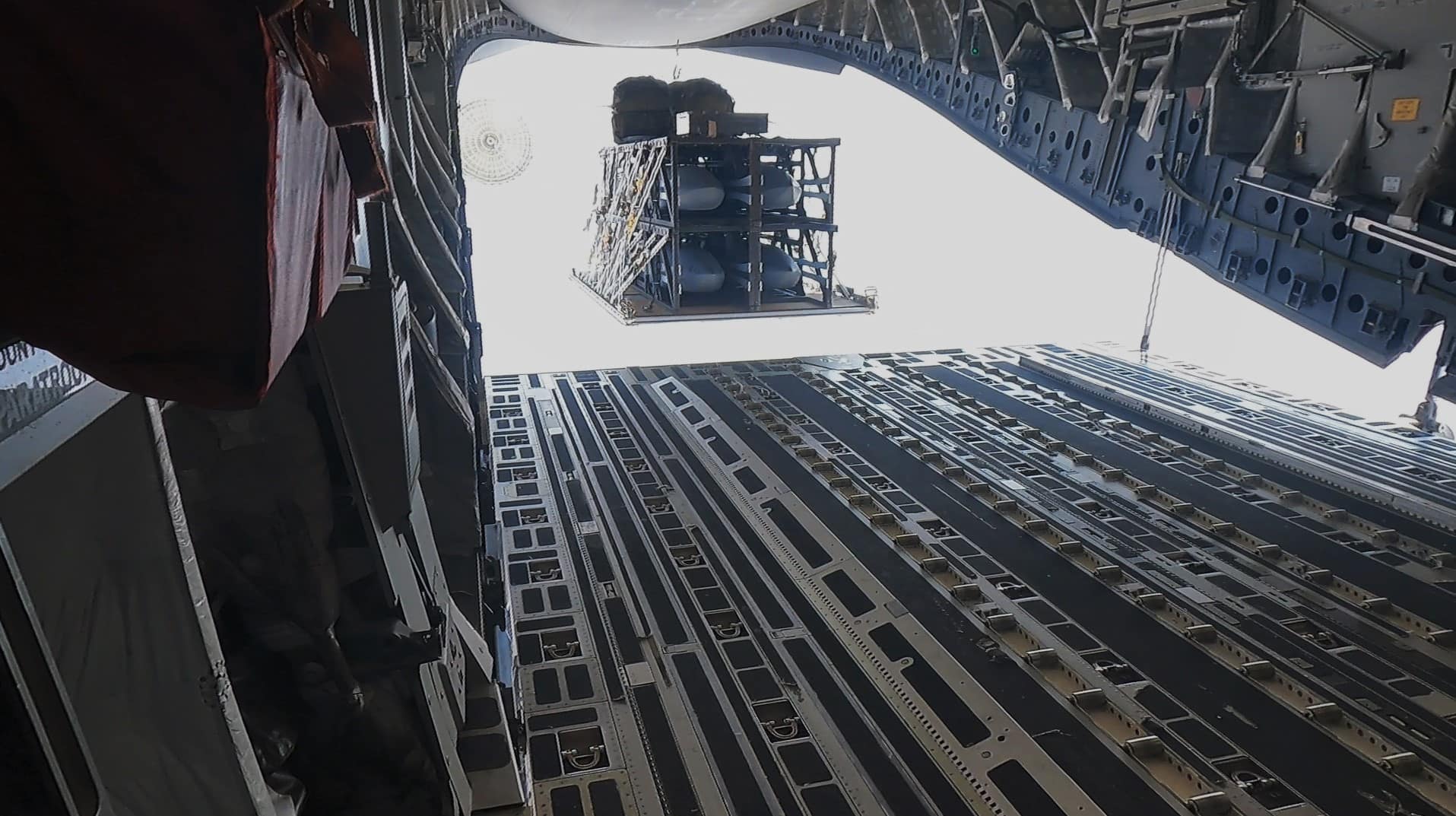
A C-17 Globemaster III pulls up to altitude, the ramp drops, and 45 cruise missiles slide out the back on pallets. That is no longer a concept video or a PowerPoint fantasy. The U.S. Air Force just turned it into a funded programme of record called Dragon Cart — and it will be operational by 2027.
The idea is deceptively simple: take the Air Force’s massive fleet of cargo aircraft, which normally haul pallets of supplies, and let them haul pallets of AGM-158 JASSM cruise missiles instead. No permanent modifications. No rewiring. Just roll the deployment boxes in, fly to a launch point, and push them out the back. The cargo plane becomes a standoff bomber for a single mission, then goes back to hauling cargo the next day.
It changes the math of a Pacific war overnight.
Quick Facts
Programme: Dragon Cart (formerly Rapid Dragon)
Status: Transitioned to formal Programme of Record
Operational target: 2027
C-130 capacity: Up to 12 JASSM cruise missiles per sortie
C-17 capacity: Up to 45 JASSM cruise missiles per sortie
Missile: AGM-158 JASSM variants (range 370+ km / 1,000+ km for JASSM-ER)
Key advantage: No aircraft modification required — pallets roll on and off
From Experiment to Arsenal
Rapid Dragon has been in testing since 2021, when the Air Force Research Laboratory first demonstrated the concept by dropping a pallet of simulated munitions from a C-130. The tests accelerated quickly. By the end of 2021, a live JASSM-ER had been successfully launched from an MC-130J at altitude, guiding itself to its target — while C-17 tests released aerodynamically identical surrogate missiles. Each test proved the same point: cargo planes can do what bombers do, at a fraction of the cost per sortie.
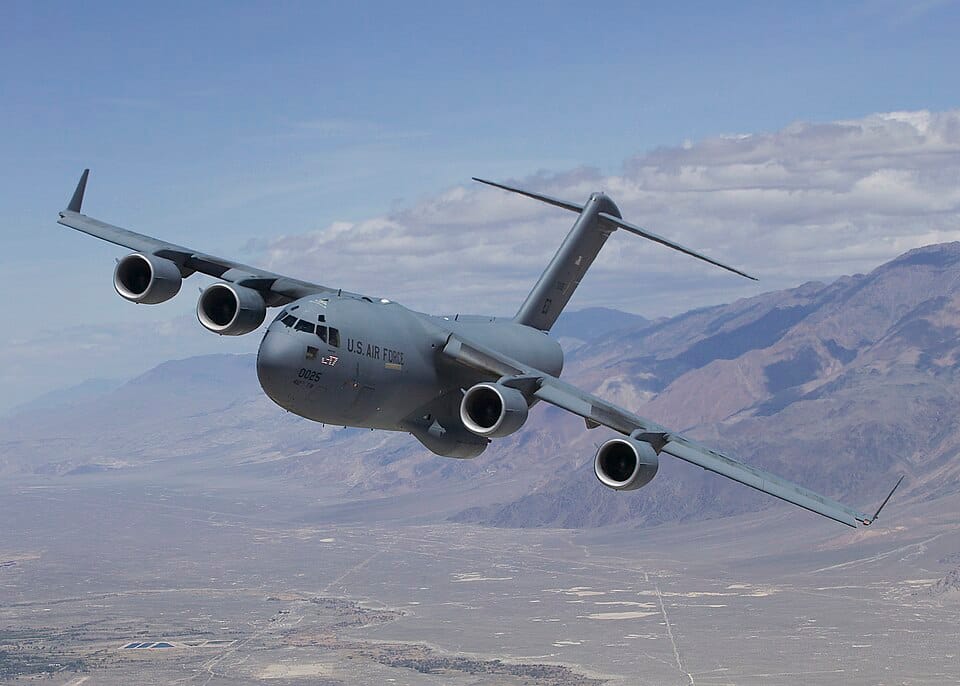
A C-17 Globemaster III — under Dragon Cart, it becomes a standoff bomber capable of launching up to 45 JASSM cruise missiles in a single sortie. Photo: Wikimedia Commons
The transition from experiment to programme of record means real money, real production contracts, and a real fielding deadline. The Air Force wants Dragon Cart operational by 2027 — meaning units will train with it, deployment plans will include it, and combatant commanders can call on it.
The thinking echoes former Air Force acquisition chief Will Roper, an early champion of palletized munitions: every cargo plane in the inventory becomes a potential bomber — hundreds of launch platforms an adversary has to account for, not dozens.
Why 45 Missiles From One Plane Matters
The numbers are staggering. A single C-17 can carry 45 JASSM cruise missiles on pallets. For context, a B-52H — the Air Force’s dedicated heavy bomber — carries 20 JASSMs. A B-1B carries 24. A single C-17 Dragon Cart sortie puts more cruise missiles in the air than any individual bomber in the U.S. inventory.
The Air Force operates roughly 220 C-17s and over 300 C-130s. Even if only a small fraction were tasked for strike missions, the capacity would be enormous. A flight of four C-17s could launch 180 cruise missiles simultaneously — a volume of fire that would overwhelm most integrated air defence systems.
The Pacific Calculus
Dragon Cart was designed with China in mind. In a Taiwan contingency, the U.S. would need to launch thousands of precision strikes in the opening hours — far more than the bomber fleet alone can deliver. Cargo aircraft operating from dispersed Pacific airfields, each loaded with palletized missiles, could saturate Chinese defences from unexpected directions.
The system also complicates Chinese targeting. Today, Beijing tracks a known number of B-2s, B-1Bs, and B-52s. With Dragon Cart, any C-17 or C-130 on the ramp becomes a potential strike platform. That ambiguity is itself a deterrent.
The Bulletin of the Atomic Scientists has flagged the system’s implications for arms control, noting that a palletized cruise missile system on cargo aircraft could blur the line between conventional and nuclear delivery — a concern that may surface in future negotiations.
For now, the Air Force is focused on getting it fielded. By 2027, the cargo fleet will have teeth.
Sources: Air & Space Forces Magazine, The Aviationist, Sandboxx, Bulletin of the Atomic Scientists
Every fighter pilot trains for it. Most pray they'll never experience it. The moment a jet engine — the machine that keeps you flying at 500 knots and 30,000 feet — stops working. Whether it's a compressor stall that sounds like a cannon going off behind your seat, a...
Luca Parmitano has lived two lives that most people only dream about. In the first, he was a fighter pilot — flying AMX Ghibli attack jets for the Italian Air Force, deployed to Afghanistan, trained to fly low and fast into hostile territory. In the second, he became...
Before the Rafale, before the Mirage 2000, before the Mirage F1 — there was the Mirage III. Dassault's first supersonic fighter was a revelation when it entered service in 1961: a sleek, tailless delta that could break Mach 2, carry a nuclear bomb, and outfight...



 English
0 Comments