

It is 0200 hours in the Eastern Mediterranean. The flight deck of USS Gerald R. Ford smells faintly of jet fuel and seawater. A yellow-shirted Air Boss raises an arm. Three hundred feet of catapult — not steam, not for the first time in U.S. naval aviation history, but a 60-megawatt linear electric motor — winds up its current. An F/A-18F Super Hornet, dripping with two thousand pounds of bombs and a half-tonne of fuel, snaps from a dead stop to 165 miles per hour in 2.3 seconds. The whole deck shudders. The jet is gone.
This is the new catapult. It is called EMALS — the Electromagnetic Aircraft Launch System — and it is one of three technologies that have quietly turned the aircraft carrier from a Cold War symbol into the most technically radical warship of the 21st century.
The Ford-class carrier carries an F-35C in the same air wing as a 1990s F/A-18F, throws either off the deck without breaking a sweat, recovers them with a magnetic brake instead of a hydraulic one, and does it all while powering a small city's worth of equipment. The world's other carriers are watching.
Quick Facts
Lead ship: USS Gerald R. Ford (CVN-78), commissioned 2017
Class: Ford-class — 1 in service, 3 more under construction
Catapult system: EMALS (Electromagnetic Aircraft Launch System)
Recovery system: AAG (Advanced Arresting Gear)
Power source: Two A1B nuclear reactors, ~700 MW thermal each (est.)
Sortie generation: +33% over Nimitz-class
Crew reduction: ~700 fewer sailors than Nimitz-class
Foreign equivalents: Chinese Fujian (Type 003, also EMALS), French PA-Ng (planned EMALS)
From Steam to Electromagnetism
For 70 years, every American carrier launched aircraft the same way. A pipe full of pressurised steam, drawn from the ship's reactors or boilers, drove a piston down a slot in the flight deck. The piston pulled the aircraft to flight speed. Then the steam vented in a cloud that became the iconic image of carrier launches.
The system worked. It also had problems. Steam catapults peak-loaded the aircraft brutally on the launch stroke — too brutally for some lightweight UAVs. They needed constant high-pressure plumbing. They required hundreds of sailors. And their force was hard to fine-tune.
EMALS solves all four. A linear induction motor — essentially an unwrapped electric motor running 300 feet down the deck — accelerates the shuttle smoothly under software control. The acceleration profile can be tailored for a 25-tonne strike fighter or a 200-kilogram reconnaissance drone with equal precision. The system uses one-third the volume below decks and far fewer people to operate.

The smoother stroke matters more than civilians realise. Steam catapults regularly inflicted high-G loads on the airframe and the pilot in the first half-second of the launch. EMALS shaves the peak by roughly 40 per cent, distributes the same total work over a longer acceleration curve, and — crucially — protects the airframe over thousands of cycles. Modern fighters cost $100 million each. Saving 5 per cent of structural fatigue per launch becomes an enormous lifetime saving across an air wing.
Vice Admiral Daniel Cheever, Commander of Naval Air Forces, has been blunt about the scale of the change:

Catching Them Again — The Advanced Arresting Gear
If EMALS is the front end of the carrier revolution, the Advanced Arresting Gear (AAG) is the back end. The classic carrier arrestor — a hydraulic cylinder paying out a steel cable — slams a landing fighter to a stop in under two seconds with all the elegance of a car crash. AAG replaces the hydraulics with a water turbine driving an induction motor in reverse, essentially using the landing aircraft's own energy to spin a generator.
The result is the same — a stopped fighter — but the deceleration curve is now software-shaped. Different aircraft types get different stopping profiles. A 25-tonne F/A-18F decelerates differently from a 33-tonne F-35C from a 14-tonne MQ-25 Stingray unmanned tanker. The hardware doesn't change. The software does.
The combination of EMALS and AAG is what allows the Ford to fly a mixed crewed-and-uncrewed air wing. The MQ-25 Stingray refuelling drone — the first operational uncrewed aircraft designed for U.S. carrier decks — is planned to fly from both Ford- and Nimitz-class ships, but the software-tailored launch and recovery profiles of EMALS and AAG make integrating a new airframe like it dramatically simpler.
The Other Side of the Pacific
The most consequential thing about EMALS may be that the Chinese have copied it. The PLA Navy's third aircraft carrier, the Fujian, entered sea trials with three electromagnetic catapults of indigenous design — the first non-American EMALS-style system to reach a flight deck. Chinese state media has been careful in what it shows. Western analysts have been even more careful in what they read into it.
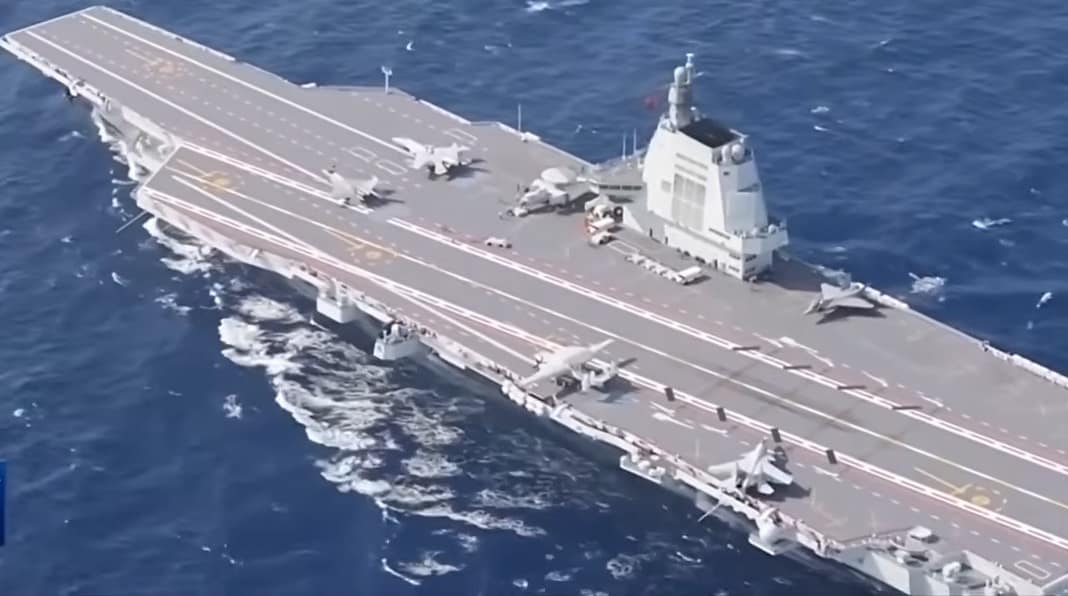
The Fujian's catapults are believed to use a different supercapacitor-bank architecture from EMALS, which the Chinese argue makes them more reliable and cheaper to maintain. Whether that is true or marketing remains to be seen — early EMALS reliability on the Ford was famously troubled, and a Chinese system reaching similar maturity in half the time would be a remarkable engineering achievement.
The French navy has chosen EMALS for its planned PA-Ng nuclear carrier. The Royal Navy stuck with ski-jump ramps for the Queen Elizabeth class, which only operates F-35Bs and so does not need catapults at all. The geographic spread is telling. EMALS has crossed an ocean. Steam has not.
The Power Plant Underneath
None of this works without astonishing electrical capacity. EMALS draws something like 60 MW at peak during the few seconds of an aircraft launch — comparable to a small city's instantaneous demand — and the Ford's two A1B nuclear reactors are sized partly to supply it. The same electrical capacity also supports laser weapons, electromagnetic railguns (if they ever arrive), and the radar suite which is the most power-hungry part of the entire ship.
This is the deeper revolution. The 21st-century carrier is not a ship with weapons attached. It is a floating power station whose job description happens to include flying aircraft. Everything that comes next — drones, lasers, hypersonic intercept missiles — needs that electrical backbone to exist.
What Comes Next
The Ford is the lead ship of a four-ship class. John F. Kennedy is in fitting-out. Enterprise and Doris Miller are under construction. By the early 2030s, four EMALS-equipped carriers will be in U.S. service — and behind them, the F/A-XX sixth-generation fighter, the CCA (Collaborative Combat Aircraft) drone family, and a rumoured next-generation tanker drone all engineered specifically around what EMALS and AAG enable.
Aircraft carriers have been declared obsolete in every decade since 1945. The submarine was going to kill them. The cruise missile was going to kill them. The hypersonic glide vehicle is now allegedly going to kill them. So far, none of those threats has stopped the U.S. Navy from building larger, more technically radical, more electrically capable carriers than ever.
The catapult, of all things, is the reason the next round of obituaries will be premature.
How EMALS is redefining carrier air power at sea — a recent feature on the Ford-class.
EMALS in action — the Ford launches an F/A-18 down the deck. Watch the shuttle vanish forward in under three seconds.
Sources: U.S. Navy press releases, USNI News, Air & Space Forces Magazine, American Enterprise Institute.
Related Questions
What is EMALS?
EMALS, the Electromagnetic Aircraft Launch System, is a catapult that uses a 60-megawatt linear induction motor, essentially an unwrapped electric motor running about 300 feet down the flight deck, to launch aircraft. It replaces the steam catapult and can accelerate a Super Hornet from a standstill to about 165 mph in 2.3 seconds.
Which ship uses EMALS?
USS Gerald R. Ford (CVN-78), commissioned in 2017, is the lead ship of the Ford class and the first U.S. carrier to use EMALS. Three more Ford-class carriers are under construction. China's Fujian (Type 003) and France's planned PA-Ng also use electromagnetic catapults.
How is EMALS better than a steam catapult?
EMALS accelerates aircraft smoothly under software control, tailoring each launch for anything from a 25-tonne strike fighter to a 200-kilogram drone. Compared with steam, it imposes a lower peak load on the airframe, uses about one-third the below-deck volume, and needs far fewer sailors to operate.
What is AAG on an aircraft carrier?
AAG, the Advanced Arresting Gear, is the Ford class's aircraft recovery system. It uses a magnetic (water-twister) brake instead of the traditional hydraulic arresting system to stop landing aircraft, giving finer control across a wider range of aircraft weights, including lighter unmanned types.
How does the Ford-class carrier compare to the Nimitz-class?
The Ford class generates about 33% more sorties than the Nimitz class while needing roughly 700 fewer sailors. It is powered by two A1B nuclear reactors producing an estimated 700 MW thermal each, enough to support power-hungry systems like EMALS, AAG and future directed-energy weapons.
What aircraft fly from the USS Gerald R. Ford?
The Ford's air wing includes the F-35C and the F/A-18F Super Hornet, launched and recovered by EMALS and AAG. Future carrier air wings are expected to add the U.S. Navy's next-generation fighter, the F/A-XX program, alongside crewed and uncrewed aircraft.
Which other countries are building advanced aircraft carriers?
China's Fujian uses EMALS-style electromagnetic catapults, and France's planned PA-Ng is slated to as well. Japan has also returned to carrier aviation, converting its Kaga to operate F-35B fighters, reflecting a global resurgence in carrier capability.
0 Comments