
Quick Facts: SAFE Complex
| Facility Name | SAFE Complex (Strategic Academic Flight Education) |
| Opening Date | March 13, 2026 |
| Investment | $16 million |
| Location | Prescott Regional Airport, Arizona |
| Training Building | 20,000 sq ft |
| Ramp Space | 263,000 sq ft of aircraft parking/ops |
| Key Features | Hangars, VR simulators, classrooms, student spaces |
| Next Phase | Student union & residence hall (Fall 2026) |
Embry-Riddle just dropped $16 million on a bet: that Arizona’s high-altitude skies will keep producing the world’s sharpest pilots.
On March 13, 2026, the university opened its SAFE Complex at Prescott Regional Airport—a sprawling flight training facility designed to do one thing incredibly well: transform students into aviators. The scale is staggering. Twenty thousand square feet of training infrastructure. Two hundred sixty-three thousand square feet of ramp space. That’s enough room to park and maintain a small air force while students learn to fly.
This isn’t just a building. It’s Embry-Riddle’s statement that the demand for trained pilots isn’t declining—it’s accelerating. And they’re prepared to meet it with metal, glass, and systems designed to teach the next generation of military and commercial aviators.
## The School That Runs on Speed Embry-Riddle isn’t a typical university. Most schools have engineering departments. Embry-Riddle is an engineering school that happens to have a few other programs. The Prescott campus sits at 5,400 feet elevation in the Bradshaw Mountains of central Arizona, surrounded by some of the most challenging flying terrain in North America. That’s intentional. High-altitude operations demand more from students. The air is thin. Performance margins shrink. Weather develops fast. Flying in Prescott teaches precision and decision-making in ways that flat-altitude training simply cannot.The university has become the single largest producer of military pilots in the United States—with the possible exception of the Air Force Academy itself. Graduates fly F-16s. F-35s. P-8 Poseidons. EA-18G Growlers. If you need a pilot for a complex military aircraft, statistically speaking, there’s a decent chance that pilot spent time at Embry-Riddle, flying out of Prescott or the Daytona Beach campus.
This isn’t conjecture. Embry-Riddle’s alumni network in military aviation is extraordinary. Ask any Air Force squadron commander and you’ll find E-RADUL graduates among the instructor pilots. That legacy of producing serious aviators—people who understand the discipline and rigor required to fly at the highest level—is what the SAFE Complex is designed to amplify.

But here’s the critical part: simulation is only half the equation. The SAFE Complex also includes 263,000 square feet of ramp space. That’s room for dozens of training aircraft operating simultaneously. Students transition from the virtual world to the real world quickly. They learn to feel wind on approach. To hear the sound of a properly trimmed aircraft. To understand the physical weight of control inputs on an actual wing.
This dual-track approach—VR simulation plus real-world flight operations—is where modern pilot training is headed. You can’t replace stick-and-rudder feel with pixels. But pixels can compress learning curves from months into weeks.
## A Military Lineage Here’s what shouldn’t be overlooked: Embry-Riddle’s DNA is military. The university was founded to serve the aviation industry, yes, but from its inception, it understood that the strongest demand for trained pilots has always come from the services. The Air Force. The Navy. The Marine Corps. The Coast Guard. Walk across the Prescott campus and you’ll see it. The discipline. The precision. The expectation that when you show up to train, you show up ready. Embry-Riddle students don’t treat aviation as a career option—they treat it as a vocation. Many will go straight into military pipeline training after graduation. Others will fly for the airlines. But all of them understand that they’re learning a skill that demands perfection.The Robertson Flight Simulation Center—recently expanded with VR technology—can now replicate scenarios that military training commands use. Embry-Riddle students can train on military-grade simulators without wearing a uniform. They can practice formation flying, emergency procedures, and tactical thinking in a virtual environment before they ever touch a military trainer aircraft.
For the Air Force and Navy, this is invaluable. They can identify which students have the aptitude and discipline required for fighter training. They can pre-screen candidates more effectively. And they can start building muscle memory in future military aviators while those aviators are still civilians, still learning the fundamentals in Arizona’s high-altitude skies.

The SAFE Complex sitting at Prescott Regional Airport represents something larger than just a training facility. It represents institutional confidence in aviation’s future. It represents the belief that humans will still be in the left seat of aircraft a decade from now. That training will still matter. That discipline and professionalism still matter.
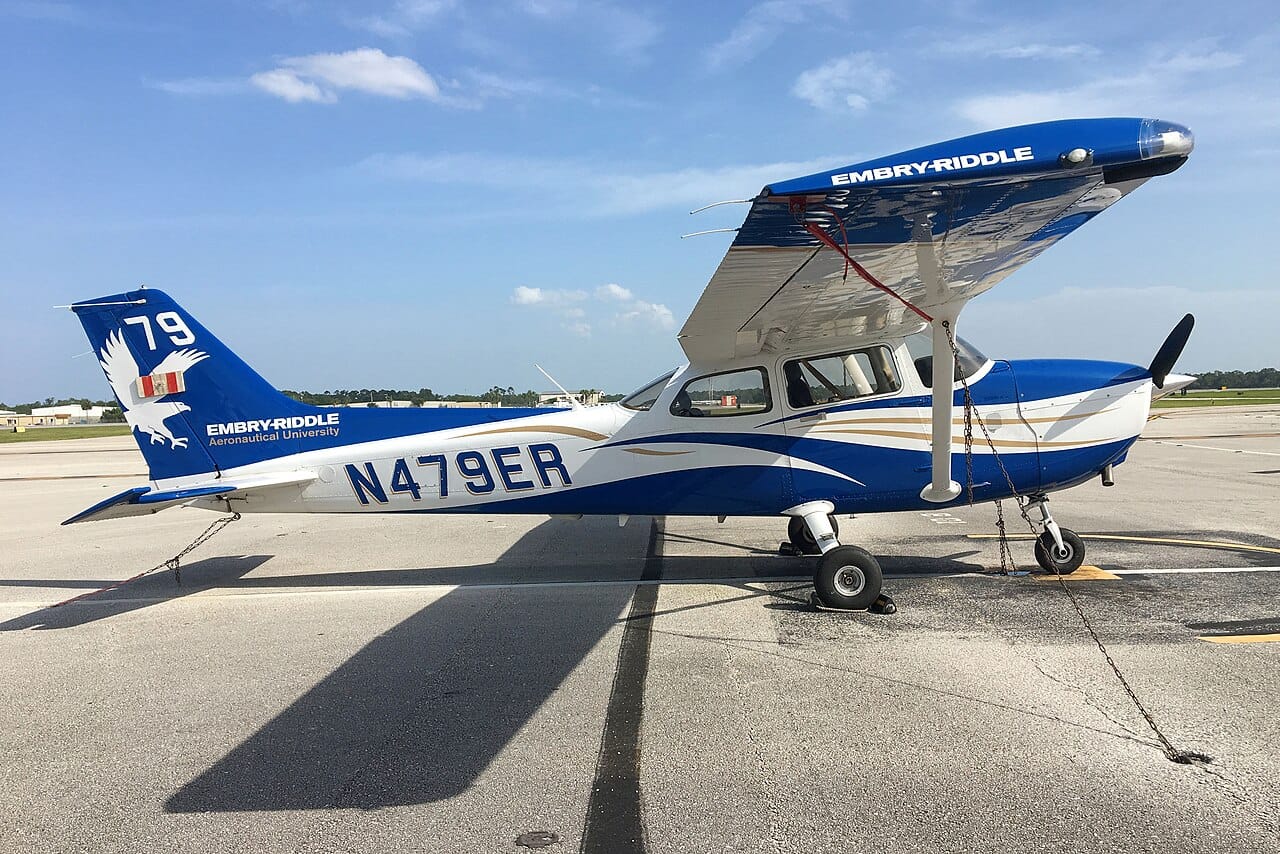
Walk the ramp at Prescott on any morning and you’ll see it: students conducting pre-flight walkarounds on training aircraft, checking fuel, testing control surfaces, going through the same procedures military pilots have been doing for 80 years. Some of those students will go on to fly F-35 Lightning IIs. Others will captain Boeing 787s across the Pacific. All of them started here, in the thin Arizona air, learning that flying is about precision, responsibility, and the willingness to pursue excellence.
The $16 million is just money. The real investment is in people who take aviation seriously enough to spend years learning to do it right. Embry-Riddle has been making that bet for decades. The SAFE Complex is just the latest doubling down.


 English
0 Comments