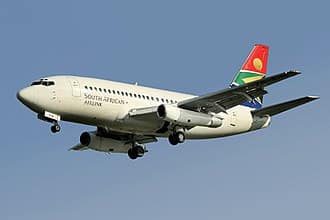
The airliner is rolling. Both engines at full power, 160 knots, the runway disappearing fast. The captain’s hand is on the throttle. The first officer calls “V1.” At that exact moment, the left engine explodes.
Too fast to stop. Too slow to fly well on one engine. The next five seconds will determine whether 200 people live or die. This is the V1 cut — the most practiced, most feared, most consequential emergency in commercial aviation.
Quick Facts — V1 and Engine Failure
V1: The maximum speed at which the pilot must take the first action to stop the aircraft within the remaining runway
Below V1: Reject the takeoff — full braking, reverse thrust, stop on the runway
Above V1: Continue the takeoff — fly on one engine, no matter what
VR: Rotation speed — pull back, lift off
V2: Takeoff safety speed — minimum speed for safe climb on one engine
Training frequency: Every pilot recurrent check, every 6 months, in the simulator
The Speed That Changes Everything
V1 is not a decision speed. It is an action speed. By the time the aircraft reaches V1, the decision has already been made: if anything fails before this number, we stop. If anything fails after, we fly. There is no middle ground. There is no “let me think about it.” The physics do not negotiate.
V1 is calculated before every takeoff based on aircraft weight, runway length, altitude, temperature, wind, and runway surface condition. A heavy aircraft on a short, hot, high-altitude runway will have a low V1 — meaning the pilots have less time to decide and less margin for error. A light aircraft on a long, cool, sea-level runway will have a higher V1 and more breathing room.
What Happens When the Engine Dies
The moment an engine fails above V1, three things happen simultaneously. First, the aircraft yaws — the nose swings toward the dead engine because all thrust is now coming from one side. The pilot must apply firm, immediate opposite rudder to stay on the centreline. Second, the aircraft loses roughly half its total thrust, which means it accelerates more slowly toward rotation speed. Third, the drag from the windmilling dead engine increases the total drag on the aircraft.
The pilot’s job: hold the centreline with rudder, continue accelerating to VR, rotate, and climb out at V2 — the minimum speed at which the aircraft can climb safely on one engine. Miss any of these steps and the aircraft drifts off the runway, fails to climb, or stalls.
Why Pilots Train for This More Than Anything
Every airline pilot practises the V1 cut in the simulator every six months, without exception. It is the single most rehearsed emergency in aviation because it is the one where hesitation kills. A rejected takeoff above V1 — where the pilot decides to stop when the physics say to fly — is one of the most dangerous things that can happen on a runway. The aircraft overruns at high speed, often with insufficient distance to stop, potentially loaded with fuel.
The V1 cut is also the most psychologically demanding emergency. Every instinct says: the engine is on fire, stop the aircraft. The training says: fly. Fly on one engine. Fly with the fire. Fly because stopping will kill you faster than the fire will.
The most dangerous conditions are what pilots call “hot and high” — high ambient temperature, high airport elevation, heavy aircraft. Both reduce engine performance and aerodynamic lift simultaneously. An engine failure at V1 during a hot departure from Mexico City (7,316 feet elevation) or Johannesburg (5,558 feet) gives the crew almost no margin. The aircraft will fly. Barely.
Sources: SKYbrary/EUROCONTROL, FAA Airplane Flying Handbook, AOPA Air Safety Institute, Mentour Pilot
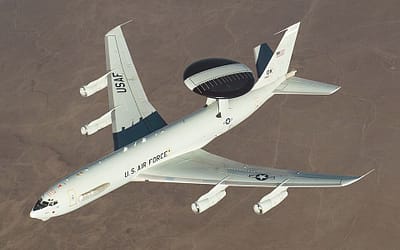
Before AWACS, air warfare was a knife fight in a dark room. Pilots relied on their own radar, ground controllers with limited visibility, and radio calls that were often confused, late, or wrong. After AWACS, one side had the lights on and the other did not. The...
On May 1, 1960, CIA pilot Francis Gary Powers took off from Peshawar, Pakistan in a Lockheed U-2 spy plane. His mission: fly across the entire Soviet Union at 70,000 feet, photographing military installations, and land in Bodø, Norway. He never made it. A Soviet S-75...
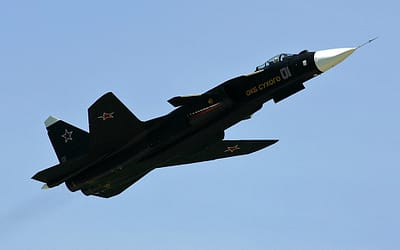
When the Sukhoi Su-47 Berkut rolled out in 1997, it looked like nothing else in the sky. Its wings swept forward instead of back — an aerodynamic concept that promised extraordinary agility, superior low-speed handling, and enhanced controllability at high angles of...

 English
0 Comments