
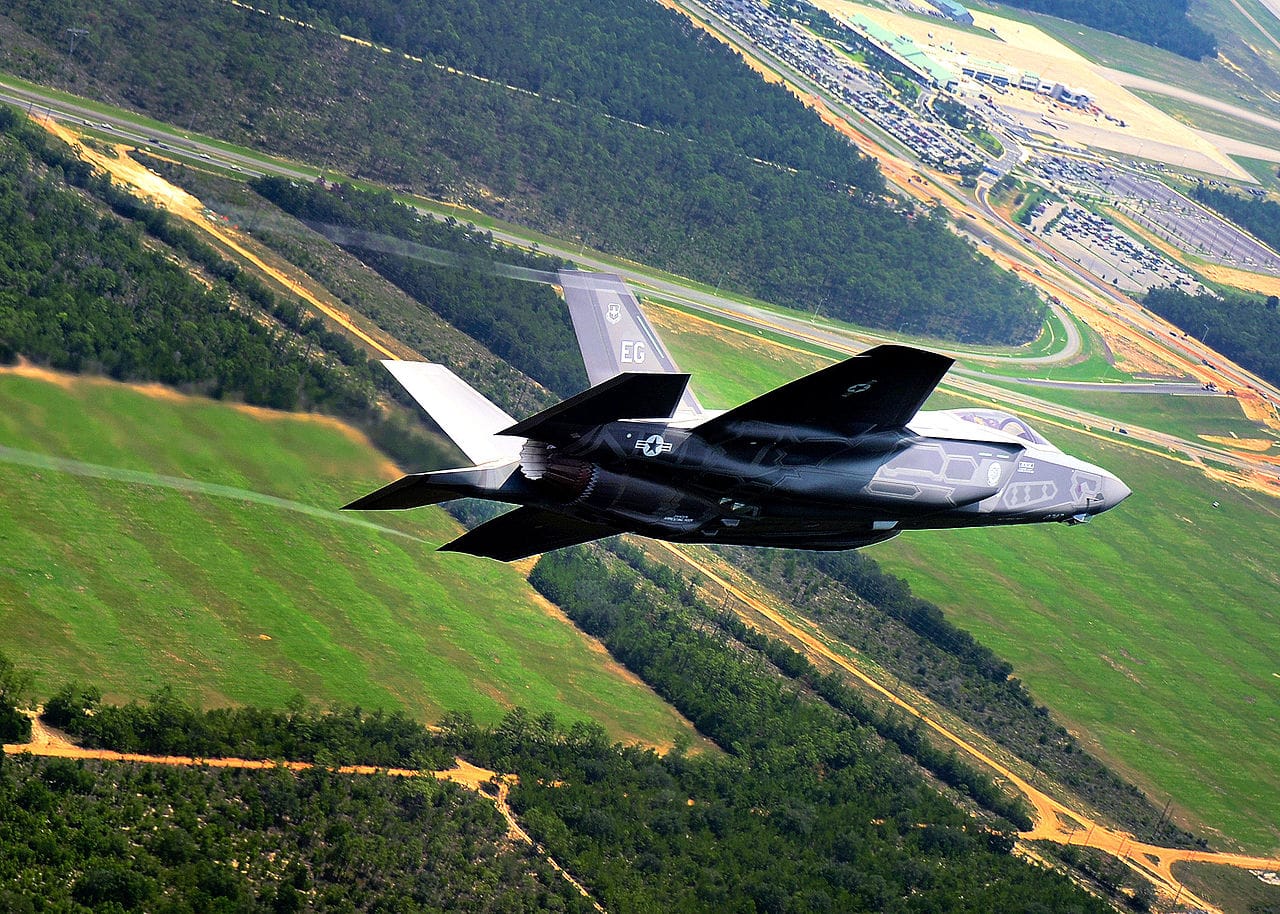
On 15 May 2026 the U.S. Navy quietly awarded Lockheed Martin one of the largest single-line modernisation contracts in the entire F-35 programme: $991 million for 432 electronic warfare modification kits, distributed across the U.S. Air Force, Marines, Navy, and foreign operators. The kits will install upgraded EW systems on existing F-35s through 2032. The kits cover only part of the global fleet, but the message to every Lightning II operator is the same: the electronic-warfare baseline the jet was delivered with is no longer good enough.
This is not a routine software refresh. It is a hardware retrofit. And it tells you exactly what the Pentagon thinks of the threat environment that ate the F-35’s development decade.
| Contract value | US $991 million |
| Awarded by | Naval Air Systems Command (NAVAIR), Patuxent River |
| Awarded to | Lockheed Martin Aeronautics, Fort Worth, Texas |
| Kits ordered | 432 total |
| Distribution | USAF 97 / USN 42 / USMC 54 / FMS 106 / non-US partners 133 |
| Completion date | March 2032 |
Why the F-35’s EW suite needs an overhaul
The F-35 Lightning II was designed in the late 1990s and early 2000s, when the assumed enemy radar environment was the SA-10/SA-20 family of Russian-built surface-to-air systems and the lower-band early-warning radars supporting them. Its electronic warfare suite — the BAE Systems AN/ASQ-239 — was, when introduced, the most capable on any fighter ever built. It still is. But the threat side of the equation has moved.
Modern hostile integrated air defence systems include very low-frequency long-band counter-stealth radars (Chinese JY-26, Russian Nebo-M), interconnected passive coherent location networks, and AI-assisted track fusion. A 2010-era electronic warfare suite cannot reliably jam, deceive, or even comprehensively characterise this environment. The new kits add updated wideband transmitter modules, a refreshed signal-processing back end, and — based on Lockheed redacted documentation — improved cognitive electronic warfare capabilities that can learn enemy emitter behaviour on the fly.

Who gets what
The 432-kit total breaks down sharply by operator. The U.S. Air Force gets 97 kits, the Marines 54, and the Navy 42 — together, roughly half of the total. Another 106 go to Foreign Military Sales customers (countries that bought F-35s through the standard FMS process — Israel, Japan, South Korea, Singapore, Belgium, Switzerland, Poland, Romania, Finland, Czechia, Greece, Germany). The remaining 133 go to F-35 Programme Partner nations — the original co-development countries: the UK, Italy, Netherlands, Norway, Denmark, Canada and Australia (Turkey, an original partner, was removed from the programme in 2019).
Notably absent: no kits are allocated to any operator that is not already a confirmed F-35 customer. The work runs through March 2032, with deliveries spread across the six-year window. That tempo implies retrofits will be performed during normal depot-level maintenance cycles rather than via fleet-wide groundings.
What this tells us
For Lockheed Martin, the contract is welcome — a guaranteed run of high-margin sustainment work alongside continuing production. For the Pentagon, the message is harder. The world’s most expensive weapons programme is having to retrofit a fundamental subsystem just over a decade after it entered initial operating capability, because the threat environment moved faster than the procurement timetable could. That is a structural problem with how the United States buys fighter aircraft, not one Lockheed can fix.
For the next contested air war — wherever and whenever that is — the F-35 fleet will have a meaningfully updated electronic warfare baseline only from the early 2030s. Until then, every Lightning II flies with the EW suite it was delivered with. Whether that is still good enough is the question every F-35 air force is asking, and the answer that prompted this contract was clearly: no.
Sources: Defence Industry Europe, Defence Blog, GovCon Wire, US Department of Defense contract announcements.



 English
0 Comments