
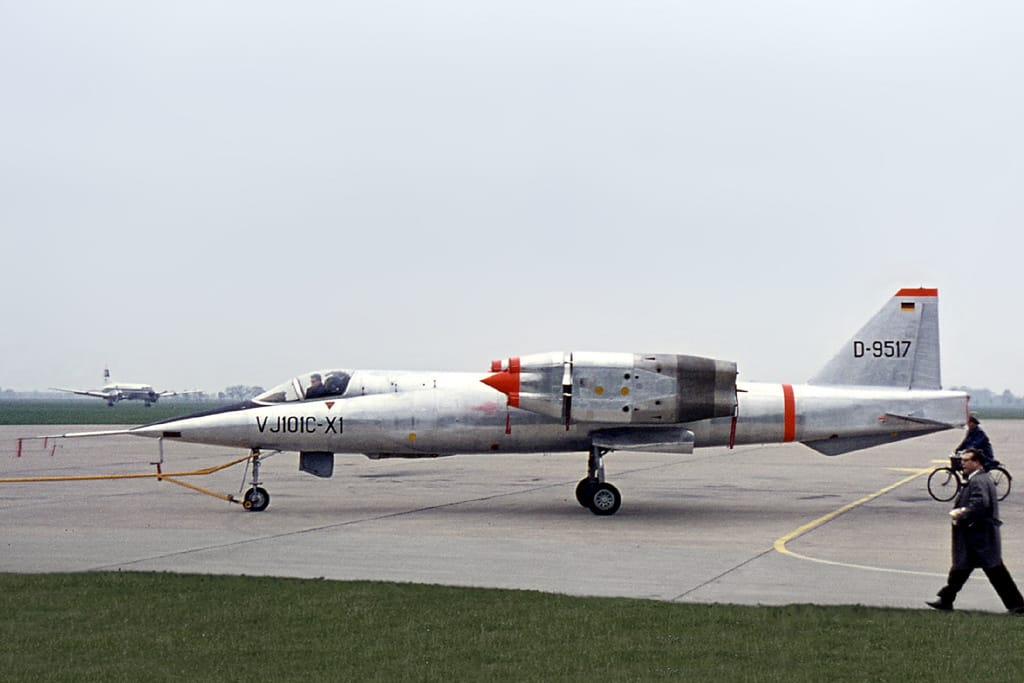
On 10 April 1963, at the Entwicklungsring Süd flight-test centre in Manching, Bavaria, a small twin-tailed jet with six engines lifted itself off the tarmac vertically. There was no nozzle deflection like a Harrier. There were no rotors like a helicopter. The four turbojets at the wingtips, mounted in nacelles that swivelled through 90 degrees, simply pointed downward, and the EWR VJ 101 X-1 hovered, holding station, three metres off the ground.
It was the first vertical takeoff by a fixed-wing combat aircraft prototype in West Germany. Fifteen months later, the same airframe pushed past Mach 1 in a shallow dive — without afterburner. It had become, in July 1964, the first VTOL aircraft in the world to break the sound barrier. And then, five years after that, the entire programme was quietly cancelled.
Quick Facts
Aircraft: EWR VJ 101C (Versuchsjäger 101)
Manufacturer: Entwicklungsring Süd — joint venture of Heinkel, Bölkow and Messerschmitt
Purpose: Mach 2 VTOL interceptor — F-104G Starfighter successor
Engines: 6× Rolls-Royce/MAN Turbo RB.145 turbojets
First hover: 10 April 1963 (X-1 prototype)
First supersonic flight: 29 July 1964 (X-1)
Cancelled: 1968
Surviving airframe: X-2 at Deutsches Museum Flugwerft Schleißheim
Why West Germany wanted a VTOL fighter
The story begins with the airfield-survivability problem the West German Bundesluftwaffe was trying to solve in the late 1950s. The Lockheed F-104G Starfighter, which Bonn was about to buy in unprecedented numbers, depended on long paved runways. Soviet planners had publicly stated that those runways would be cratered by tactical nuclear strikes within the first hour of a war in Central Europe. A NATO air force without runways was an air force without aircraft.
The British answer was the Hawker P.1127, which became the Harrier. The German answer, ambitious almost to the point of recklessness, was to build a VTOL fighter that would not just match the Harrier in vertical capability but actually exceed the F-104 in horizontal performance — supersonic, twin-tailed, eventually fitted with a multimode pulse-Doppler radar. The specification was issued in 1956. By 1959 the three German firms competing for the contract — Heinkel, Bölkow and Messerschmitt — had been told to merge their efforts. The joint venture they formed was Entwicklungsring Süd (Development Ring South), abbreviated to EWR.
Six engines, two prototypes
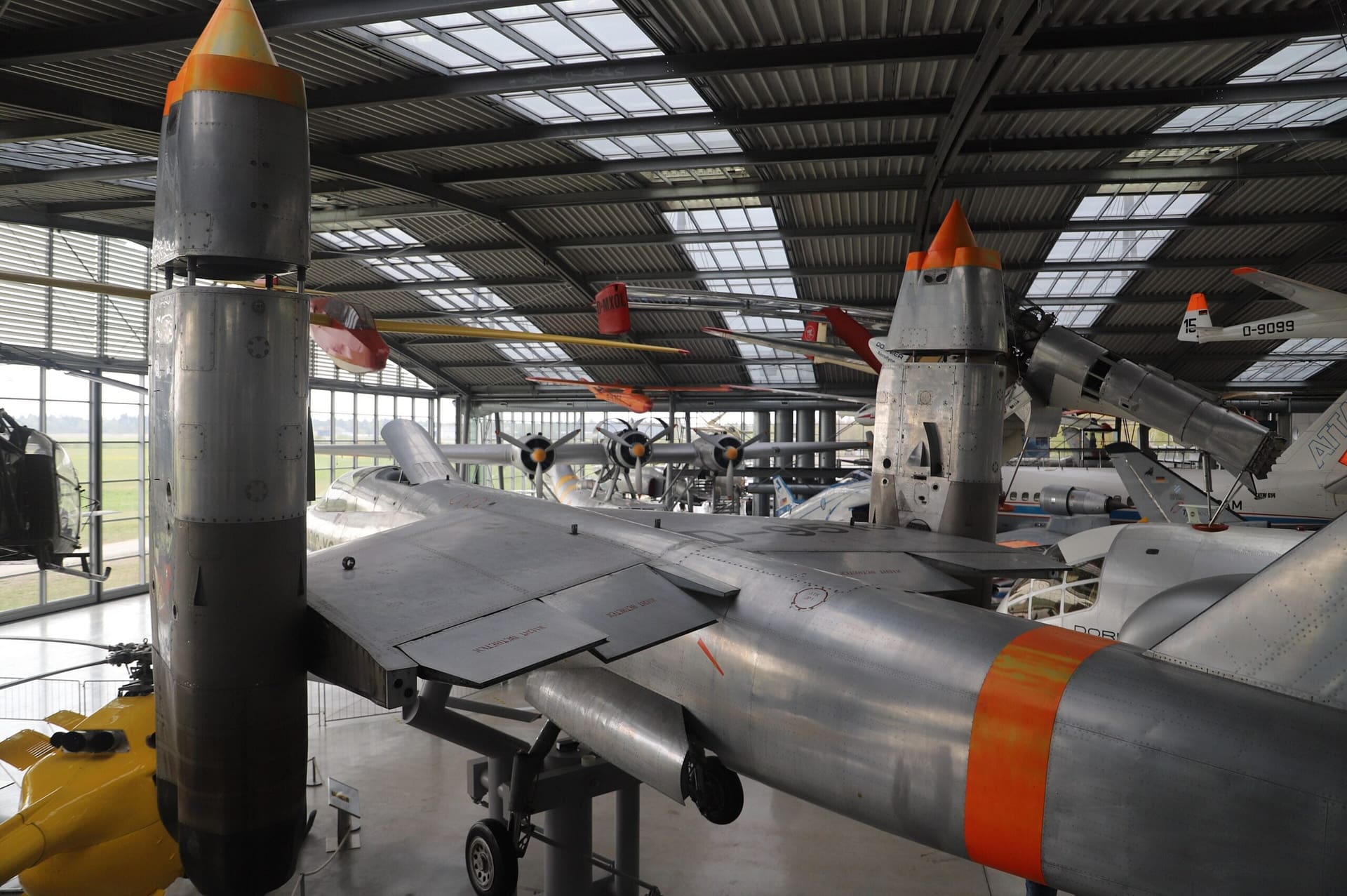
The aircraft EWR designed used a “lift plus lift-cruise” propulsion architecture. Two turbojets sat in tandem behind the cockpit, oriented vertically — pure lift engines, used only during takeoff and landing. The other four engines were mounted in pairs in nacelles at the wingtips, where they could pivot through 90 degrees: vertical for takeoff, horizontal for cruise. With the wingtip engines rotated forward, the aircraft was a conventional jet fighter. With them rotated vertical, it was a hovercraft with afterburners.
The Rolls-Royce/MAN Turbo RB.145 turbojet that powered the prototype was a lightweight design specifically developed for this role. It produced 12.2 kN of thrust dry and was small enough that mounting two in a single wingtip nacelle was actually possible. The wingtip arrangement also solved the engine-out problem: if one engine failed in hover, the second engine in the same nacelle could compensate.
29 July 1964 — Mach 1 in vertical-takeoff configuration
The X-1 prototype began hover trials in April 1963. By September it was performing complete transitions — vertical takeoff, transition to horizontal flight, transition back to vertical, vertical landing. In May 1964 it appeared at the Hannover Air Show. And on 29 July 1964 it reached Mach 1.04 in a shallow dive over Bavaria — without afterburner — becoming the first VTOL aircraft in the world to break the sound barrier.
The X-2 prototype, an evolved version with afterburning RB.145R engines, began hover tests in 1965. It first hovered freely on 12 June 1965 and completed its first full transition, with a new autopilot system, on 22 October 1965. The combined programme had now demonstrated every element EWR had promised — vertical takeoff, transition, supersonic flight, vertical landing — though never the Mach 2 performance the operational fighter was meant to deliver.
And it was at this point that the West German government cancelled the programme.
Why it died
Three reasons. First, the original X-1 prototype crashed at Manching on 14 September 1964, seven weeks after its supersonic flight. The pilot ejected safely; the airframe was a write-off. The crash was traced to a defect in the autopilot. Second, the projected cost of the operational VJ 101D — the full Mach 2 version with radar and weapons — had climbed far beyond that of the F-104G it was meant to replace. Third, the Bundesluftwaffe doctrine had shifted. By 1967 the assumption that all runways would be destroyed in a Warsaw Pact attack was being challenged by NATO planners who argued that dispersed, hardened shelters offered better survivability per Deutschmark.
The programme was formally cancelled in 1968. EWR was wound down. The X-2 prototype was sent to the Deutsches Museum at Flugwerft Schleißheim outside Munich, where it remains on public display.
The VJ 101 left a quiet legacy. Germany’s broader VTOL effort of the era also produced the VFW VAK 191B strike fighter and the Dornier Do 31 transport — neither of which entered service either. But the fundamental idea — propulsion units that swivel between vertical and horizontal — re-emerged decades later in tiltrotors like the V-22 Osprey and is now the basis of many modern eVTOL air-taxi designs.
What Germany did at Manching in April 1963 was, by every honest engineering measure, a remarkable achievement. A six-engined VTOL fighter that could hover, transition, fly supersonic, transition again, and land vertically was, in 1964, the most advanced aircraft of its category in the world. The Harrier — which entered service in 1969 — was simpler, cheaper, and ultimately operational. The VJ 101 was none of those things. But it was the first to do what every modern eVTOL designer is now trying to do all over again.
Sources: EWR VJ 101 Wikipedia entry; Deutsches Museum Flugwerft Schleißheim collection notes; Air Vectors (Greg Goebel) “German Jet VTOL”; Plane Historia.


 English
0 Comments