
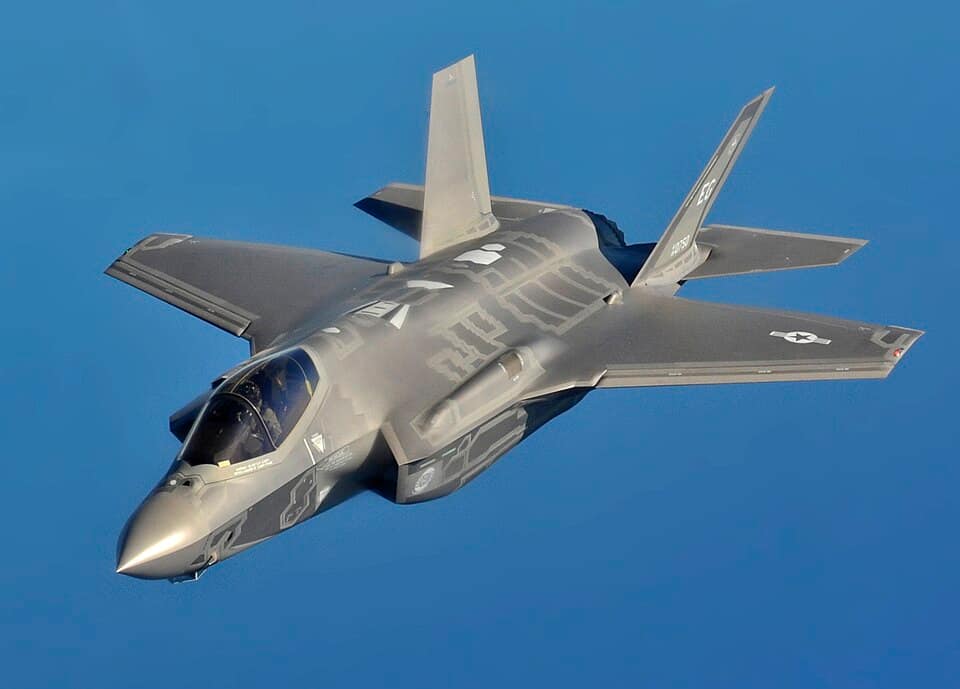

The pilot reported trouble maneuvering. Seconds later, the canopy blew off, the Martin-Baker US16E ejection seat fired, and a $100-million stealth fighter plummeted into the empty Nevada desert. On March 31, 2026, an F-35A Lightning II from Nellis Air Force Base went down approximately 25 miles northeast of Indian Springs — deep inside the restricted airspace of the Nevada Test and Training Range.
The pilot survived with minor injuries. Emergency responders reached the scene quickly, and the 57th Wing confirmed there was no impact to populated areas. But the crash adds another entry to a growing list — and raises fresh questions about the world’s most expensive weapons programme at a moment when the F-35 fleet is expanding faster than ever.
This is at least the 16th time an F-35 has been destroyed or damaged beyond repair since the type entered operational service. That’s a crash rate of roughly 1.6 per 100,000 flying hours — still better than the F-16’s lifetime average of 3.55. But each loss stings differently when the airframe costs north of $80 million.
What We Know So Far
The aircraft belonged to the 57th Wing, which runs some of the Air Force’s most demanding mission sets: weapons evaluation, tactics development, aggressor training, and large-force exercises like Red Flag. Nellis is where the best pilots in the world come to sharpen their edge — and where aircraft get pushed hardest.
Details remain thin. The 57th Wing’s statement was terse: “The incident occurred approximately 25 miles northeast of Indian Springs, Nevada, within the controlled airspace and restricted federal property of the Nevada Test & Training Range. Emergency responders are on-scene and there is no impact to populated areas.” A formal crash investigation is underway, and investigators will likely need weeks — possibly months — to determine the cause.
What we do know: the pilot told controllers the jet was not responding normally before ejecting. That points toward a flight-control or engine issue rather than a mid-air collision or spatial disorientation. But speculation at this stage is just that — speculation.
The Seat That Saves Lives
If there’s one piece of good news in any fighter crash, it’s when the ejection seat works. The Martin-Baker US16E — the common seat across all F-35 variants — is designed to get a pilot out of the cockpit and under a parachute in under three seconds. It uses an under-seat rocket motor to blast the entire seat assembly clear of the aircraft, then stabilises the pilot with drogue chutes before deploying the main canopy.
“The pilot ejected safely and was treated for minor injuries.” — 57th Wing, Nellis Air Force Base
The US16E includes a unique Neck Protection Device — essentially an airbag system with three inflatable cushions that cradle the pilot’s head and prevent the heavy F-35 helmet from snapping the neck backward during the violent deceleration of ejection. Martin-Baker has delivered over 1,400 of these seats to Lockheed Martin. Every single one is built on the assumption that, someday, it might have to work for real.
In this case, it did.
A Pattern — Or Just Statistics?
The previous F-35 loss came just two months earlier, in January 2026, when an F-35A at Eielson Air Force Base in Alaska crashed during the landing phase of a routine training mission. That pilot also ejected safely. Before that, a South Carolina Air National Guard F-35 went down in 2025. And a Marine Corps F-35B was lost in 2022 after the pilot ejected over a neighbourhood in Fort Worth, Texas — one of the more surreal images in modern military aviation.
Lockheed Martin and the Pentagon argue the numbers are in context. With over 1,000 aircraft delivered to more than a dozen nations and hundreds of thousands of flight hours logged, the F-35 fleet is enormous. The crash rate per flying hour remains well within historical norms for tactical fighters. But the programme’s critics point out that each jet costs roughly twice what an F-16 does — and that the fleet has been plagued by supply-chain delays, engine problems, and software bugs that have nothing to do with crashes but everything to do with confidence.
The Nevada crash won’t ground the global fleet. It will, however, add fuel to an already heated debate in Congress about whether the F-35’s Technology Refresh 3 upgrade and new Pratt & Whitney engines — the subject of a $6.6 billion contract signed just the day before the crash — can finally deliver the reliability the programme has long promised.
For the pilot who punched out over the desert, none of that matters. The seat worked. The chute opened. And he walked away. In a business where the margins are measured in milliseconds, that’s the only statistic that counts.
Sources: The War Zone, Stars and Stripes, Air & Space Forces Magazine, Military.com

 English
0 Comments