
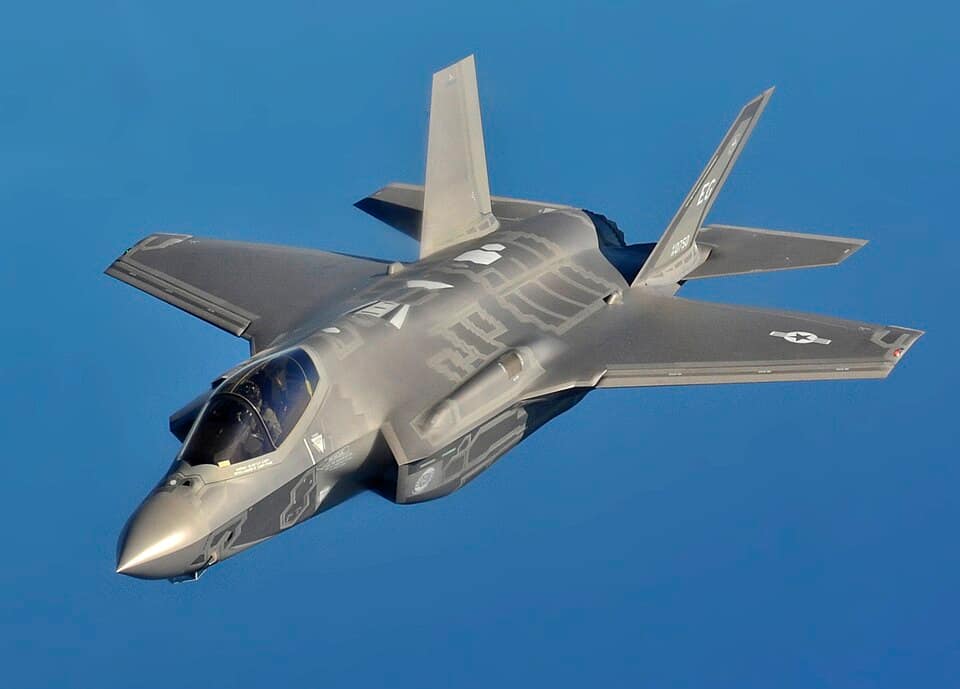
Quick Facts
- What: F-35A Lightning II crash with successful pilot ejection
- When: March 31, 2026, around noon local time
- Where: Nevada Test and Training Range, ~25 miles NE of Indian Springs
- Unit: 57th Wing, Nellis Air Force Base
- Pilot status: Safe, minor injuries

A $100-million stealth fighter hits the Nevada desert at noon. The pilot is already under a parachute canopy, drifting toward the sand. Below, the wreckage of an F-35A Lightning II sends a column of smoke into the clear sky over the Nevada Test and Training Range — America’s most important patch of military airspace.
The crash happened on March 31, approximately 25 miles northeast of Indian Springs, Nevada, well within the restricted federal airspace that surrounds Nellis Air Force Base. The jet belonged to the 57th Wing, the unit responsible for weapons testing, advanced tactics development, and aggressor training — the missions that push the F-35 to its limits every day.
The Air Force confirmed the pilot ejected safely. “Emergency responders are on-scene and there is no impact to populated areas,” the 57th Wing said in a statement. “The pilot is safe and being treated for minor injuries.”
When the World’s Most Advanced Fighter Goes Down
An F-35 crash is never routine news. At roughly $100 million per airframe, every loss carries a price tag that dwarfs most military budgets. But it’s the ejection that tells the real story. Punching out of a fast jet is a last-resort decision — the canopy blows, a rocket catapult fires the pilot clear, and the forces involved compress the spine and batter the body. That this pilot walked away with minor injuries is a testament to both training and the Martin-Baker ejection seat.
The Air Force reported the aircraft had “trouble maneuvering” before the ejection, a deliberately vague phrase that could mean anything from a flight-control malfunction to an engine problem. A formal investigation will follow, but answers are months away — the wreckage sits in some of the most restricted airspace on Earth.
A Pattern — But Not the One You Think
Critics will point to this as evidence the F-35 is unreliable. The record tells a more nuanced story. The Lightning II’s Class A mishap rate — roughly 1.6 per 100,000 flying hours — is less than half the F-16’s lifetime average of 3.55. With over 965 aircraft delivered and more than 720,000 flight hours logged across nine nations, the F-35 fleet is enormous. Statistically, incidents will occur.
What matters is what caused them. Of previous F-35 losses, roughly six were attributed to pilot error and three to mechanical failures. One involved a power-plant fuel tube; another, an air-data-system glitch that left the pilot flying partially blind. The Alaska crash in January 2025 was especially dramatic — the pilot spent 50 minutes on a phone call with Lockheed Martin engineers before the jet became unflyable and he punched out. The aircraft was destroyed, but the pilot survived with minor injuries.
Why Nellis Matters
This wasn’t a student pilot on a training hop. Nellis is where the Air Force’s best fly the hardest. The Nevada Test and Training Range covers more than 12,000 square miles of desert — a vast sandbox where every scenario from basic combat manoeuvring to full-scale Red Flag exercises plays out at speeds above Mach 1. The 57th Wing’s F-35s fly aggressor sorties, develop new tactics, and test weapon integrations that define how the jet will fight in a real war.
Losing an F-35 here hurts twice: the aircraft is gone, and the mission it was flying — whatever cutting-edge test or evaluation was underway — is set back by months.
The Bigger Picture
The F-35 program is the largest and most expensive weapons system in history, with a projected lifecycle cost north of $1.7 trillion. Every crash feeds a debate that has raged since the jet’s troubled development years: is the Lightning II worth the investment? Supporters point to its unmatched sensor fusion and stealth capability. Detractors see a jet that tries to do everything and does nothing cheaply.
For the pilot who stepped out of a parachute harness into the Nevada sand on Monday, the debate is academic. The jet did what it was supposed to do right up until it didn’t — and the ejection seat did the rest. That’s as good an outcome as you can hope for when a $100-million machine meets the desert floor.
Sources: The War Zone, Stars and Stripes, Air & Space Forces Magazine, Simple Flying


 English
0 Comments