
Prime Contractor Boeing
FY2027 Budget Request ~$3.5 billion ($2.6B discretionary + $900M reconciliation)
Congressional Add Additional $500M (raising base to $3.08B)
Replaces Lockheed Martin F-22 Raptor
Planned Fleet 185+ aircraft
Expected In Service Early-to-mid 2030s
Estimated Programme Cost $20+ billion before production begins

The Pentagon just bet $3.5 billion on a jet most people have never heard of. The Boeing F-47 — America’s sixth-generation fighter — received its largest funding allocation to date in the fiscal year 2027 budget, signalling that the programme is no longer a concept study or a technology demonstrator. It’s a fighter that’s getting built.
The budget request combines $2.6 billion in discretionary funding with $900 million from the reconciliation bill. Congress then added another $500 million on top, pushing the base allocation to $3.08 billion. Analysts estimate the total programme cost will exceed $20 billion before a single production aircraft rolls off the line. By comparison, the entire Apollo programme cost roughly $25 billion in 1973 dollars.
The F-47 will replace the F-22 Raptor — itself the world’s most capable air superiority fighter. The Air Force plans to buy at least 185 F-47s, with initial operational capability expected in the early-to-mid 2030s. That timeline is aggressive for an aircraft this advanced, but the Pentagon clearly isn’t in the mood to wait.
Boeing Over Lockheed — the Upset
The biggest surprise wasn’t the money. It was who got it. Boeing — not Lockheed Martin — won the contract to build the F-47. Lockheed had built every American stealth fighter since the F-117 Nighthawk in the 1980s: the F-22, the F-35, and every classified demonstrator in between. The assumption across the defence industry was that Lockheed would win again. They didn’t.
The Air Force hasn’t publicly explained the decision in detail, but analysts point to several factors. Lockheed’s F-35 programme has been plagued by cost overruns and delays that frustrated military leadership. Boeing’s proposal reportedly offered a more producible design — easier to build, cheaper to maintain, and better suited to rapid scaling if a major conflict demanded it. In a world where the F-22’s production line shut down after just 187 aircraft because Congress refused to fund more, the ability to mass-produce matters.
The decision also reflects a deliberate Pentagon strategy to keep Boeing viable as a fighter manufacturer. If Lockheed won every major combat aircraft programme, the defence industrial base would effectively become a monopoly. By awarding the F-47 to Boeing, the Air Force keeps two companies capable of designing and building cutting-edge fighters. Competition drives innovation. Monopoly kills it.

What We Know — and What We Don’t
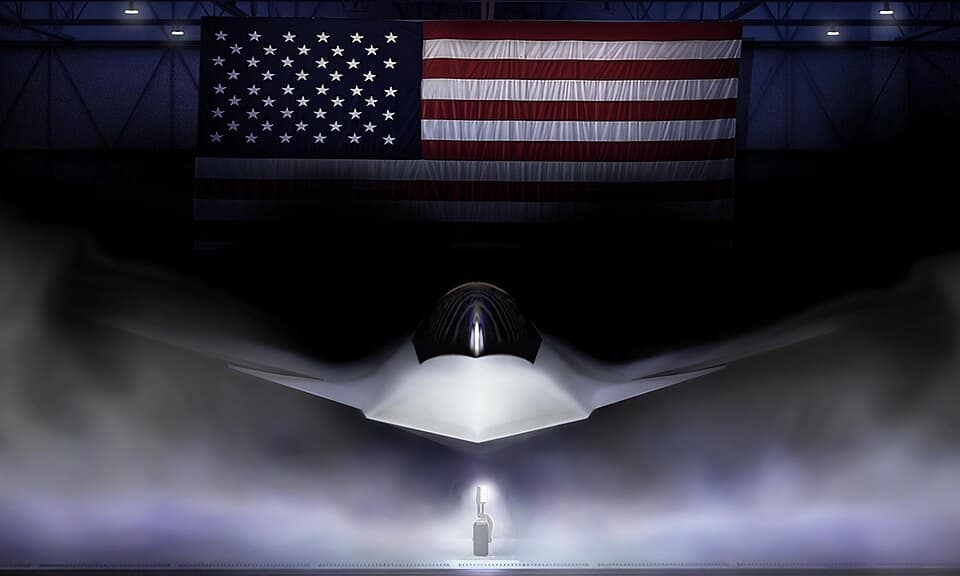
Almost everything about the F-47 is classified. The official artist’s rendering shows a large, tailless flying-wing shape — more like a stealth bomber than a traditional fighter. That suggests range is a primary design driver. The Pacific Ocean is vast, and any conflict with China would require fighters that can fly enormous distances without tanker support. The F-22 has a combat radius of roughly 460 miles. The F-47 is expected to reach substantially farther.
The aircraft is being designed to work alongside autonomous wingmen — the Collaborative Combat Aircraft (CCA) drones that the Air Force is developing in parallel. A single F-47 pilot could command two or three CCAs, multiplying the firepower and sensor coverage of each mission without multiplying the number of human pilots at risk. The fighter becomes a command node in a network of crewed and uncrewed platforms.
Sixth-generation features are expected to include advanced sensor fusion far beyond what the F-35 offers, next-generation stealth shaping, adaptive engines that can switch between high-thrust and high-efficiency modes, and directed-energy weapons — possibly laser systems for close-in defence or offensive use. Whether all of these will make it into the production aircraft is an open question, but the budget allocation suggests the Air Force isn’t cutting corners.
The Navy Gets Left Behind
While the F-47 gets billions, the Navy’s own sixth-generation programme — the F/A-XX, intended to replace the F/A-18E/F Super Hornet — received only a fraction of the funding. The 2027 budget effectively puts the Navy’s next fighter on hold while the Air Force sprints ahead. Defense analysts describe it as the Pentagon going “all in” on the Air Force’s programme and asking the Navy to wait its turn.
The contrast is stark. The Air Force is accelerating toward a future where human pilots command drone wingmen from a stealth platform that can cross oceans. The Navy is still flying upgraded versions of a jet that first flew in 1995. At some point, that gap will become untenable — but for now, the F-47 is eating the budget, and Boeing’s engineers are building the future of American air power.
Three and a half billion dollars. A jet nobody outside a classified briefing room has ever seen fly. And a bet that the next war in the sky will be won by the side that gets there first. The F-47 isn’t a fighter yet. But it’s not a PowerPoint slide anymore, either.
Sources: Defense One, Air & Space Forces Magazine, DefenseScoop, Congressional appropriations records



 English
0 Comments