The most important procurement decision in American naval aviation this decade will be made in August. Two companies — Boeing and Northrop Grumman — are competing for the F/A-XX contract, the programme to build the United States Navy’s sixth-generation carrier-based fighter. The loser walks away with nothing. The winner defines what lands on American flight decks for the next fifty years.
Defense Secretary Pete Hegseth confirmed the timeline during congressional testimony in April 2026. The Navy’s top admiral has echoed it. And Congress has put real money behind the words: approximately $1.69 billion has been appropriated to keep the F/A-XX moving — including $750 million specifically earmarked to support the contract decision itself.
This is not a study. It is not a concept. It is a downselect with a date on it.
Quick Facts
Programme: F/A-XX Next Generation Fighter (NGF) — Navy 6th-generation carrier fighter
Decision: Downselect expected August 2026
Competitors: Boeing and Northrop Grumman (Lockheed Martin eliminated early 2025)
Funding: ~$1.69 billion appropriated, including $750 million for the contract decision (through FY2029)
Replaces: F/A-18E/F Super Hornet
Key requirement: Carrier-compatible, long-range, stealthy, networked with uncrewed wingmen
Context: Europe’s SCAF 6th-gen programme collapsed in early 2026, making F/A-XX the world’s most advanced naval fighter effort
Boeing vs. Northrop Grumman
Lockheed Martin — builder of the F-35 and F-22 — was eliminated from the F/A-XX competition in early 2025 after its proposal failed to meet programme requirements. That left Boeing and Northrop Grumman as the two remaining contenders.
Both companies have been extraordinarily tight-lipped about their designs. The programme is classified at a level that makes even the F-47 look transparent. But in April 2026, Northrop Grumman broke the silence with a polished concept video showing a tailless naval fighter on the deck of a Ford-class carrier — the most detailed public rendering either competitor has produced.
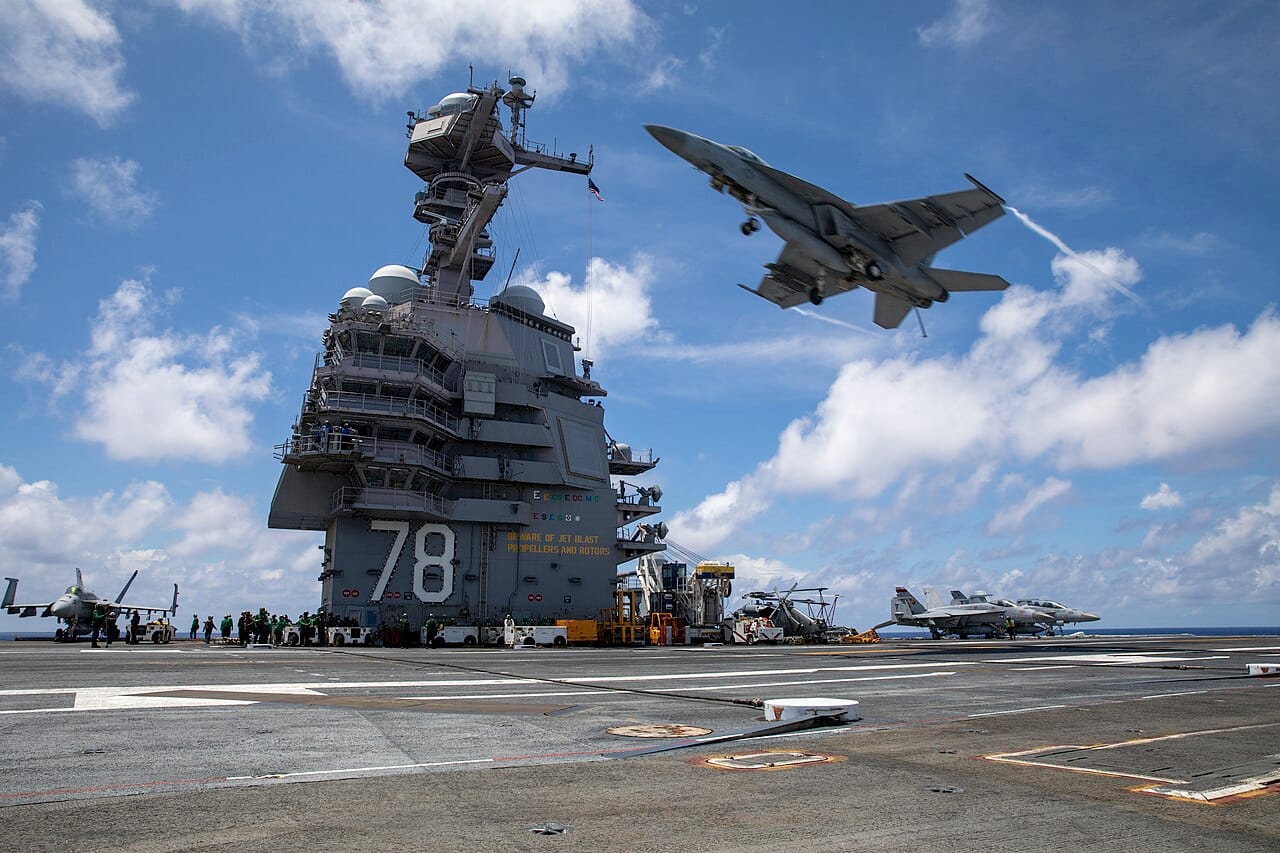
The flight deck of USS Gerald R. Ford — the F/A-XX sixth-generation fighter is designed to operate from these decks alongside F-35Cs and MQ-25 Stingray tanker drones. US Navy / Wikimedia Commons
The concept showed a large, flying-wing-type aircraft with no vertical tail surfaces — a design that maximises stealth and range at the expense of traditional agility. If the final aircraft resembles the concept, the F/A-XX will look nothing like the Super Hornet it replaces.
Boeing, which built the Super Hornet and the ill-fated X-32 Joint Strike Fighter prototype, has shown nothing publicly. Whatever Boeing is proposing remains behind the classification wall.
Why August Matters
The F/A-XX downselect is the culmination of a programme that has been in conceptual development since the early 2010s. The Navy has known for more than a decade that the Super Hornet — first flown in 1995 — will eventually reach the limits of what a fourth-generation airframe can absorb in terms of upgrades. The F-35C provides stealth and sensor fusion but lacks the range, payload, and raw performance that a purpose-built air superiority fighter demands.
The F/A-XX is designed to fill that gap: a carrier-compatible sixth-generation platform with long range, low observability, advanced electronic warfare, and deep integration with uncrewed collaborative combat aircraft. It is the Navy’s answer to China’s J-35 and whatever comes after it.
“It is not a matter of if, it is a matter of when. It is a critical capability that we need to fund for the future of naval aviation.”
Secretary of Defense Pete Hegseth — Congressional testimony, April 2026
The SCAF Collapse Changes the Calculus
The timing of the F/A-XX decision is especially significant in light of the early-2026 collapse of Europe’s SCAF programme — the Franco-German-Spanish attempt to build a sixth-generation fighter. With SCAF dead and the UK-Italy-Japan GCAP programme still years from hardware, the F/A-XX is now the most advanced sixth-generation naval fighter programme on earth.
That puts immense pressure on the August decision. Whatever the Navy picks will not only define American carrier aviation but also set the benchmark that allied navies measure against. The Royal Navy, the French Navy, and eventually the Japanese Maritime Self-Defense Force will all be watching.
$1.69 Billion and Counting
The nearly $1.7 billion in Congressional funding — including the $750 million earmarked for the contract decision — signals that lawmakers are serious about keeping the timeline. In a defence budget environment where programmes routinely slip, that kind of money speaks louder than any press release.
August 2026. Two companies. One contract. The fighter that launches from American carriers in the 2030s and beyond is about to be chosen. Whatever emerges from behind the classification wall will define naval air power for half a century.
Sources: USNI News, The War Zone, FlightGlobal, 19FortyFive, Bloomberg
Every fighter pilot trains for it. Most pray they'll never experience it. The moment a jet engine — the machine that keeps you flying at 500 knots and 30,000 feet — stops working. Whether it's a compressor stall that sounds like a cannon going off behind your seat, a...
Luca Parmitano has lived two lives that most people only dream about. In the first, he was a fighter pilot — flying AMX Ghibli attack jets for the Italian Air Force, deployed to Afghanistan, trained to fly low and fast into hostile territory. In the second, he became...
Before the Rafale, before the Mirage 2000, before the Mirage F1 — there was the Mirage III. Dassault's first supersonic fighter was a revelation when it entered service in 1961: a sleek, tailless delta that could break Mach 2, carry a nuclear bomb, and outfight...



 English
0 Comments