

Quick Facts
Date: April 19, 2026
Location: North Arabian Sea, en route to Bandar Abbas, Iran
U.S. Ship: USS Spruance (DDG 111), Arleigh Burke-class guided-missile destroyer
Iranian Vessel: M/V Touska, Iranian-flagged cargo ship (under sanctions since 2018)
Weapon Used: 5-inch MK 45 Mod 4 naval gun
Boarding Force: 31st Marine Expeditionary Unit, launched from USS Tripoli (LHA 7)
Last Comparable Incident: Operation Praying Mantis, April 18, 1988
Operation: Operation Epic Fury naval blockade
Six Hours of Silence, Then a Shell
The standoff began when the Touska entered the U.S. Navy’s blockade zone in the north Arabian Sea. Under the rules of Operation Epic Fury — the naval blockade that went into effect on April 13, involving more than 10,000 troops, over a dozen warships, and more than 100 aircraft — no vessel may transit to or from Iranian ports without inspection. Spruance‘s crew tried radio contact. They tried visual signals. They tried every escalation short of kinetic action. For six hours, Touska held course at 17 knots, heading straight for Bandar Abbas. Then Spruance ordered the Touska‘s crew to evacuate the engine room. Several rounds from the destroyer’s 5-inch gun followed, punching into the engine spaces and killing the ship’s propulsion. The Touska drifted to a stop.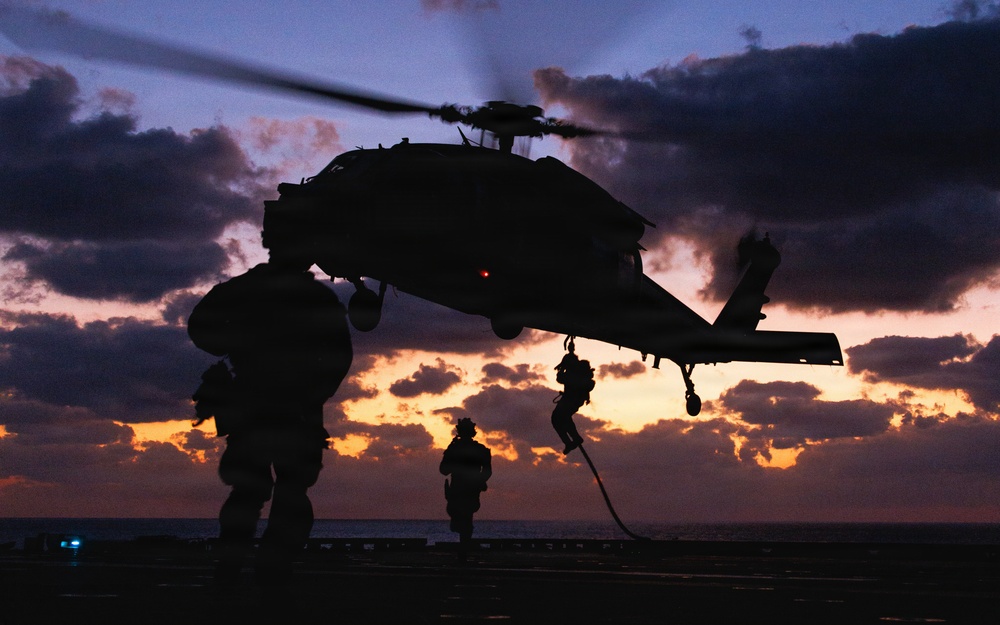
Marines on the Deck
Once the Touska was dead in the water, helicopters lifted off from the amphibious assault ship USS Tripoli (LHA 7), carrying Marines from the 31st MEU’s Maritime Raid Force. They flew across the Arabian Sea, hovered over the cargo ship’s deck, and fast-roped down. The boarding was textbook. CENTCOM released video showing Marines descending onto the vessel, sweeping compartments, and securing the crew. President Trump announced the seizure on social media before CENTCOM’s formal statement followed hours later. The Touska has been under U.S. sanctions since 2018 and remains in American custody. Iran’s military has vowed retaliation for what it calls a violation of international maritime law. The ship’s cargo has not been publicly disclosed.Praying Mantis: The Last Time a Destroyer Opened Fire
The Navy confirmed that the last time an American warship fired its deck gun at another vessel was April 18, 1988 — Operation Praying Mantis, the largest U.S. naval engagement since the Second World War. That day, a task force of cruisers, destroyers, and frigates struck back after the guided-missile frigate USS Samuel B. Roberts hit an Iranian mine four days earlier. Among the targets was the Iranian fast attack craft IRIS Joshan, which made the suicidal decision to fire a Harpoon missile at USS Wainwright. The missile missed. Wainwright, along with USS Simpson and USS Bagley, returned fire with 5-inch guns and sank the Joshan.
What It Means
The Touska incident is a signal — not just to Iran, but to every nation watching the blockade. The U.S. Navy is willing to use its most basic, most visible weapon to enforce the cordon. Not a missile. Not an electronic attack. A shell through the engine room. Unmistakable and extremely public. The blockade involves a massive force: more than a dozen warships, over 100 fighter and surveillance aircraft, and 10,000 personnel. It is the largest naval enforcement operation since Desert Storm. And unlike missile strikes — which happen over the horizon and appear on radar screens — a 5-inch gun leaves a hole you can photograph. Iran’s navy, already weakened by weeks of Epic Fury strikes, has limited options. The conventional fleet is degraded. The fast-attack boat swarms that once threatened the Strait of Hormuz have been thinned. What remains is asymmetric — mines, small boats, and the political will to absorb punishment. The Touska seizure may not be the last. As long as the blockade holds, ships will try to run it. And if they refuse to stop, the Navy has now demonstrated exactly what happens next.Sources: The War Zone, Military Times, Stars and Stripes, Naval News, CENTCOM

 English
0 Comments