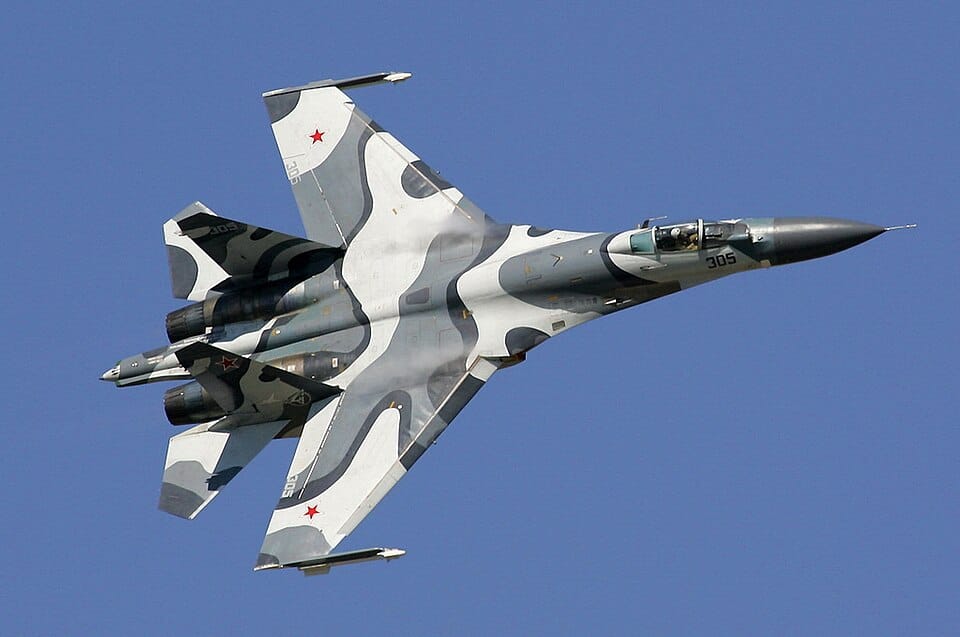
In February 1999, over the dusty plains of the Horn of Africa, two Soviet-designed fighters that had been built to fight NATO met each other instead. Ethiopian Su-27 Flankers engaged Eritrean MiG-29 Fulcrums in the first Sukhoi-versus-Mikoyan air combat in history — a duel between the two finest products of Cold War Soviet aviation, fought by two of the world’s poorest nations, with Russian and Ukrainian advisors coaching from opposite sides of the airfield.
The result was lopsided. At least two MiG-29s were confirmed shot down, with a third claimed. Zero Su-27s were lost. Air supremacy over the Badme front passed to Ethiopia within days and never returned to Eritrea. It was a small air war — a handful of jets, a handful of pilots — but its lessons about fourth-generation fighter combat are studied in war colleges to this day.
Quick Facts
Conflict: Eritrean-Ethiopian War (1998-2000)
Key engagements: 21, 25, and 26 February 1999
Ethiopia: 6x Su-27SK + 2x Su-27UB, with Russian technical advisors
Eritrea: 8x MiG-29A + 2x MiG-29UB, with Ukrainian technical advisors
Result: 2 MiG-29s confirmed shot down (plus 1 claimed), 0 Su-27s lost
Significance: Only Su-27 vs MiG-29 combat in history
The Arms Race
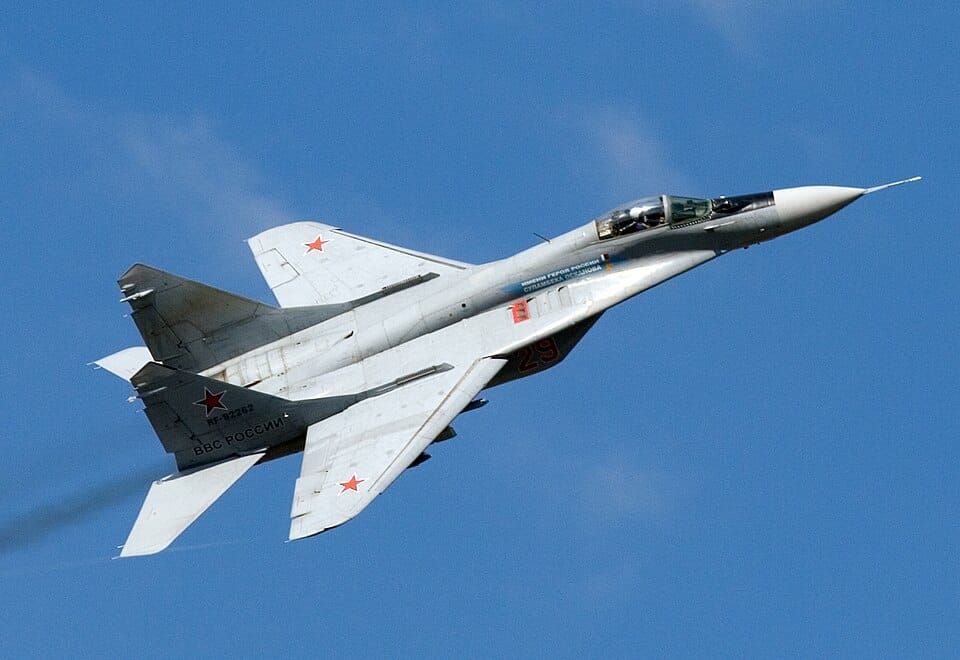
The war began in May 1998 over a patch of scrubland around the border town of Badme. Neither country had a modern air force. Both scrambled to buy one. Ethiopia turned to Russia and purchased six Su-27SK single-seat fighters and two Su-27UB two-seat trainers, delivered from December 1998 with 300 Russian advisors. Eritrea turned to Ukraine and acquired eight MiG-29As and two MiG-29UB trainers, with Ukrainian instructors.
The MiG-29 Fulcrum — two Eritrean MiG-29s were confirmed shot down (plus one claimed) by Ethiopian Su-27s for zero losses. Wikimedia Commons
The irony was extraordinary. Both aircraft were products of the same Soviet military-industrial complex, designed in the same era, to fight the same enemy. Now they would fight each other, crewed by African pilots with barely a hundred hours on type, advised by post-Soviet experts whose own nations could no longer afford to operate these jets.
Three Days in February
On 21 February 1999, two Eritrean MiG-29s attempted to ambush an Ethiopian Su-27 north of Mekelle. The Flanker evaded and damaged one attacker — the first shots of the air war. On 25 February, an Eritrean MiG-29 piloted by Yonas Misghinna scrambled from Asmara to intercept an Ethiopian Su-27SK flown by Lt. Col. Gebre-Salassie. The engagement was brief. The Su-27 fired and the MiG-29 went down. Misghinna was killed.
Historian Tom Cooper, who documented this air war in detail, concluded the Flanker decisively outclassed the Fulcrum in these engagements.
The next day, 26 February, another Eritrean MiG-29 — this one piloted by Samuel Girmay — was sent south to intercept the same Su-27 pilot. Gebre-Salassie shot him down too. Two kills in two days. The Eritrean Air Force had lost a quarter of its fighter fleet in 48 hours, and its best pilots were dead. They never regained the initiative.
Why the Flanker Won
The Su-27 had advantages the MiG-29 could not overcome. Longer range — both in fuel and in radar detection — meant the Flanker pilot saw the Fulcrum first and could dictate the terms of the engagement. The Su-27’s R-27 missiles outranged the MiG-29’s weapons. And critically, the Russian advisors coaching the Ethiopian pilots were more experienced than the Ukrainian advisors on the Eritrean side.
But the biggest factor may have been the simplest: the Su-27 is a bigger, more capable aircraft. It was designed as the Soviet air-superiority heavyweight — their answer to the F-15. The MiG-29 was the lightweight complement — their F-16. In a head-to-head fight without the numerical advantage the MiG-29 was supposed to enjoy, the Flanker’s superior radar, range, and missile loadout proved decisive.
The Ethiopian-Eritrean air war lasted barely a month in its most intense phase. But it answered a question that Cold War planners had debated for decades: what happens when the Flanker meets the Fulcrum? The answer, over the Horn of Africa, was unambiguous.
Sources: Wikipedia, Russia Beyond, Military Watch Magazine, We Are The Mighty, Tom Cooper
Before AWACS, air warfare was a knife fight in a dark room. Pilots relied on their own radar, ground controllers with limited visibility, and radio calls that were often confused, late, or wrong. After AWACS, one side had the lights on and the other did not. The...
On May 1, 1960, CIA pilot Francis Gary Powers took off from Peshawar, Pakistan in a Lockheed U-2 spy plane. His mission: fly across the entire Soviet Union at 70,000 feet, photographing military installations, and land in Bodø, Norway. He never made it. A Soviet S-75...
When the Sukhoi Su-47 Berkut rolled out in 1997, it looked like nothing else in the sky. Its wings swept forward instead of back — an aerodynamic concept that promised extraordinary agility, superior low-speed handling, and enhanced controllability at high angles of...

 English
0 Comments