
Partners United Kingdom and France
Purpose 12-month joint study into a successor to the MBDA Meteor BVRAAM
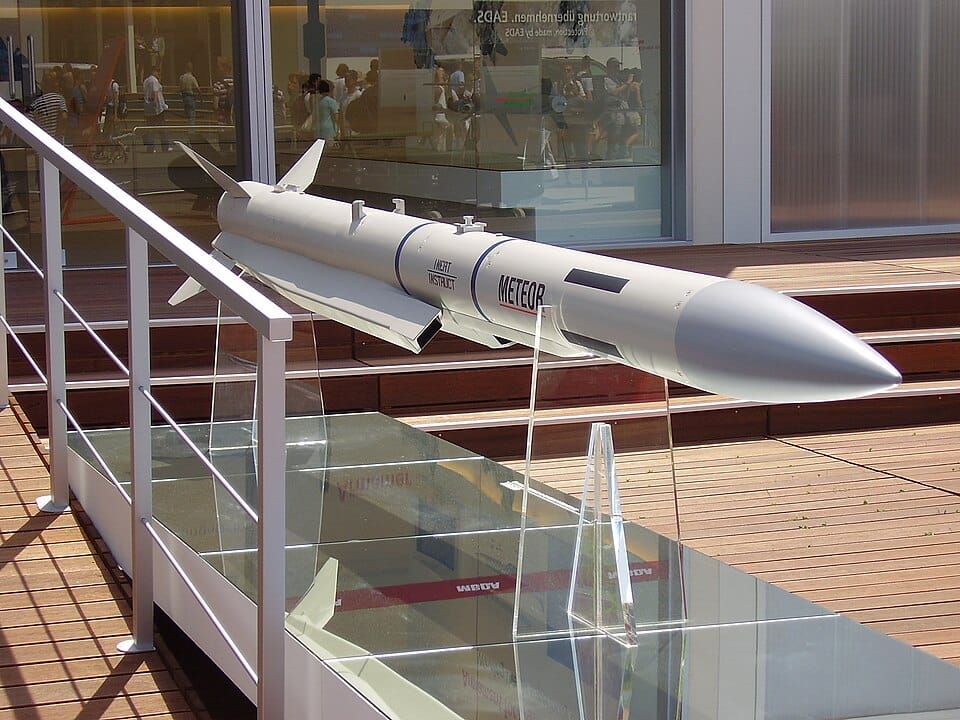
Current Missile MBDA Meteor — ramjet-powered, 100+ km range, in service on Typhoon, Rafale, and Gripen
Why Now Emerging threats including China’s PL-17 ultra-long-range AAM and advancing electronic countermeasures
Framework Lancaster House 2.0 bilateral defence agreement (signed July 2025)
Coordination Joint Complex Weapons Portfolio Office within OCCAR

The best air-to-air missile in European service is not good enough anymore. On April 1, the United Kingdom and France signed a memorandum of understanding to begin a 12-month joint study into what comes after the MBDA Meteor — the ramjet-powered beyond-visual-range missile that currently arms Typhoon, Rafale, and Gripen fighters across a dozen air forces.
The Meteor is widely considered the most capable Western BVRAAM in service. Its throttleable ramjet motor gives it a no-escape zone significantly larger than the American AIM-120 AMRAAM, and it has been a genuine success story for European defence cooperation. But the threat is evolving faster than the missile.
China’s PL-17, reportedly capable of engaging targets at ranges beyond 300 kilometres, has concentrated minds in London and Paris. So have advances in electronic countermeasures, stealth technology, and the proliferation of networked air defence systems that can coordinate to defeat incoming missiles.
Lancaster House 2.0
The MOU is a deliverable from the Lancaster House 2.0 agreement — the bilateral defence and security framework signed by Prime Minister Keir Starmer and President Emmanuel Macron in London on July 10, 2025. That pact committed both nations to deeper cooperation on next-generation weapons, and the Meteor successor study is the first concrete missile programme to emerge from it.
A joint Complex Weapons Portfolio Office will be established within OCCAR, the European defence procurement agency, to coordinate the study and align national priorities. The 12-month timeline is deliberately tight — the goal is not to design a missile but to define what the next missile needs to do, which technologies should go into it, and how to structure the development programme.
MBDA, which built the Meteor and is jointly owned by Airbus, BAE Systems, and Leonardo, is the obvious candidate to develop whatever emerges. But the study phase will also assess whether new entrants or technologies from outside the traditional missile industry should play a role.

Why the Meteor Is Not Enough
The Meteor entered service in 2016 and represented a genuine leap forward. Its ramjet sustainer motor — which breathes air rather than carrying its own oxidiser — gives it far more energy at long range than any rocket-powered competitor. Where a conventional missile’s motor burns out after a few seconds, leaving it to coast on dwindling speed, the Meteor keeps accelerating.
But air combat is entering a new era. Fifth- and sixth-generation fighters are stealthier, harder to detect, and can engage from further away. Drone swarms present a problem of volume — dozens of targets approaching simultaneously. And China’s PL-17 threatens to outrange every Western missile in service, potentially forcing NATO fighters into a disadvantaged first-shot scenario.
The successor will need to fly further, hit harder, and think smarter. That likely means some combination of improved propulsion, more sophisticated seekers with multi-mode guidance, and possibly networked capabilities that allow missiles to share targeting data in flight.
Arming the Next Generation
The timing matters because both nations are building new fighters. The UK’s GCAP programme — a joint effort with Italy and Japan — aims to deliver a sixth-generation combat aircraft in the mid-2030s. France is leading the SCAF programme with Germany and Spain. Both aircraft will need a missile that matches their ambitions.
Designing a missile takes a decade or more from concept to cockpit. Starting the study now gives the programme just enough runway to deliver a weapon in time for these new platforms. Wait another two years, and the maths stop working.
For two nations that do not always agree on defence priorities, the speed and specificity of this agreement is notable. The message is clear: Europe’s air-to-air dominance is not guaranteed, and the work to maintain it starts now.
Sources: FlightGlobal, Aviation Week, UK Defence Equipment & Support, Army Recognition


 English
0 Comments