On June 2, France took a step that puts it in a club with only three other members. The Direction générale de l’armement formally awarded MBDA the development contract for the ASN4G — a scramjet-powered hypersonic nuclear cruise missile designed to travel at speeds between Mach 6 and Mach 8, strike targets beyond 1,000 kilometres, and render every existing air defence system irrelevant.
With this single contract, France becomes the first European nation to develop a hypersonic nuclear weapon. The only other countries pursuing comparable technology are the United States, Russia, and China.
The ASN4G represents a deliberate strategic choice. During the programme’s upstream phase, two competing concepts were studied: Camosis, which favoured stealth and low observability, and Prométhée, which prioritised raw hypersonic speed. In 2021, the French president selected the hypersonic path.
Admiral Hervé de Bonnaventure explained the reasoning to a parliamentary panel: “Very high performance in speed and maneuverability is the best method to achieve detection as late as possible, and complicate the task of tracking a radar, or even of locking onto it, and finally, to disrupt an anti-missile attack.”
The logic is compelling. A missile travelling at Mach 8 covers more than two and a half kilometres every second. By the time a radar acquires it, a fire-control system calculates an intercept solution, and a surface-to-air missile is launched, the ASN4G has already moved. At those velocities, speed itself becomes a form of stealth.
The scramjet engine — developed under the Prométhée programme with ONERA, the French national aerospace research laboratory — uses dual-mode combustion that transitions from subsonic to supersonic to full hypersonic airflow. It is fueled by hydrocarbons rather than the exotic fuels sometimes associated with hypersonic research, which simplifies logistics considerably.
The Missile It Replaces
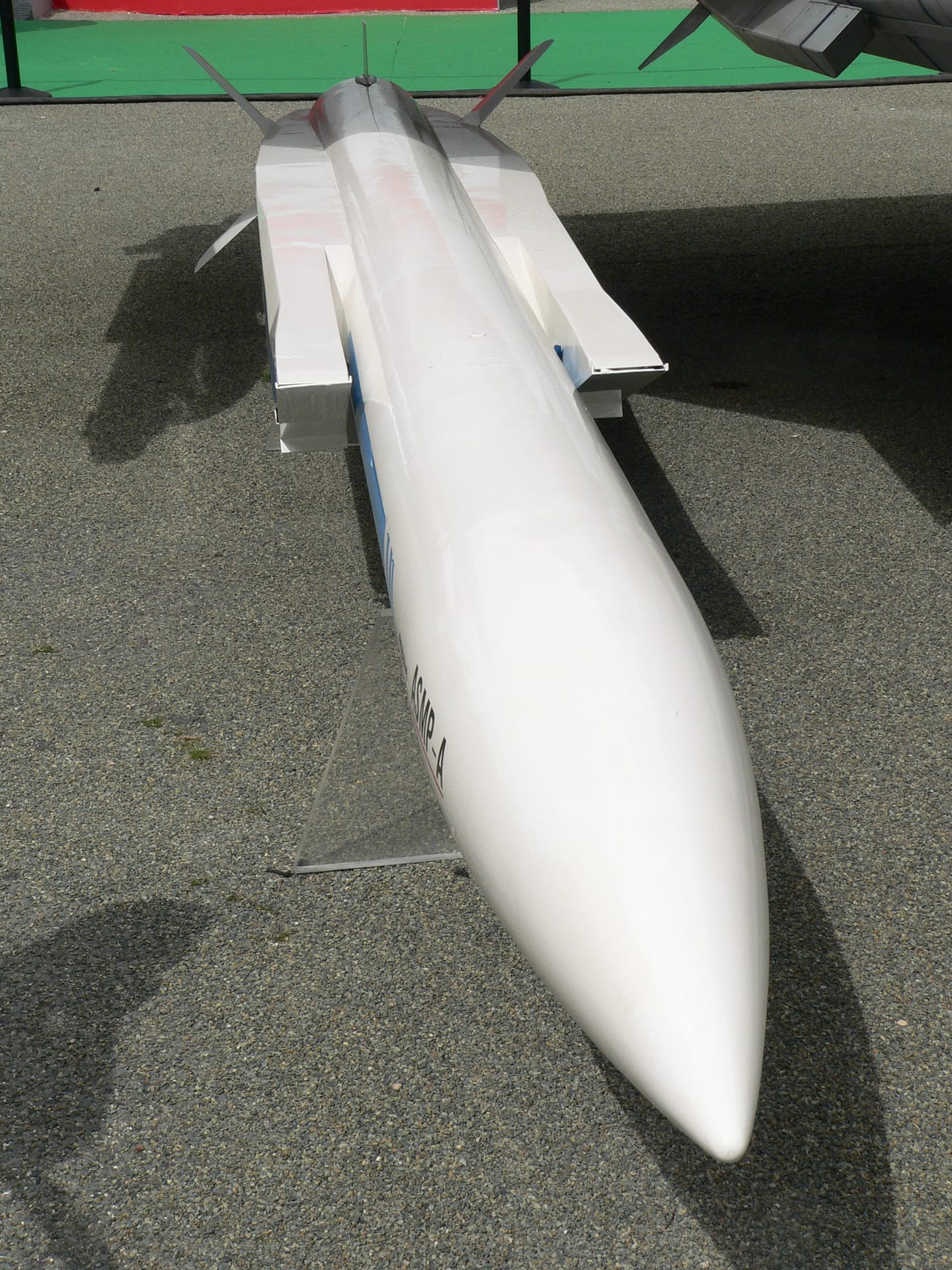
The ASMP-A cruise missile — France’s current air-launched nuclear deterrent. The ASN4G will be more than twice as fast with double the range. Wikimedia Commons
The ASN4G succeeds a lineage that stretches back to the 1960s. France’s airborne nuclear deterrent evolved from the AN-11 gravity bomb through the ASMP ramjet missile of 1986, the improved ASMP-A that entered service in 2009, and the recently delivered ASMPA-R renovation. Each generation improved on the last, but all shared the same fundamental limitation: Mach 3 speed and roughly 500 kilometres of range.
The current ASMP-A is 5.38 metres long, weighs 860 kilograms, and carries a TN 81 / TNA thermonuclear warhead with a variable yield of 100–300 kilotons. It has served France well — 54 were delivered, and the renovated ASMPA-R variant was test-fired in May 2024 and first spotted on a Navy Rafale M in November 2025.
But Mach 3 is no longer fast enough. Modern integrated air defence systems — Russia’s S-400 and the forthcoming S-500, China’s HQ-9B — have dramatically shortened the engagement timeline for subsonic and low-supersonic targets. A Mach 3 missile launched from 500 kilometres away gives the defender roughly five minutes. A Mach 8 missile launched from beyond 1,000 kilometres gives them perhaps two minutes — against an object that is maneuvering unpredictably and wrapped in a plasma sheath that complicates radar tracking.
Rafale F5 and Luxeuil
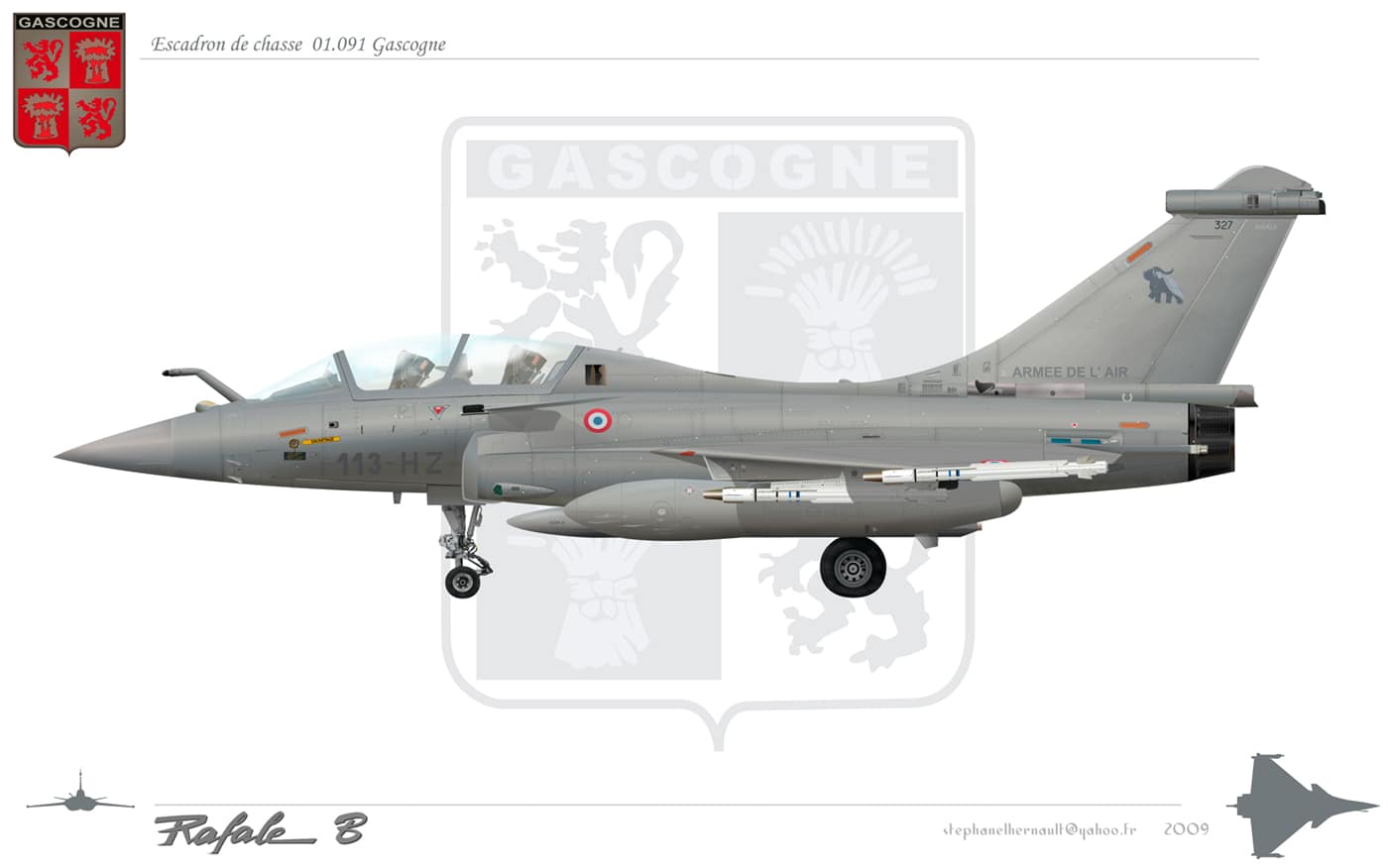
The ASN4G will be carried exclusively by the Rafale F5, the next major evolution of Dassault’s omnirole fighter. The F5 standard is currently in development, with the first aircraft expected around 2030 and the first operational squadron forming by 2032. Among its innovations, the Rafale F5 will integrate collaborative combat aircraft — loyal wingman drones derived from the nEUROn demonstrator — designed to keep the Rafale relevant through 2060.
In March 2025, President Macron announced that Base aérienne 116 Luxeuil-Saint-Sauveur, near the German border, will be reactivated to host two squadrons of nuclear-capable Rafale F5 armed with the ASN4G. The investment is estimated at 1.5 billion euros. The first squadron will form in 2032 and become operational in 2033; the second will follow in 2036, bringing the total to 40 aircraft.
The choice of Luxeuil — deep in eastern France, closer to the Rhine than to Paris — is a signal aimed squarely at Moscow.
A Continental Deterrent?
France’s nuclear arsenal is smaller than those of the United States and Russia, but it is entirely sovereign. No NATO codes, no dual-key arrangements, no American warheads stored on French soil. The force de dissuasion — still sometimes called the force de frappe — rests on two pillars: four Triomphant-class nuclear submarines carrying M51 ballistic missiles, at least one of which is permanently at sea, and the airborne component operated by the Forces Aériennes Stratégiques and the Force Aéronavale Nucléaire.
The ASN4G strengthens the second pillar at a moment when the first is also being modernised. The next-generation Invincible-class submarine (SNLE-3G) is scheduled to launch in 2036 — the same year the second ASN4G-equipped squadron at Luxeuil becomes operational.
MBDA CEO Éric Béranger framed the contract in terms that went beyond the purely military. “This new capacity will be carried out by the future Rafale F5 fighter aircraft, serving as the ultimate and decisive weapon system that will ensure, in any circumstances, France’s sovereignty and protection,” he said. He stressed that the ASN4G relies on “rare and cutting-edge technology” that places France in “the small group of countries possessing such a capability.”
The DGA itself was characteristically direct: “The performance of the ASN4G, and in particular its hypervelocity, will make it possible to maintain the credibility of airborne deterrence in the face of evolving threats.”
For the rest of Europe, the message is clear. As the continent confronts a Russia that routinely brandishes nuclear threats and a strategic environment that has not been this volatile since the Cold War, France is not simply maintaining its deterrent. It is making it faster, longer-ranged, and harder to stop — and basing it closer to the countries that feel most threatened.
Sources: DGA press release (June 2, 2026), MBDA, The Aviationist, Naval News, ArmyRecognition, ONERA, CSIS Missile Threat
The U.S. Army and allies signed a joint statement at Eurosatory 2026 to pool drone and counter-drone marketplaces — a coordinated push against the swarm.



 English
0 Comments