
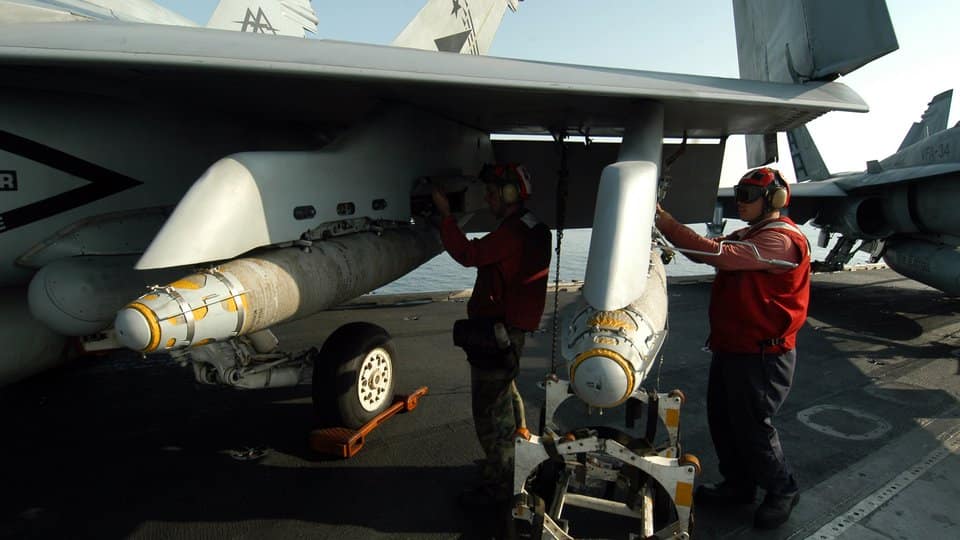
Quick Facts
- Designation: GBU-75 JDAM-LR (Long Range)
- Tested range: 200 nm (370 km) in 34 minutes
- Max range: 300+ nm (Boeing spec); decoy variant 700+ nm
- Engine: Kratos TDI-J85 turbojet, ~200 lbs thrust
- Warhead: 500-lb Mark 82 (or fuel tank for decoy variant)
- Launch platform: Any aircraft compatible with GBU-38 JDAM
- New aircraft mods required: None
Cruise Missile on a JDAM Budget
The genius of the GBU-75 is what it doesn’t require. No new pylons, no software updates, no integration testing. The JDAM-LR uses the same wing kit as the existing JDAM-ER (Extended Range), adding only the Kratos turbojet and its fuel supply. Any aircraft that can carry a GBU-38 — that’s every tactical fighter in the American inventory — can carry this weapon without modification. That’s a radical departure from how the Pentagon typically acquires standoff weapons. A Tomahawk cruise missile costs roughly $2 million. The JASSM-ER runs about $1.5 million. A standard JDAM kit costs around $25,000. Boeing hasn’t disclosed the GBU-75’s price, but the modular approach and commodity-grade turbojet suggest a figure far closer to the JDAM end of the spectrum.The Decoy Trick
Boeing revealed one more surprise at the Sea-Air-Space exposition: a decoy variant. By swapping the 500-pound Mark 82 warhead for an additional fuel tank, the JDAM-LR becomes a long-endurance decoy capable of flying over 700 nautical miles. Launched in salvos ahead of a strike package, decoy JDAMs could saturate enemy air defences, force radar operators to waste interceptors on cheap targets, and create corridors for manned aircraft. This concept mirrors what Ukraine has done with modified Soviet-era drones — flooding Russian air defences with cheap threats to exhaust their interceptor stocks. The difference is that the JDAM-LR decoy could be launched from a fighter at altitude, giving it range and speed that ground-launched decoys can’t match.Why the Navy Wants It Now
The timing is not accidental. With three carrier strike groups operating in the Persian Gulf, Navy pilots are flying combat sorties against Iranian targets daily. Standoff range is survival. Every nautical mile of distance between the launch aircraft and the target is a nautical mile less exposure to Iranian air defences — the same defences that shot down an F-15E on April 3. A weapon that lets an F/A-18 pilot release from 200 miles out and return to the carrier while the bomb flies itself to the target changes the risk calculus entirely. And unlike a Tomahawk, which requires a vertical launch cell on a destroyer or submarine, the GBU-75 launches from any bomb rack on any fighter.
Cheap, Abundant, and Devastating
The JDAM-LR fits into a broader Pentagon strategy of affordable mass. The Air Force is buying thousands of cheap cruise missiles. The Army is fielding one-way attack drones by the pallet. And now the Navy has a powered precision bomb that costs a fraction of legacy standoff weapons and requires zero aircraft modifications. In a high-volume conflict against a peer adversary, the side that runs out of precision munitions first loses. The GBU-75 ensures the US can keep delivering guided warheads at scale — and at range — long after the Tomahawk magazines run dry.Sources: The War Zone, Naval News, Breaking Defense, Military Times

 English
0 Comments