
| Quick Facts | |
|---|---|
| Programme | Global Combat Air Programme (GCAP) |
| Partners | United Kingdom, Italy, Japan |
| Lead Company | Edgewing (BAE Systems + Leonardo + JAIEC) |
| First Contract Value | £686 million (~$912 million) |
| Contract Type | Bridge contract through June 2026 |
| Target Delivery | 2035 |
| Generation | Sixth-generation stealth fighter |

Nearly a billion dollars just landed in the bank accounts of three defence giants on two continents and the message is clear: the sixth generation of fighter jets is no longer a concept. It’s a programme with a contract, a company, and a deadline.
The GCAP International Government Organisation — the body representing Britain, Italy and Japan — awarded a £686 million contract to Edgewing, the trilateral joint venture formed by BAE Systems, Leonardo and Japan Aircraft Industrial Enhancement Co. (JAIEC). It’s the first international contract the programme has ever signed, and it turns years of political handshakes and feasibility studies into actual engineering work.
There’s a catch. It’s a bridge.
A Bridge, Not a Foundation
The £686 million doesn’t fund the full development programme. It keeps the lights on through June 2026 — paying for ongoing design work, systems engineering and the thousands of specialists across three countries who are already working on the aircraft’s architecture. A larger, more comprehensive development contract is expected once the UK completes its Defence Investment Plan, which will map out the next decade of British defence spending.
In practical terms, this is life support with a purpose. Without this bridge, engineers in Warton, Turin and Nagoya would have faced a funding gap that could have scattered the workforce and stalled momentum at a critical design phase. The contract ensures continuity while the politicians sort out the money.
It also sends a political signal. Three nations from three continents — Europe, Asia and the Atlantic alliance — are investing real money in a shared combat aircraft. In an era when defence partnerships fracture under trade disputes and political realignment, GCAP is holding together.
What They’re Building
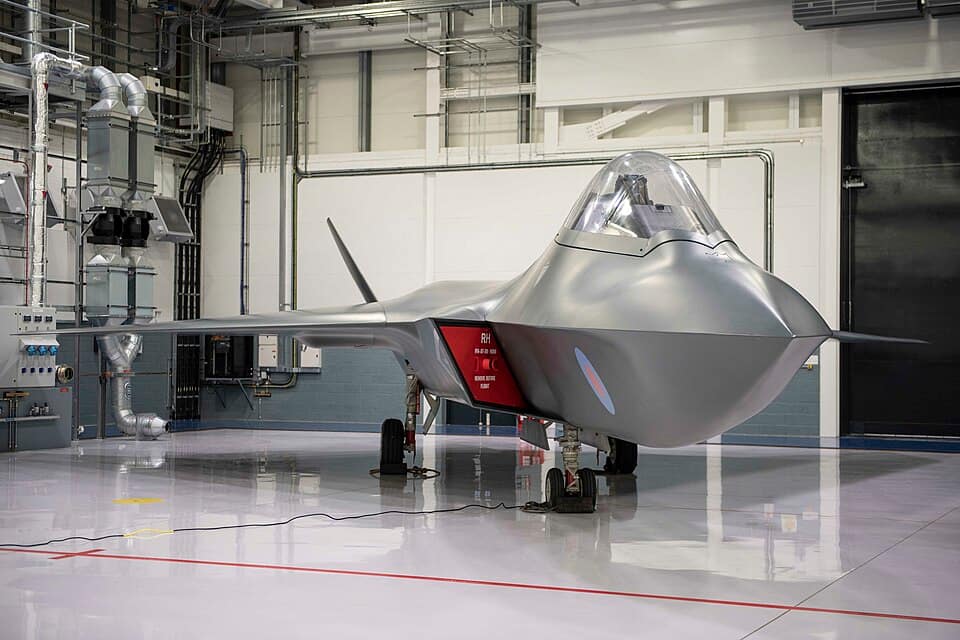
GCAP aims to produce a sixth-generation stealth fighter that goes beyond anything the F-35 or Eurofighter Typhoon can do. The concept centres on a large, twin-engine airframe designed for deep penetration of contested airspace, with an emphasis on sensor fusion, autonomous teaming with uncrewed wingmen, and electronic warfare capabilities that are integrated into the airframe from the first line of code.
Each partner brings something specific. BAE Systems brings decades of stealth and combat aircraft experience from the Typhoon and the classified Taranis drone programme. Leonardo contributes advanced sensor suites and electronic warfare systems. JAIEC — a consortium of Mitsubishi Heavy Industries, IHI Corporation and other Japanese defence firms — brings precision manufacturing and engine technology honed through Japan’s X-2 Shinshin demonstrator programme.

The target: first deliveries by 2035. For the Royal Air Force, that means a replacement for the Typhoon. For the Italian Air Force, the same. For Japan’s Air Self-Defense Force, it replaces the ageing F-2 — a modified F-16 that Japan has long wanted to succeed with a domestic design.
Italy’s Billion-Euro Bet
Italy has committed €8.8 billion to GCAP — a figure that now exceeds what the country spent on its entire F-35 fleet. For a nation that joined the F-35 programme as a junior partner assembling aircraft at Cameri, GCAP represents something different: a seat at the design table from day one. Leonardo won’t be bolting together someone else’s jet. They’ll be co-authoring the next one.
Japan’s investment is similarly strategic. Tokyo has long sought to reduce its dependence on American combat aircraft while maintaining interoperability with U.S. forces. GCAP gives Japan a domestically designed, internationally partnered fighter that sits outside the U.S. export control framework — a significant consideration in a region where arms sales are becoming a geopolitical tool.
The Race Is On
GCAP isn’t building in a vacuum. France, Germany and Spain are developing their own sixth-generation fighter under the Future Combat Air System (FCAS) programme, led by Dassault and Airbus. The United States had its own Next Generation Air Dominance (NGAD) programme, though its future is uncertain after reported cost overruns pushed the per-unit price above $300 million.
China is working on at least one sixth-generation concept. Russia claims to be doing the same, though its industrial capacity is currently consumed by the war in Ukraine.

The £686 million bridge contract won’t decide which of these programmes wins the generational race. But it keeps GCAP in it. And in fighter jet development, momentum is everything — once you stop, the engineers leave, the knowledge disperses, and restarting costs ten times more than continuing ever would.
Three nations just decided to keep going.
Sources: Defense News, The Aviationist, Breaking Defense

 English
0 Comments