
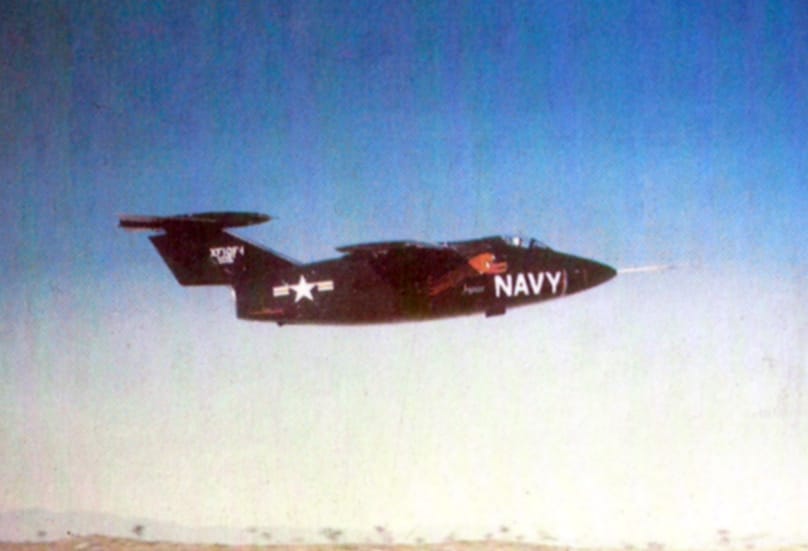
Seventy-four years ago today — 19 May 1952 — at Edwards Air Force Base in the high California desert, Grumman test pilot Corwin "Corky" Meyer climbed into the cockpit of an aircraft so strange that nobody else in the U.S. Navy was qualified to fly it. The XF10F-1 Jaguar had a wing that swept back and forward at the pilot's command, a tailplane that floated freely on bearings, a Westinghouse J40 turbojet that produced barely enough thrust to keep the airframe airborne, and a flight-control system that was a nest of incompatibilities.
It would fly thirty-two times. Meyer would be the only pilot who ever took it up. By April 1953 the U.S. Navy would have killed the programme, and the two airframes — one flying, one ninety percent finished — would be expended in crash barrier tests on aircraft-carrier deck simulators. The Jaguar, on paper, was a complete failure.
It was also the aircraft that proved the swing wing could work. Without the XF10F-1 there would be no F-111 Aardvark, no F-14 Tomcat, no MiG-23, no Tornado, no B-1B Lancer. Every variable-geometry fighter of the second half of the twentieth century traces, in lineage, back to one of the strangest prototypes ever to fly out of an American military test base.
An Aircraft Carrier Problem
The Jaguar was designed to solve a contradiction the U.S. Navy could not engineer its way out of in 1947. Jet fighters were getting heavier every year. Carrier-deck approach speeds were climbing toward 130 knots, the upper limit of what a 1940s catapult and arresting gear could handle. Naval aviation had two choices: build bigger carriers, or build wings that could change shape between takeoff and supersonic dash.

Grumman submitted a design with both. The wing pivoted at the root, sweeping from a 13.5-degree position for takeoff and landing to a 42.5-degree position for high-speed flight. Combined with leading-edge slats and a slow approach speed, the configuration would let a 1950s carrier launch a jet fighter as easily as a piston-engined Avenger. Combined with a high-sweep cruise setting, the same airframe would be capable of low-supersonic dash.
The Westinghouse J40 Catastrophe
The J40 turbojet, which was supposed to produce around 11,000 pounds of thrust, was the single most destructive engine programme in U.S. naval-aviation history. Westinghouse's J40 was a year late, then two years late, then four years late. By the time the Jaguar was ready for engine fitment, only the older, lower-rated XJ40-WE-8 was available — producing 6,800 pounds of thrust instead of the promised 11,000. The Jaguar, designed around the higher figure, was now severely underpowered.

Meyer's first flight on 19 May 1952 confirmed what Grumman engineers privately feared. The aircraft would not climb on a single engine. Slats deployed asymmetrically. The free-floating T-tail oscillated. Pitch authority was marginal. Meyer brought it back to Edwards safely, mostly because he was one of the best test pilots in the country.

Thirty-Two Flights and Out
Over the next year, Meyer flew the airframe again and again — 32 flights in all. The swing-wing mechanism — the part everyone expected to fail — was the only feature of the aircraft that worked flawlessly. The wing pivoted on command, locked into position, and produced exactly the aerodynamic behaviour Grumman's wind-tunnel models had predicted. The variable-geometry concept was, in this sense, vindicated.
Everything else, however, was a disaster. The J40 had compressor stalls. The hydraulic system leaked. The flight-control computer — an analogue system Grumman had built specifically for the Jaguar — behaved unpredictably in pitch. Pilot-induced oscillation was the rule rather than the exception. The free-floating tailplane that was supposed to reduce control loads at high Mach numbers behaved like a separate aircraft strapped to the back of the Jaguar.
In April 1953, the U.S. Navy cancelled the programme. The single flying prototype was retired immediately. The second airframe, ninety percent complete on the production floor, was finished only to be expended in carrier-barrier crash tests. A third static-test airframe became a gunnery target.
The Idea That Outlived the Aircraft
The Jaguar did not enter service. The Jaguar's wing, however, never left service after 1952. Grumman engineers who had worked on the XF10F-1 carried the variable-geometry concept with them through the rest of the 1950s and into the 1960s. When General Dynamics began work on the F-111 in 1962, the Jaguar's wind-tunnel data was on the desk. When Grumman won the U.S. Navy's VFX competition in 1969 — the contract that became the F-14 Tomcat — the lineage was even more direct. Several of the Jaguar's engineers were on the Tomcat team. The Tomcat's wing-sweep system, refined through twenty years of variable-geometry experience, traces its operating logic to the XF10F-1.

The MiG-23, Tornado IDS, B-1B Lancer and Tu-160 all owe a debt to the swing-wing pioneering work the Jaguar started. None of those aircraft would have been built if the XF10F-1 had not first proved that the concept was aerodynamically sound, even if the rest of the airframe could not catch up.
The Single Test Pilot
Corky Meyer never lost his affection for the Jaguar. He flew most of Grumman's great post-war fighters — the F9F Panther, the F9F Cougar and the F-11 Tiger — but the XF10F-1 was the airframe he talked about most in retirement. He outlived every member of the Jaguar design team, becoming the last living institutional memory of an aircraft that had, technically, never gone anywhere. He died in 2011, aged 91, having spent the last decade of his life patiently explaining to aviation historians that the Jaguar was much more important than its operational record suggested.
Meyer was right. Every Tomcat that ever launched off a Nimitz-class catapult, every F-111 that ever flew low through Indian Springs, every Tornado that ever buzzed across the Friesian flatlands, was descended from the strange experimental aircraft that flew once a month for a year out of Edwards Air Force Base, broke down constantly, never delivered on a single original requirement, and yet quietly changed every variable-geometry programme that followed. Seventy-four years after the Jaguar's first flight, that legacy is still in flight every time an F-14 Tomcat — the Maverick Act may yet put one back in the air over the United States — folds its wings back.
Sources: U.S. Naval Institute Naval History Magazine (December 2020); Wikipedia — Grumman XF10F Jaguar; Defense Media Network; Plane Historia; MilitaryFactory; Military Matters — Forgotten Aircraft; War Wings Daily.
Related Questions
What was the Grumman XF10F Jaguar?
The Grumman XF10F-1 Jaguar was an experimental U.S. Navy carrier fighter with a variable-sweep, or swing, wing. It first flew on 19 May 1952 at Edwards Air Force Base. Plagued by an underpowered engine and control problems, it flew just 32 times before being cancelled in April 1953.
When did the XF10F Jaguar first fly?
The XF10F-1 Jaguar first flew on 19 May 1952 at Edwards Air Force Base, California, piloted by Grumman test pilot Corwin "Corky" Meyer. Meyer was the only pilot ever to fly it, and the aircraft made 32 test flights before the Navy cancelled the program.
Why did the Jaguar program fail?
The Jaguar was crippled by its Westinghouse J40 turbojet, which produced barely enough thrust to keep it airborne, and by an unreliable flight-control system. The Navy cancelled the program in April 1953, and the two airframes were expended in carrier crash-barrier tests.
What was the point of the Jaguar's swing wing?
The variable-sweep wing aimed to solve a carrier problem: jets were getting heavier and approach speeds were climbing toward the limits of 1940s catapults and arresting gear. A wing that could spread for slow carrier landings and sweep back for fast flight promised to do both.
Did the Jaguar influence later aircraft?
Yes. Although the Jaguar itself failed, its variable-sweep wing concept was later vindicated by successful swing-wing aircraft, most notably the General Dynamics F-111 Aardvark and the Grumman F-14 Tomcat, both direct descendants of the idea it pioneered.
Who was Corky Meyer?
Corwin "Corky" Meyer was Grumman's chief test pilot and the only person ever to fly the XF10F Jaguar. He personally made all 32 of the aircraft's test flights between 1952 and 1953 before the program was cancelled.
Related Posts
Maverick Act Saves Last Three F-14 Tomcats
0 Comments