
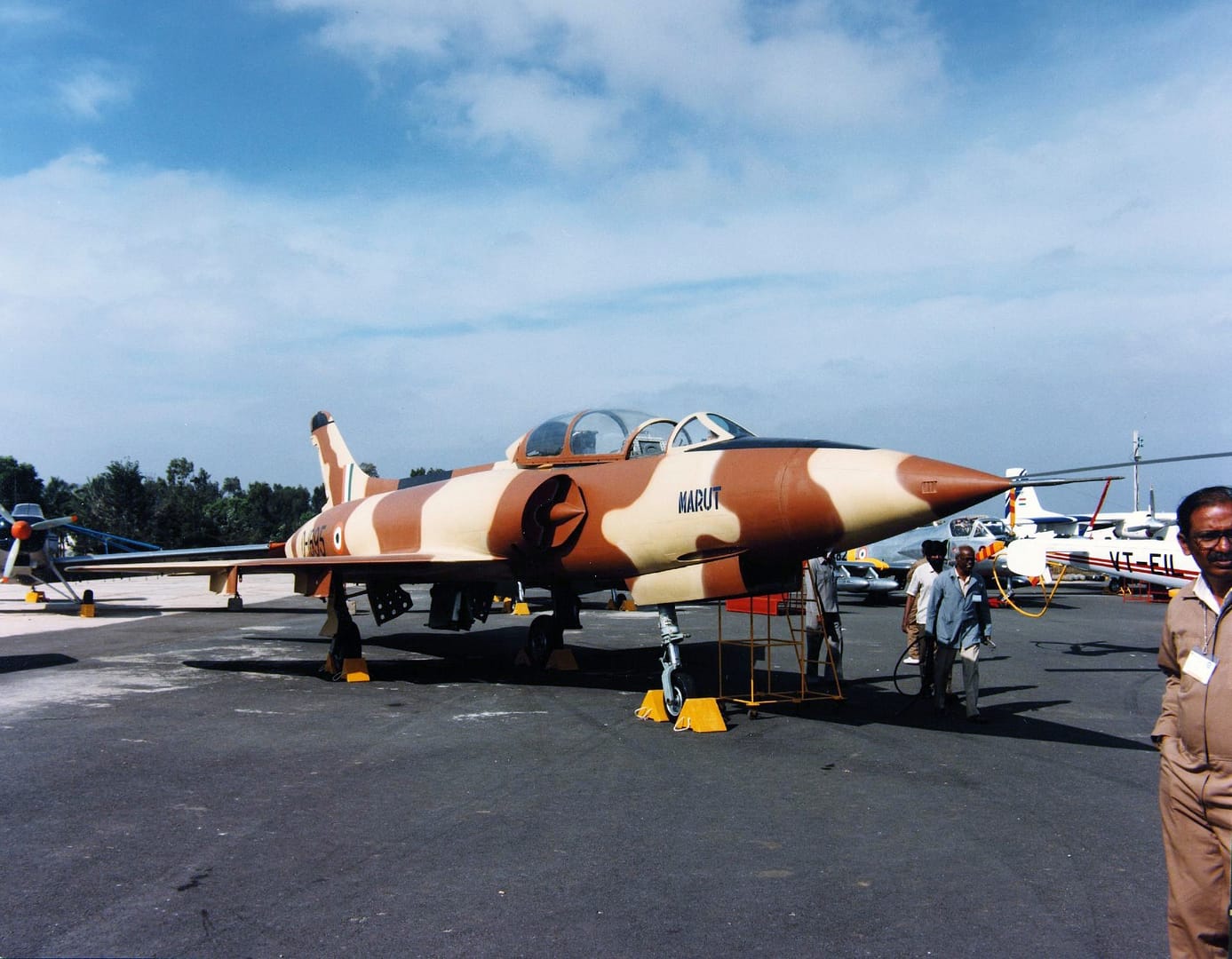
In 1956, the Indian government did something the United States, Britain and France considered impossible. It hired a German aircraft designer — a man who had designed one of the deadliest fighters of the Second World War — to build India’s first indigenous supersonic combat aircraft. His name was Kurt Tank. The aircraft was called the HF-24 Marut. And it became the first indigenous jet fighter designed and built outside the established aviation powers.
Quick Facts
Aircraft: HAL HF-24 Marut (“Spirit of the Tempest”)
Designer: Kurt Tank — formerly chief designer at Focke-Wulf (Fw 190)
Manufacturer: Hindustan Aeronautics Limited, Bangalore
First flight: 17 June 1961
Top speed: just short of Mach 1 in level flight — supersonic only in a shallow dive
Total built: 147 airframes between 1964 and 1977
Kurt Tank Goes to Bangalore
Kurt Tank’s wartime work had made him famous. As chief designer at Focke-Wulf, he had created the Fw 190 — arguably the best piston-engine fighter of the war, and a personal headache for every Allied pilot who encountered it. After 1945, Tank fled Europe and worked briefly in Argentina, designing the Pulqui II jet fighter for Juan Perón. When that programme stalled, India came calling.
Prime Minister Jawaharlal Nehru wanted an indigenous fighter for the new Indian Air Force. India had won independence in 1947 and felt — correctly — that it could not buy its way to military credibility through endless purchases of British or Soviet equipment. It needed its own combat aircraft, and it needed someone who could actually design one.
Tank arrived in Bangalore in 1956. He found a tiny team of Indian engineers, a workshop with rudimentary tools, and almost no aerospace industrial base. He went to work.
“She was a feast for the eyes, that was my first impression. The airframe was rock solid — easy to fly, easy to handle and as stable as a rock. It was the pride to be flying India’s first full-blown fighter.”
— Dara Cooper, IAF Marut pilot, in an interview with Hush-Kit
An Aircraft From First Principles
The HF-24 Marut — Sanskrit for “spirit of the tempest” — was designed from first principles around the engines available to India. Tank initially wanted high-thrust afterburning turbojets. India could not get them. The Bristol Orpheus engine eventually selected was significantly underpowered for what Tank had drawn, which left the Marut with strong handling but a relatively low thrust-to-weight ratio.
The airframe was elegant. Swept wings, area-ruled fuselage, twin engines clustered tightly side-by-side, and a sharply swept tail. In level flight the aircraft stayed just short of Mach 1 — it could pass the sound barrier only in a shallow dive, far from the Mach 1.4–1.5 the original requirement had demanded. Even so, a homegrown jet fighter was, for India in 1961, an extraordinary national achievement.
“I say Coops, amazing aircraft! Only thing that moved on the take-off roll was the fuel gauge!”
— Air Marshal Johnny Greene, IAF, after his first solo in the Marut — a quip about the underpowered Orpheus engines that never achieved the Mach 2 design target
Combat and Quiet Withdrawal
The Marut fought in the 1971 Indo-Pakistani War, flying ground-attack missions against Pakistani armour in the Rajasthan desert. Pilots respected it for its handling and low-altitude stability. The Marut was outclassed in air-to-air combat by faster MiG-21s, but it was a workmanlike fighter-bomber that proved its concept.
The bigger problem was the supply chain. The Marut depended on imported components — engines from Britain, electronics from Europe — and India’s foreign-exchange constraints in the 1970s made the supply chain increasingly fragile. Production wound down in 1977. The last squadron gave up its Maruts in 1990.
Kurt Tank had returned to Germany years earlier. He died in Munich in 1983. The Marut, built far from any aerospace centre by a team trained from scratch, remains one of aviation’s most surprising achievements — a Mach-1 fighter built in a country that had no fighter industry before its designer arrived.
No Maruts were lost in air-to-air combat in the 1971 war — a record even Pakistani accounts support. The fleet flew more than 300 combat sorties in two weeks, and on at least three occasions Maruts came home on a single engine.
Sources: HAL historical archives, Indian Air Force museum records, Bharat-Rakshak.
 English
0 Comments