
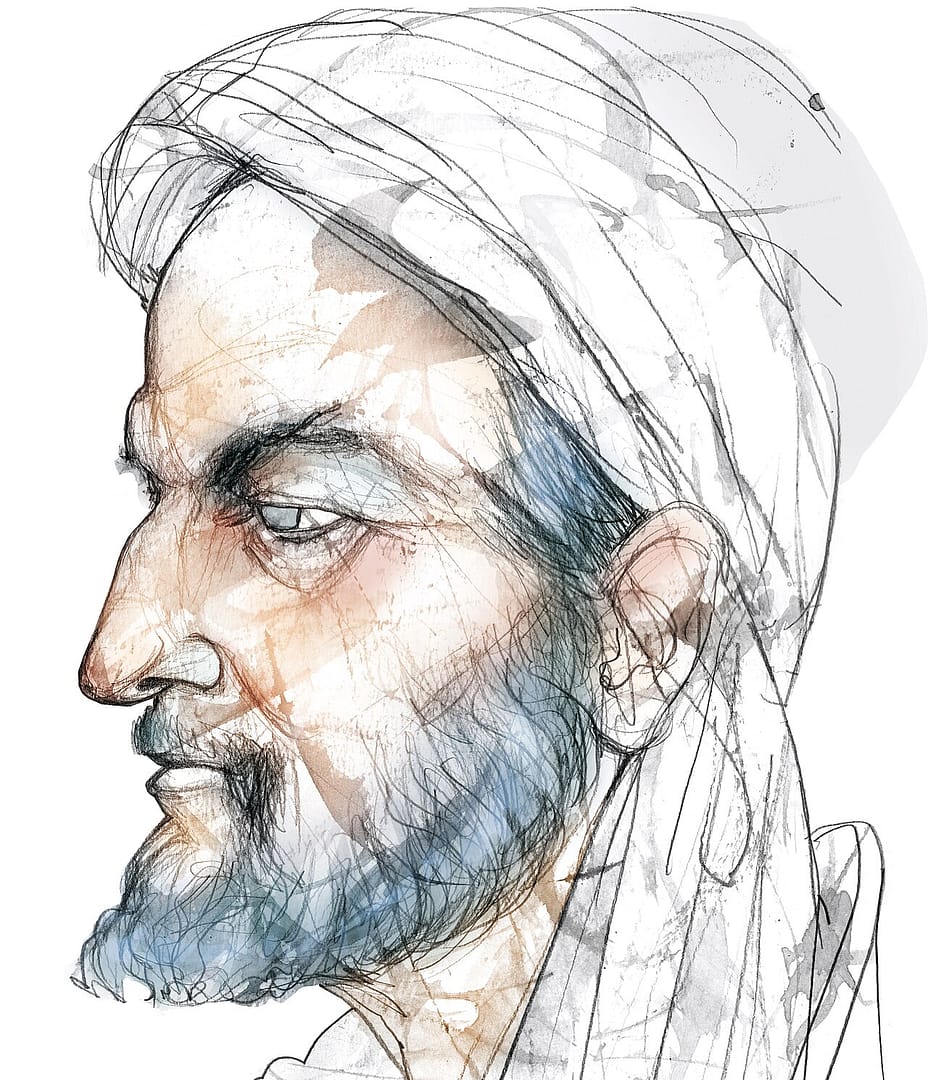
In the year 875 AD, a 70-year-old man climbed to the top of a mountain near Córdoba, strapped a pair of wings to his body, and jumped. He was not a madman. He was one of the most brilliant minds in the world.
Abbas ibn Firnas was an Andalusian polymath — a musician, poet, astronomer, chemist, and engineer who had spent decades studying the mechanics of bird flight. On that day above the Jabal al-‘Arus, he flew. He stayed aloft for several minutes, gliding through the air over the crowd watching below. It was the first documented attempt at human flight in history — nearly a thousand years before Orville Wright lifted off from the sand at Kitty Hawk.

A Mind That Refused to Accept Limits
Born around 810 AD in Ronda, in what is now southern Spain, Ibn Firnas lived and worked in Córdoba — then the most sophisticated city in Europe. Under the Umayyad Caliphate, the city was a beacon of science, philosophy, and engineering. The great library held half a million volumes. Ibn Firnas fit perfectly into this world.
He invented a water clock known as the clepsydra, designed a form of corrective lenses that helped people read, and built a mechanical planetarium in his home — a room where artificial stars moved across an artificial sky, complete with thunder and lightning effects. He also developed a process for manufacturing glass from sand, transforming how Andalusia made its windows and vessels.
But the sky was what obsessed him. Ibn Firnas studied birds the way engineers study machines — watching how they used their wings, how they adjusted their angle in a gust, how they slowed before landing. For years, he built and refined his design. His wing frame was wood. His covering was silk. His outer layer was genuine feathers, carefully sourced and attached.
He flew swiftly and when his friends considered he might have broken his body to pieces, he came back to us safe and sound.
Al-Makkari, 17th-century historian, quoting earlier sources
The Flight — and the Crash That Changed History
By all accounts, the flight itself was a genuine success. Ibn Firnas remained airborne for an extended glide, controlling his descent over the watching crowd. The Arabic historian Al-Makkari, writing centuries later, records that “he flew swiftly and when his friends considered he might have broken his body to pieces, he came back to us safe and sound.”
The landing, though, was hard. Ibn Firnas had studied everything about birds in flight — except how they land. He hadn’t incorporated a tail into his design. Birds use their tails as air brakes, pitching them down to slow before touchdown. Without one, Ibn Firnas came in too fast and injured his back on impact. He recovered, but the lesson wasn’t lost on him. He spent years afterward analyzing what had gone wrong.
The 13th-century Moroccan poet Ahmed Mohammed al-Maqqari credited him directly: “He of Córdoba. He who dared the air.” His legacy was so firmly embedded in Andalusian memory that he was still celebrated seven centuries after his death. Today, a statue of him stands outside Baghdad International Airport. A crater on the moon bears his name. And the airport in his home city of Córdoba honours him too.
Before Him: The Other Dreamers
Ibn Firnas was not the first human to attempt flight — but he was arguably the first to approach it scientifically rather than mythologically. Earlier attempts exist in the historical record: Eilmer of Malmesbury, an English Benedictine monk, allegedly leaped from a tower around 1010 AD with wings strapped to his hands and feet. He is said to have glided roughly 200 metres before crashing and breaking both legs. He reportedly blamed the failure on forgetting a tail.
In China, man-carrying kites were documented as far back as the 6th century, used for military signalling and — in at least one account — for execution, where prisoners were strapped to kites and forced to test whether they would fly. The experience of flight, it seems, was irresistible to the human imagination long before anyone had the tools to pursue it safely.
What made Ibn Firnas different was the systematic approach: the years of study, the carefully engineered wings, the public demonstration, and the post-flight analysis. He didn’t jump and hope. He designed, tested, and evaluated. In that sense, he was the world’s first aeronautical engineer.
What Came Next — and What Didn’t
Ibn Firnas died around 887 AD, likely from the injuries sustained in his landing. The dream of flight died with him — not because humanity lost interest, but because the tools to pursue it didn’t yet exist. Without engines, without metallurgy, without the understanding of aerodynamics that would take another millennium to develop, flight remained just beyond reach.
Leonardo da Vinci would sketch magnificent flying machines six centuries later. The Montgolfier brothers would rise over Paris in 1783. And in 1903, two bicycle mechanics from Ohio would finally crack the puzzle on a windswept beach in North Carolina. But the chain begins earlier — on a mountain above Córdoba, with a 70-year-old man who looked at birds and saw possibility.
Aviation history didn’t begin with the Wright Flyer. It began with the courage to jump.
Sources: Al-Makkari, The History of the Mohammedan Dynasties in Spain; Lynn Townsend White Jr., Medieval Technology and Social Change (1962); Wikipedia, “Abbas ibn Firnas”



 English
0 Comments