
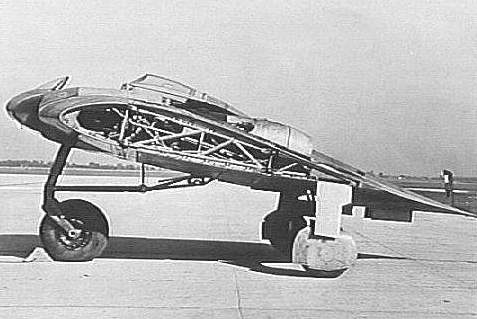
In the film Captain America, the villain escapes aboard a sleek, tailless flying wing. It looks like science fiction. It is not entirely invented: the design is lifted almost directly from a real German aircraft that flew in the last winter of the Second World War — the Horten Ho 229.
The Ho 229 was the world’s first jet-powered flying wing, and for eighty years it has carried a seductive nickname: “Hitler’s stealth fighter.” It is a wonderful story. It is also, in the parts that matter most, a myth — and the truth is stranger and more interesting than the legend.
QUICK FACTS
| Aircraft | Horten Ho 229 (Horten H.IX) — jet-powered flying wing |
| Designers | Reimar and Walter Horten |
| Origin | Nazi Germany, 1943–1945 |
| Engines | 2 × Junkers Jumo 004 turbojets |
| On paper | 600+ mph, tailless, ~50 ft wingspan |
| Built | V1 (glider), V2 (jet, crashed), V3 (captured, never flew) |
| Today | V3 preserved at the Smithsonian, Udvar-Hazy Center |
The 3×1000 problem
In 1943 Luftwaffe chief Hermann Göring set his industry a demand he called “3×1000”: a bomber that could carry 1,000 kilograms of bombs 1,000 kilometres at 1,000 kilometres per hour. Conventional aircraft could not do it. The Horten brothers — Reimar the self-taught design genius, Walter the fighter pilot — believed an all-wing aircraft could. Göring was impressed enough to allocate half a million Reichsmarks for three prototypes.

Wood, jets and no tail
The Ho 229 was built from a welded steel-tube frame skinned in laminated, layered wood, with tricycle landing gear and a wing swept back some 32 degrees. It had no tail at all — control came from elevons, spoilers and drag rudders. On paper the numbers were extraordinary: speeds above 600 mph, comfortably faster than the Me 262, and in a different league from the piston-engined P-51 Mustang at 437 mph or the Supermarine Spitfire at 330 mph.
“On paper” is the crucial phrase. Turning a radical shape into a usable weapon is a different task entirely, and the Ho 229 never got close.
National Geographic’s documentary on the Ho 229.
The flight that ended it
The V1 glider first took to the air on 28 February 1944 and flew well. Reimar pressed on to a powered version, the V2, fitted with two Junkers Jumo 004 turbojets. It first flew on 2 February 1945, was damaged in a crash landing on its second flight, and on 18 February 1945 was lost for good. One engine failed; the aircraft spiralled into the ground, killing test pilot Lieutenant Erwin Ziller.
The third airframe, the V3, was never finished. When the war in Europe ended a few months later, it was captured by General George S. Patton’s Third Army and shipped to the United States for study.
The stealth myth, examined
Here the legend takes over. After the war, Reimar Horten claimed he had intended to mix charcoal into the wing’s wood glue to absorb radar. A 2009 documentary, made with Northrop Grumman, christened the aircraft “Hitler’s Stealth Fighter” and the myth hardened into fact in the public mind. The Smithsonian, which holds the only surviving example, decided to actually check.

Their conservators sampled the coatings and studied the structure. A separate Northrop Grumman radar test found the flying-wing shape did reduce radar returns somewhat — but any carbon in the aircraft was a poor absorber, and the machine would still have been detectable. There was no evidence of a deliberate stealth design.
Separating the Ho 229’s reality from its legend.
The real legacy
Strip away the myth and what remains is still remarkable: the first jet flying wing ever built, decades ahead of its contemporaries in shape if not in maturity. Its silhouette is uncannily close to the B-2 Spirit that would follow half a century later, and it has fascinated designers ever since. The U.S. Air Force donated the V3 to the National Air and Space Museum in 1952; careful preservation began only in 2011, and it stands today at the Udvar-Hazy Center.
The Ho 229 did not win the war, and it was never a stealth aircraft. What it was — a bold, doomed leap toward a shape aviation would not master for another generation — is a better story than the myth. Truth, here, really is stranger than fiction.
How the Ho 229’s flying-wing shape echoed into later aircraft.
Sources: Smithsonian Magazine; National Air and Space Museum (curator Russell E. Lee); Northrop Grumman radar study.


0 Comments