
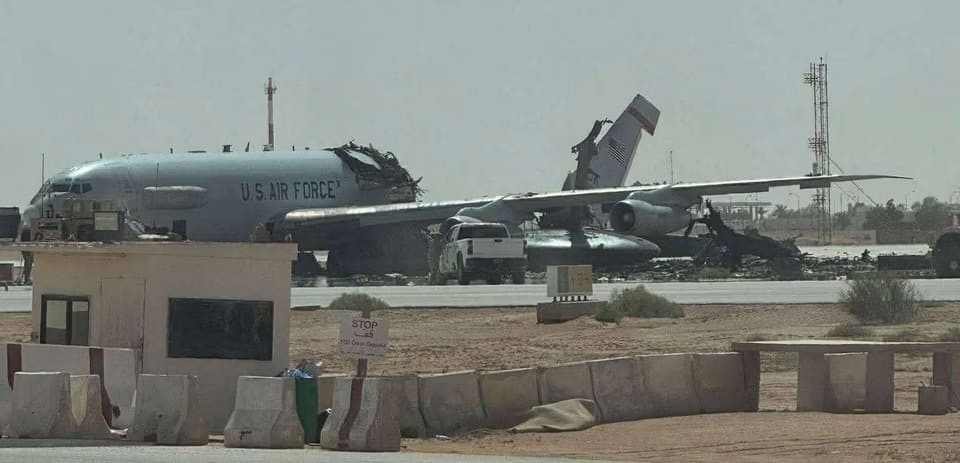
E-3 Sentry destroyed
On March 27, 2026, Iranian ballistic missiles and drones screamed across the Arabian Gulf and slammed into Prince Sultan Air Base south of Riyadh. When the dust settled, the damage was devastating: a U.S. Air Force E-3G Sentry early-warning aircraft sat crippled on the tarmac, its fuselage cratered, likely never to fly again.
The loss of aircraft registration 81-0005 marks a rare and operationally significant blow. This isn’t just another airframe. It’s a flying command center—a battle-management node worth roughly $250 million that ties together fighters, tankers, and coalition air operations across an entire theater. Losing one compresses surveillance coverage, weakens battlespace coordination, and leaves the U.S. Air Force with fewer eyes in the sky when tensions are at a boiling point.
The Attack and the Damage
The strike came without warning. Multiple Iranian Khalij Fars cruise missiles and drone swarms targeted one of the busiest U.S. air bases in the Middle East. At least 10 American service members were wounded, two seriously. The base’s shelters and dispersal areas couldn’t protect everything.
Satellite imagery in the days following the attack showed the brutal picture: E-3 Sentry 81-0005 with its massive rotating radar dome still intact but the fuselage torn open. Multiple KC-135 Stratotanker refueling aircraft were also confirmed damaged or destroyed. The logistics of maintaining air operations over the next weeks just became exponentially harder.
Before the attack, the U.S. had six E-3s stationed at Prince Sultan. After March 27, that number dropped by one in the worst possible way.
Why an E-3 Matters More Than You Think
The E-3 Sentry is not a spy plane. It doesn’t photograph. It doesn’t eavesdrop. But take away one, and an air force suddenly struggles.
Each Sentry carries a phased-array radar that peers 250 nautical miles in all directions. More crucially, it’s equipped with advanced battle-management systems that fuse data from fighter radars, satellites, and ground stations into a single tactical picture. Controllers aboard coordinate intercepts, vector fighters toward threats, deconflict allied aircraft, and manage the complex choreography of air-to-air refueling for assets ranging from F-15s to bombers.
Remove one E-3, and you compress coverage. You force tanker sequences to become tighter, less flexible. You reduce the bandwidth for supporting coalition partners. You lose redundancy at a moment when potential adversaries are watching and testing responses.
The Fleet is Aging and Shrinking
The U.S. Air Force operates just 31 E-3 Sentries—a fleet that’s been in continuous service since 1977. Some airframes are pushing 50 years old. Maintenance backlogs are chronic. Spare parts are scarce. The aircraft are still deadly effective, but they’re not immortal, and they’re not replaceable on a whim.
The Air Force’s plan is clear: replace them with the E-7A Wedgetail, a newer aircraft based on the Boeing 737 with more modern avionics and open-architecture systems. The first E-7As are entering service now, but the transition will take years. Until then, every E-3 lost is operational capacity that won’t come back soon.
The loss of 81-0005 highlights a painful asymmetry: it takes seconds and a few million dollars in missiles to destroy what takes years and billions to replace.
The Operational Aftermath
In the days after the attack, the U.S. likely reshuffled its fleet—rotating aircraft in from other commands, pulling maintenance stands to get damaged airframes back in the air, and accepting tighter coverage windows. KC-135s had to be brought in from elsewhere or repaired urgently. Coalition partners who depend on U.S. air-battle management felt the impact immediately.
The Iranian strike proved what military planners have long known: the ecosystem supporting air operations is fragile. Target the tankers, and fighters can’t reach as far. Target the AWACS, and the entire coordination system becomes fragmented. The U.S. military is built for deep operations, but it’s vulnerable to strikes on enablers that simply can’t be quickly replaced.
As long as the E-3 remains the backbone of American air-battle management, every airframe matters. And now there are 30 left.
Sources: Air & Space Forces Magazine; Defence Security Asia; The Aviation Geek Club


 English
0 Comments