
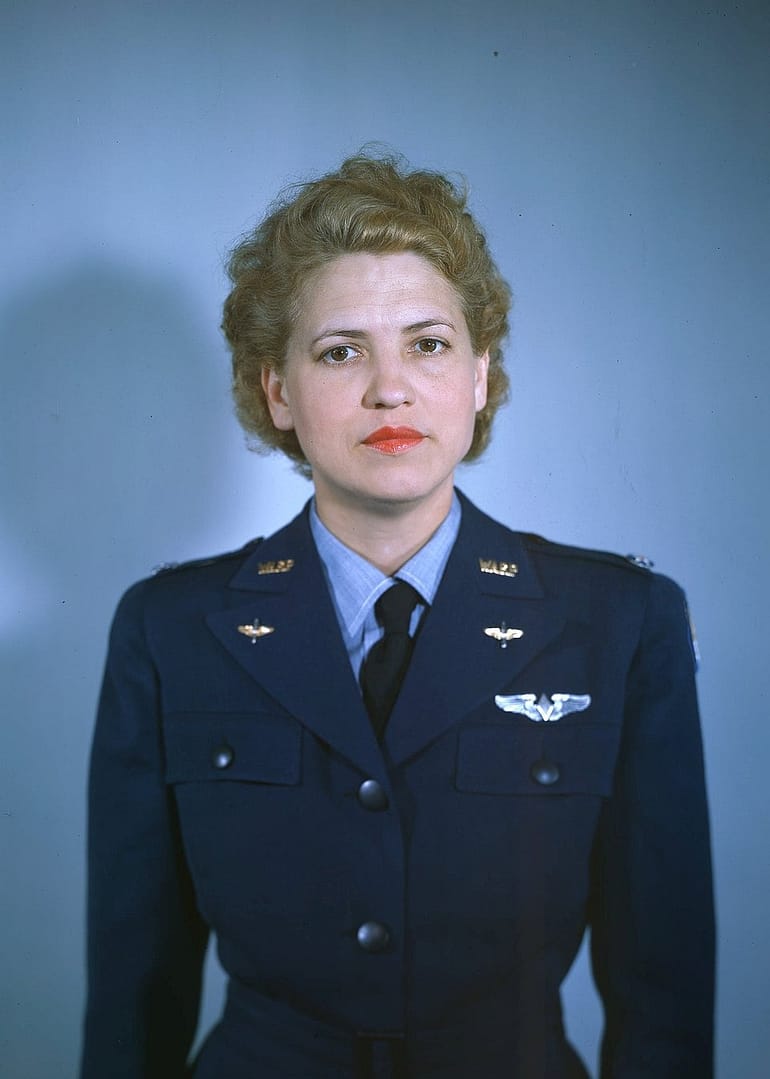
Born in poverty in a Florida sawmill town, Jacqueline Cochran rose from orphan mill worker to become the most decorated female pilot in aviation history. Her journey from rags to the sound barrier is a testament to unwavering determination, audacious ambition, and a refusal to accept the limits society placed on women—especially women in aviation.
By the time Jacqueline Cochran died in 1980, she had broken the sound barrier, set more speed, altitude, and distance records than any pilot alive (male or female), founded and directed the Women Airforce Service Pilots during World War II, and earned the nation’s highest military honors. Her story is one of the most remarkable in American aviation history—and yet it remains far less known than it deserves.
This is the story of a girl who chose the sky over circumstances.
Died: August 9, 1980 (age 74)
First Woman to Break Sound Barrier: May 18, 1953 (F-86 Sabre, Edwards AFB, age 47)
Records Held: 200+ world records in speed, altitude, and distance
Major Achievements: Founded WASP (1943), Won Bendix Trophy (1938), Distinguished Service Medal, Legion of Merit, Distinguished Flying Cross
From Sawmill to Cosmetics: The Girl Who Would Not Quit
The early years of Jacqueline Cochran’s life read like a Horatio Alger story, except infinitely harder. Born in Muscogee, Florida—a small sawmill town in the rural panhandle—Jacqueline was an orphan. Raised by foster parents, she grew up in grinding poverty, working in cotton mills as a child when most American children her age were in school.
But the mills were never meant to hold her. As a teenager, she apprenticed as a beautician, working her way up to opening her own cosmetics business. By the early 1930s, Jacqueline Cochran had built a successful enterprise selling beauty products—an accomplishment that would have satisfied most people emerging from her circumstances. But Jacqueline was not most people.

Learning to Fly: The Sky Calls
In 1932, at the age of 26, Jacqueline took her first flying lesson. She was immediately enthralled. What began as a curiosity became an obsession. She earned her pilot’s license in just three weeks—a remarkable achievement for the era—and by 1935, she had entered her first air race. Within years, she was competing at the highest levels of aviation, flying in the prestigious Bendix Trophy Race, the Indianapolis 500 of the air.
In 1938, Jacqueline won the Bendix Trophy, one of the most coveted prizes in civilian aviation. It was a stunning victory that made her name in aviation circles. But this was just the beginning of her ascent.
WASP: Forging the Path for Women Pilots
When the United States entered World War II in December 1941, Jacqueline Cochran saw an opportunity to serve her country—and to prove that women could be combat-ready military pilots. She advocated tirelessly for the creation of a women pilot program, drawing on her decades of experience and her credibility as a record-setting aviator.
In 1943, her vision became reality: the Women Airforce Service Pilots (WASP) was officially established, and Jacqueline was named its director. Under her leadership, the WASP program trained more than 1,000 women pilots who flew every military aircraft then in use—training pilots, towing targets, testing new planes, and carrying cargo. They were civilians, but they flew military aircraft in service of their nation.

The WASP pilots faced skepticism, hostility, and bureaucratic obstacles at every turn. Many male pilots viewed them as threats. Military officials questioned whether women had the stamina or judgment to fly high-performance military aircraft. But Jacqueline fought for her pilots—advocating for better treatment, better assignments, and recognition of their service. When the war ended and the WASP program was disbanded in 1944, Jacqueline had opened a door that would never fully close again.
Breaking the Sound Barrier: The Moment That Defined a Generation
By the 1950s, aviation had entered the jet age. The sound barrier—long considered an impenetrable wall—had been broken by Chuck Yeager in 1947. But breaking it once was an anomaly; breaking it repeatedly, under controlled conditions, and by different pilots, was the frontier of aviation.
On May 18, 1953, Jacqueline Cochran climbed into the cockpit of an F-86 Sabre at Edwards Air Force Base. She was 47 years old. As she pushed the aircraft to supersonic speed, she became the first woman in history to break the sound barrier. She didn’t just cross the threshold—she shattered it, flying at Mach 1.05 over the Mojave Desert.
The achievement was staggering. At an age when many pilots were hanging up their wings, Jacqueline was redefining what was possible. She wasn’t the first human to break the sound barrier, but she was the first woman. And in an era when gender discrimination in aviation was absolute, her achievement felt like a reckoning.

Records Without End
The sound barrier was far from the end of Jacqueline’s record-breaking career. After 1953, she continued to set records in speed, altitude, and distance. She established over 200 world records, more than any other pilot alive at the time. She flew faster, higher, and farther than anyone else—male or female—in the world.
Her list of honors grew accordingly. She received the Distinguished Service Medal, the Legion of Merit, and the Distinguished Flying Cross. She was honored by governments, universities, and aviation organizations around the globe. She became a living symbol of what was possible when talent, determination, and courage converged.
The Woman Amelia Never Met
Jacqueline Cochran and Amelia Earhart were contemporaries in an era when female pilots were rare. The two became close friends, bonded by their shared passion for aviation and their refusal to accept the limitations society imposed on women. Amelia Earhart disappeared in 1937; Jacqueline carried their friendship forward for the rest of her life, honoring Amelia’s legacy even as she forged her own extraordinary path.
Where Amelia symbolized the pioneering spirit of early aviation, Jacqueline embodied its evolution and professionalization. She didn’t just fly; she led. She didn’t just break records; she changed the institution of aviation itself, proving that military and commercial aviation could not function without women pilots.
Legacy: A Sky Without Limits
Jacqueline Cochran died on August 9, 1980, at the age of 74. By then, the aviation world had transformed in ways she had helped make possible. Women were flying as military pilots, commercial pilots, and test pilots. The barriers she had confronted and overcome had been breached by thousands of women who followed in her wake.
But the full measure of her achievement transcends records and firsts. Jacqueline Cochran proved that the limits placed on women in aviation—and in society at large—were not natural limits. They were social limits, imposed by convention and prejudice. She lived as if those limits did not exist, and in doing so, she proved they could be overcome.
From the cotton mills of rural Florida to the sound barrier, from founding a historic military program to setting records that stood for decades, Jacqueline Cochran’s life was an unrelenting climb toward the sky. She refused to accept what society said was impossible. And in that refusal, she changed aviation history.
Sources: FAA, Smithsonian National Air and Space Museum, Women Airforce Service Pilots Legacy, Jacqueline Cochran Foundation Archives
 English
0 Comments